A rolled ankle at Saturday netball, a torn hamstring on the football pitch, a shoulder that goes at cricket training: sport injuries happen on local grounds, to local people. And the recovery that actually works is usually the one you can keep showing up for, week after week, close to home. That is the quiet reason athletes around Carlingford lean on physiotherapists nearby rather than a clinic across the city.
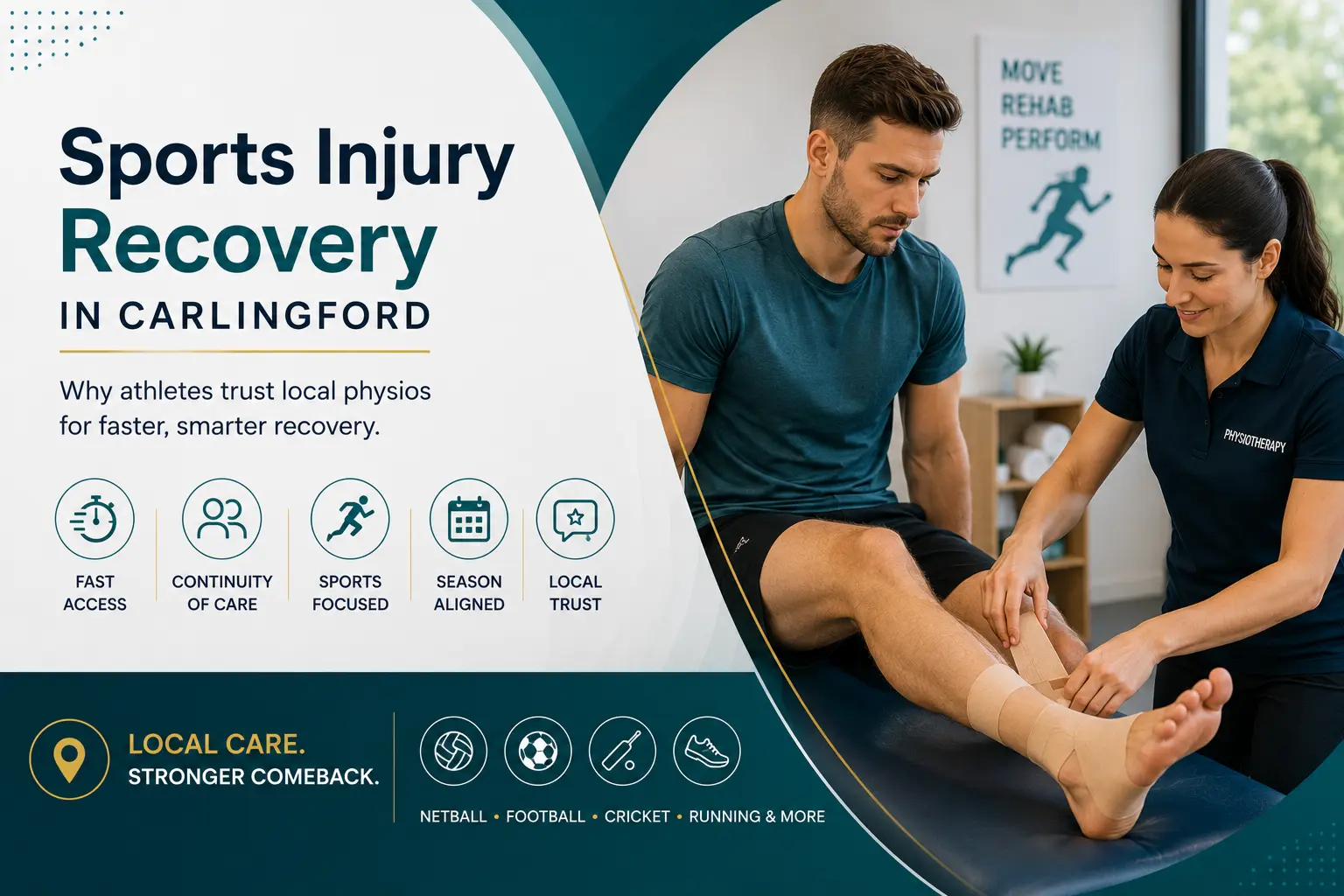
Getting better after a sports injury is rarely one heroic appointment. It is a series of them, plus the exercises in between, all pointing toward a safe return to your sport. Where you do that, and who you do it with, shapes how well and how quickly it goes. This is why local matters, and what to look for in a physiotherapist you can trust with your season.
Carlingford is a genuinely sporting suburb
This part of Sydney runs on grassroots sport. Netball is played through clubs like Carlingford Netball Club out of Don Moore Reserve, weekend cricket and football fill grounds such as J.E. Moore Reserve, and there are bowls, school sport across the Carlingford High ovals, and district competitions that feed into the wider Parramatta region. You can see the full local picture through the City of Parramatta sport club directory. For a physiotherapist, that mix of juniors, weekend warriors and masters players is not background noise; it is the community whose knees, shoulders and hamstrings walk through the door.
Why being local matters when you are the one injured
Convenience sounds like a minor perk. For an injured athlete it is closer to a clinical advantage, because the things that speed recovery all get easier when help is nearby.
| What being local gives you | Why it matters when you are injured |
|---|---|
| Fast, early access | Injuries do best when they are assessed and managed early, and a nearby clinic makes that first appointment easy to reach quickly |
| Frequent early sessions | The first weeks often need several visits; short travel makes that realistic rather than a burden you skip |
| Continuity with one physio | Seeing the same physiotherapist across assessment, rehab and return builds the understanding and trust that support a better result |
| Local sporting knowledge | A physio who knows the grounds, seasons and competitions can plan your return around your real fixtures, not a generic timeline |
| A reputation you can check | You can ask teammates and neighbours, and judge a local clinic by the results you can actually see |
Continuity is the one that is easy to underrate. When the same physiotherapist follows you from the first swollen, painful days through to your final return-to-training session, nothing gets lost in handover. They remember how your injury behaved, what your body responded to, and what your goals are, so each session builds on the last instead of starting over. That thread of familiarity is a large part of what athletes mean when they say they trust their local physio.
A sports physio, not just a physio
All physiotherapists are trained to treat injuries, but a sports focus changes the questions asked. Instead of only settling your pain, a sports physiotherapist looks at the demands of your sport, the loads your body must handle, and what it will take to meet them again safely. That is why the return decision is treated as its own careful step rather than a date, as our guide to returning to sport safely explains, and why the whole arc from injury to full training follows a planned path, set out in our sports injury rehabilitation guide. The local runners we see, for instance, get load and training advice tailored to their goals in our guide for local runners.
The injuries local sport tends to serve up
Different sports stress the body in different ways, so what turns up in the clinic often tracks the local fixture list. Knowing the usual suspects helps you act early rather than pushing through:
- Netball and basketball: ankle sprains and knee injuries from all the landing, stopping and pivoting on hard courts.
- Football and soccer: hamstring strains and knee injuries from sprinting and change of direction, which our hamstring recovery guide covers in depth.
- Runners: shin splints and Achilles trouble from doing too much too soon, addressed in our guides for shin splints and everyday runners.
- Cricket and throwing sports: shoulder complaints and lower-back pain from bowling, throwing and repetitive load.
- Junior sport: growth-related aches around the knee and heel that flare during busy playing seasons.
Most of these respond well when they are assessed early and managed with a clear plan, rather than left to settle on their own and quietly turn into a longer problem.
Recover around your season, not just your injury
Here is something a physio who knows local sport does that a generic appointment often misses: they plan your comeback around what actually matters to you. There is a difference between rushing back for a mid-season game and building carefully toward finals, and a good local physiotherapist will ask about your fixtures, your position and what you are aiming for. The injury sets the boundaries; your season shapes the plan within them. That conversation, held early, is often what separates a comeback that lasts from one that lands you back on the sideline.
How to know a local physio has earned your trust
Trust should be based on more than the drive being short. A few things genuinely signal quality:
- Verifiable registration. Every physiotherapist in Australia must be registered with the national health practitioner regulator, which you can check.
- Real one-on-one time with the physiotherapist, so your program is tailored and progressed, not handed off.
- Clear communication, so you understand your injury, the plan and the milestones you are working toward.
These are the athlete-specific signals; for the full set of questions to ask any physiotherapist before you commit, see our guide to choosing a physiotherapist.
Back to your sport, from right here
Whether you play at Don Moore Reserve or run the local streets, recovery is easier when your physiotherapist is part of your community. That is what our sports injury care in Carlingford is built for: prompt assessment, a plan that fits your sport, and a return timed to your season.
- Book an assessment at our Carlingford clinic or our North Kellyville clinic, with evening appointments available.
- Bring your sport. Tell us your code, level and next big fixture, so we can plan around it.
| Injured and keen to get back? Call Carlingford on 02 9872 2005 or North Kellyville on 02 9624 2047, or book online. We will assess the injury and map a realistic path back to your sport. |
Frequently asked questions
What is the difference between a physiotherapist and a sports physiotherapist?
Both are qualified to treat injuries, but a sports physiotherapist focuses on the demands of sport: how your body needs to move, jump, sprint or tackle, and what a safe return to that involves. The treatment of the injury is similar; the difference is the emphasis on performance, load and getting you back to your specific sport rather than just pain-free daily life.
Do I need a referral to see a sports physio in Carlingford?
No. You can book a physiotherapist directly for a sports injury without a GP referral. A referral is only needed for certain funding pathways, such as a Medicare care plan or an insurance or workers-compensation claim. If you are simply paying privately or through health-fund extras, you can book straight in.
How soon after a sports injury should I see a physio?
Sooner is generally better. Early assessment helps confirm what the injury is, rules out anything serious, and gets the right early management started, which sets up a smoother recovery. Being able to reach a local clinic quickly is part of why proximity helps; you are more likely to get seen in those important first days.
Can a physio help me get back in time for finals?
Often they can help you aim for it safely, but the injury sets the limits. A good physiotherapist will be honest about what is realistic, then build a plan toward your key fixtures rather than a generic timeline, and guide the return decision so you do not rush back before your body can handle it and risk a setback.
Is a local clinic as good as a big specialist sports centre?
For the vast majority of sporting injuries, yes, and the continuity and easy access of a local clinic can be an advantage. What matters most is a registered physiotherapist, genuine one-on-one care and a clear, sport-specific plan. More complex cases can always be referred on when that is the right call.
About the author and clinical review
| Author: Anshu Sudan, Principal Physiotherapist, Befit Physiotherapy & Sports Injury Centre. Clinically reviewed by: a Befit physiotherapist. Carlingford: Shop 2/1 Post Office St, Carlingford NSW 2118. North Kellyville: 15/21 Hezlett Rd, North Kellyville NSW 2155. |
| Medical disclaimer This article is general information, not personal medical advice, and reflects the evidence as at July 2026. Sports injuries vary, and the right management depends on your specific injury and circumstances. For a diagnosis and a plan suited to you, see a physiotherapist or doctor, and seek prompt care for severe pain, a joint that gives way, or an injury you cannot bear weight on. |