The hardest question in any comeback is not how to rehabilitate an injury, but when it is safe to go back. Return too soon and you risk doing it again; wait too long and you lose fitness and confidence for no reason. The mistake most people make is treating return to sport as a date on the calendar. It is better understood as a decision, made when your body can handle the demands of your sport and the risk of harm has dropped to a level you and your team are willing to accept.
This guide gives you the framework and the checklist physiotherapists use to make that call. It sits at the end of the wider rehabilitation journey, where earlier stages rebuild the movement and strength that the return decision then tests.
Return to sport is a decision about risk
A useful way to think about the decision comes from the StARRT framework, used widely in sports medicine. It breaks the call into three questions, answered in order:
- How healthy is the tissue? Has the injured structure healed and regained its strength and control, based on your history, symptoms and testing?
- What will your sport ask of it? A contact code, a pivoting sport and a straight-line runner place very different loads on the same injury, so the demands of your sport and position matter.
- How much risk is acceptable right now? Timing in the season, how important the game is, whether you can protect the area, and your own tolerance for setback all shift where the line sits.
You are ready to return when the risk from the first two questions falls below the threshold set by the third. That is why two athletes with the same injury can safely return at different times, and why the decision is always a shared one rather than a single test result.
| A player is cleared to return when the assessed risk of harm sits below the level of risk everyone involved is willing to accept. The StARRT return-to-play framework |
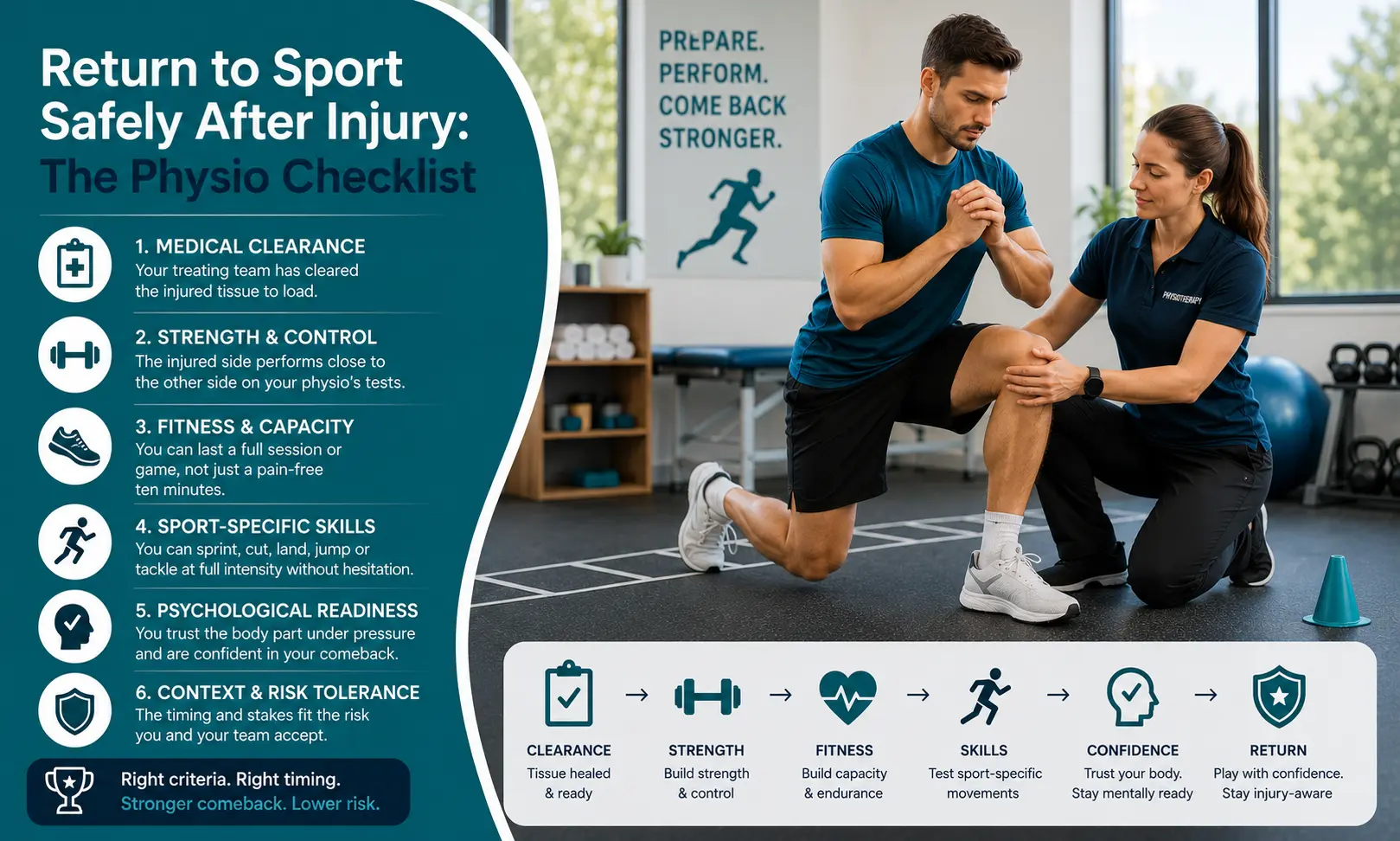
The return-to-sport checklist
Work through these six domains with your physiotherapist. Physical readiness is only part of it, and the domains people skip, capacity and mindset, are often the ones that decide whether a comeback lasts.
| Readiness domain | You are ready when |
|---|---|
| Medical clearance | Your treating team has cleared the injured tissue to load |
| Strength and control | The injured side performs close to the other side on your physio’s tests |
| Fitness and capacity | You can last a full session or game, not just a pain-free ten minutes |
| Sport-specific skills | You can sprint, cut, land, jump or tackle at full intensity without hesitation |
| Psychological readiness | You trust the body part under pressure and are not guarding it |
| Context and risk tolerance | The timing and stakes fit the risk you and your team accept |
The physical targets behind these domains, such as strength and hop-test symmetry, are covered in our rehabilitation guide. No single test guarantees safety, so these are judged together (return-to-sport testing evidence).
The domain most people miss: are you ready in your head?
You can pass every physical test and still not be ready, because fear changes how you move. An athlete who does not trust a knee or shoulder tenses, hesitates and offloads it, which paradoxically raises the risk of another injury. This is why psychological readiness is now measured alongside strength, using tools that capture three things physical testing misses: your emotions about the injury, your confidence in performing, and how you appraise the risk of it happening again (psychological readiness research). If the thought of the movement that hurt you makes you flinch, that is useful information, not weakness, and it is something rehabilitation can rebuild.
Return in stages, not all at once
Safe return is rarely a switch from rehab to full competition. It is a graded exposure: back to training with modifications, then full training, then limited game time, then full competition, with each step confirming the body copes before the next is added. This staged approach lets you test readiness under real conditions while keeping the risk controlled, and it gives you and your physiotherapist clear points to pause or progress rather than a single leap of faith.
How the checklist plays out depends on the injury. After an ACL reconstruction, the timeline is long and the criteria strict, as our guide to returning after an ACL injury explains. After a hamstring strain, the focus is on regaining speed and full-effort sprinting before match play, which our hamstring recovery guide covers. Same framework, different emphasis.
Whose decision is it?
The best return decisions are shared, because no single person holds the whole picture. Your treating doctor or surgeon confirms the tissue has healed. Your physiotherapist tests strength, control and capacity, and tracks how you move. Your coach knows the demands of the position and the calendar. And you, the athlete, own the piece no test can measure: how much risk you are willing to carry, and whether you trust the body part when it matters. Problems tend to happen when one voice, often the pressure of an upcoming game, overrides the rest. Bringing the group together, and being honest about how the injury feels, is what keeps the decision safe rather than rushed.
| ⚠ Signs you are not ready yet Hold off on full return, and get reassessed, if you still have pain during or after activity, swelling that returns with load, a joint that gives way or catches, noticeably less strength on the injured side, or a genuine fear of the movement that caused the injury. Returning through these is the most common reason injuries recur. If you are unsure, a physiotherapy assessment settles it (healthdirect). |
Get your return-to-sport check at Befit
A physiotherapist can run the tests, weigh the risk with you, and plan a staged return that fits your sport and your season. It is what our return-to-sport care is designed to do, so your comeback lasts rather than lands you back on the sidelines.
- Book an assessment with the physios at our Carlingford clinic or the physios at our North Kellyville clinic, online or by phone.
- Bring your sport. Tell us your code, position and level, because the demands of your sport shape the decision.
| Not sure if you are ready to play again? Book a return-to-sport assessment online, or call Carlingford on 02 9872 2005 or North Kellyville on 02 9624 2047. We will test where you are and map the safe path back. |
Frequently asked questions
How do I know when I am ready to return to sport?
Readiness is judged across several domains, not a single test: medical clearance, restored strength and control, the fitness to last a full session, sport-specific skills at full intensity, psychological confidence, and a risk level that fits your situation. When these line up, and your physiotherapist agrees, you are ready. It is a shared decision, not a date.
Is it bad to return to sport too early?
Yes, because returning before the tissue and your control have caught up is a leading reason injuries recur. Early return often means you are still weaker, less match-fit or hesitant, all of which raise the risk of a repeat. Meeting objective criteria first is what makes a comeback durable rather than a quick relapse.
What if I feel physically fine but nervous about playing?
That is common and worth taking seriously. Fear of reinjury changes how you move and can itself increase risk, so psychological readiness is assessed alongside physical tests. A graded return, rebuilding confidence in stages under real conditions, usually resolves it, and your physiotherapist can guide that process.
Should I return straight to full competition?
Rarely. A staged return, from modified training to full training to limited game time to full competition, lets you test readiness while keeping the risk controlled. Each step confirms your body copes before the next is added, which is safer than jumping from rehabilitation straight into a full game.
Does clearing a return-to-sport test mean I definitely will not get injured again?
No. Meeting the criteria lowers the risk, but it does not remove it, because sport carries inherent risk and no test is perfect. The value of the checklist is that it stacks the odds in your favour and gives you and your physiotherapist an honest, shared basis for the decision, rather than guessing from a date or how you feel on one good day.
About the author and clinical review
| Author: Anshu Sudan, Principal Physiotherapist, Befit Physiotherapy & Sports Injury Centre. Clinically reviewed by: a Befit physiotherapist. Carlingford: Shop 2/1 Post Office St, Carlingford NSW 2118. North Kellyville: 15/21 Hezlett Rd, North Kellyville NSW 2155. |
| Medical disclaimer This article is general information, not personal medical advice, and reflects the evidence as at July 2026. Return-to-sport decisions depend on your specific injury, your sport and your individual circumstances, and should be made with your treating team. Do not return to full sport against clinical advice, and seek assessment if you have any of the warning signs above. |