Coming back from a sports injury is a process with a destination, not a wait for a calendar date. Good rehabilitation does two things at once: it gets you back to your sport faster and it makes sure you return less likely to be injured again.
That second part matters, because returning before your body is ready is one of the strongest predictors of a repeat injury. The reassuring flip side is that a structured, criteria-based return sharply lowers that risk (return-to-sport evidence).
This guide walks through the whole journey, from the first days after an injury to full return to play, the milestones that mark real progress and the objective tests that tell you when you are genuinely ready rather than just hopeful.
By the numbers
|
Sources: return-to-sport timing and re-injury meta-analysis (JOSPT). Figures vary by injury, sport and individual.
Rehabilitation is a continuum, not a countdown
Sports medicine now describes recovery as a return-to-sport continuum with three points: return to participation (training with some restrictions), return to sport (back in your sport at your previous level), and return to performance (performing at or above where you were).
Thinking in these stages stops the all-or-nothing trap of feeling either injured or fully fit, and it explains why your physiotherapist progresses you through graded steps rather than clearing you all at once. Each step is earned by meeting a goal, not by the calendar reaching a certain date.
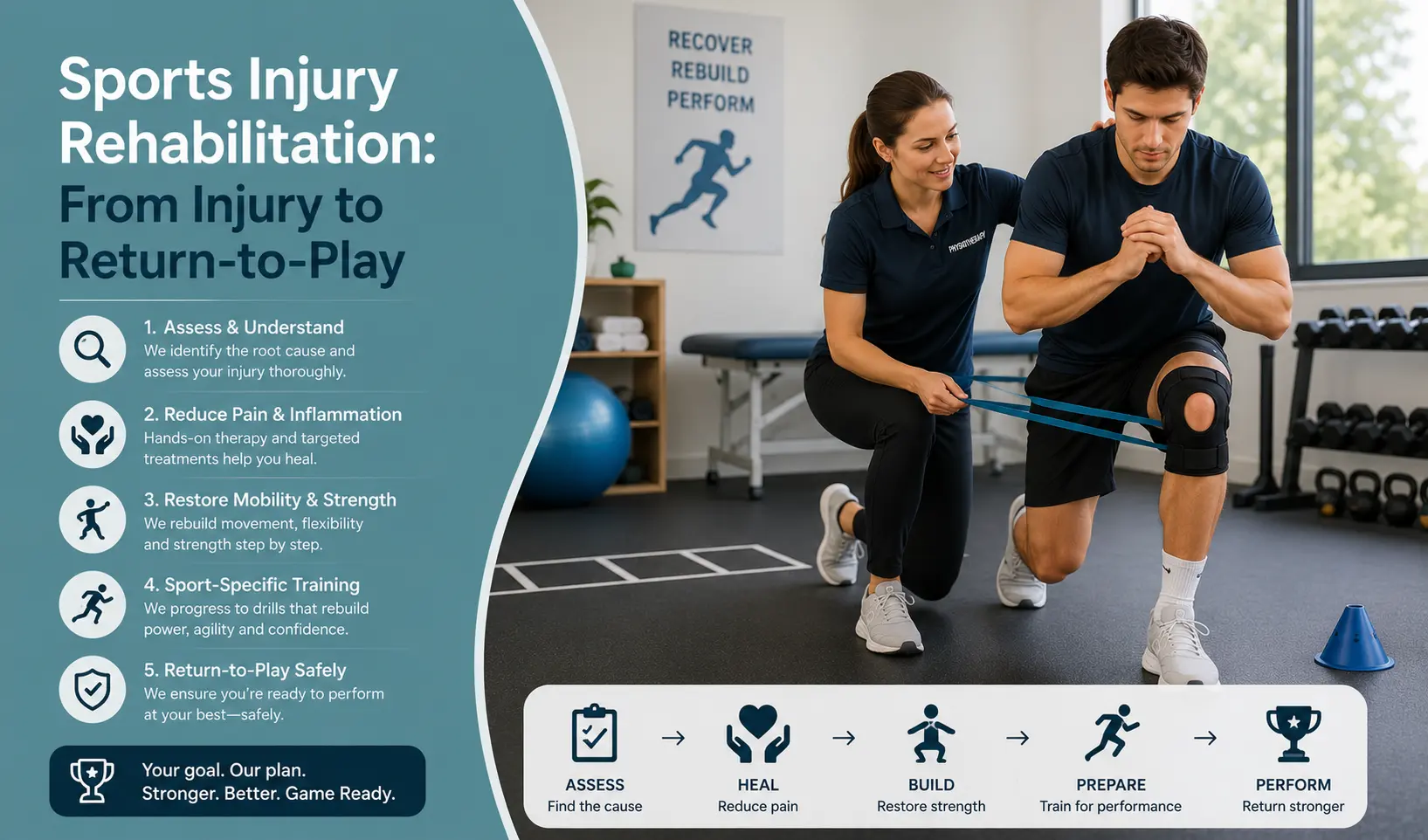
The five phases of sports injury rehabilitation
Almost every rehabilitation program moves through the same five phases, whatever the injury. The modern acute-phase approach has moved on from RICE to PEACE and LOVE, which protects the injury early while avoiding the prolonged rest and routine anti-inflammatories that can slow healing.
| Phase | Goal | Ready to progress when |
|---|---|---|
| 1. Protect (first days) | Calm pain and swelling and protect healing tissue | Pain and swelling are settling and you can move the area gently |
| 2. Restore (weeks) | Regain full movement and everyday strength | Full range of motion and near-normal strength for daily tasks |
| 3. Rebuild (weeks to months) | Build strength, power and control toward your sport’s demands | Symmetrical strength and confident running or jumping |
| 4. Return to sport (criteria-based) | Meet objective targets and rehearse your sport | You pass the readiness criteria below |
| 5. Return to performance | Full training and competition, and staying injury-free | Performing without setbacks, with prevention work ongoing |
Why time off alone does not make you ready
It is tempting to treat a recovery timeframe as a finish line, but time heals tissue without necessarily restoring strength, control or confidence. This is where the data is striking. In studies following athletes after knee surgery, those who returned on a criteria basis and did not rush the timeline had far fewer repeat injuries than those who returned early, and objective strength symmetry was closely tied to that lower risk (return-to-sport evidence).
In plain terms: feeling fine is not the same as being ready, and the gap between the two is where re-injuries happen.
Return-to-play readiness: the criteria that matter
Rather than asking how many weeks it has been, a good physiotherapist checks whether you meet a set of objective targets. These are the criteria we work toward before clearing an athlete for full return.
| Readiness criterion | Why it matters | Typical target |
|---|---|---|
| Strength symmetry (injured vs other side) | Lingering weakness predicts re-injury | At least 90% of the uninjured limb |
| Hop and jump test symmetry | Shows the limb can absorb and produce force | At least 90% on single and triple hop tests |
| Full, pain-free movement | Restricted or painful movement means the tissue is not ready | Full range, no swelling, minimal pain |
| Sport-specific fitness and skills | You need the endurance and technique your sport demands | Sport drills completed at full intensity |
| Psychological readiness | Fear of re-injury changes how you move and raises risk | Confident to compete without hesitation |
| Time since injury or surgery | Tissue healing takes time regardless of how you feel | Meets the guideline for your injury |
Befit Physio Return-to-Play Readiness Checklist v1.0 · 11 July 2026. Criteria vary by injury and sport; meeting them lowers re-injury risk but does not remove it entirely. Use with your physiotherapist.
The same principles, tuned to your injury
The five phases apply broadly, but the detail changes with the injury. An overuse injury from training load, common in runners, is managed mostly by adjusting load and building capacity.
An acute injury like a sprain or strain leans harder on the early protect-and-restore phases. A post-surgical recovery such as an ACL reconstruction has the longest timeline and the strictest criteria.
How a physiotherapist gets you back safely
A physiotherapist turns all of this into a plan tailored to you and your sport, and adjusts it as you progress. That means guiding the early phase, loading the tissue at the right rate, testing you against the criteria above and rehearsing the specific demands of your game before you step back into it. It is exactly what our sports injury centre is built around.
Start or restart your rehab at Befit Physio
- Get assessed early. The sooner rehab starts, the smoother the return; we can guide the protect phase from day one.
- Book with us at our Carlingford physios or the North Kellyville clinic, online or by phone.
| Injured, or coming back from one? Book a sports rehabilitation assessment online, or call Carlingford on 02 9872 2005 or North Kellyville on 02 9624 2047. We will map out your phases and the targets that get you back to play safely. |
Frequently asked questions
How long does it take to return to sport after an injury?
It depends on the injury, but the honest answer is that it is based on meeting targets, not a fixed number of weeks. A minor sprain may take a couple of weeks, while an ACL reconstruction usually needs around nine months or more. Returning once you meet objective strength and function criteria lowers your re-injury risk.
Why should I keep doing rehab once the pain is gone?
Because pain settles well before strength, control and tissue tolerance are fully restored. Studies show that returning while still weak on the injured side is closely linked to re-injury. Finishing the rebuild and return phases is what makes your comeback durable rather than a quick fix that breaks down.
What are return-to-sport tests?
They are objective checks a physiotherapist uses to decide if you are ready, such as comparing strength and hop-test performance between your injured and uninjured sides, checking movement quality, sport-specific fitness, and your confidence. Meeting objective strength and function targets is a common gate before full return.
Do I need surgery to return to sport after a serious injury?
Not always. Many injuries, including some ligament injuries, are managed well with rehabilitation alone, while others do better with surgery followed by rehab. Either way, the rehabilitation and return-to-sport criteria are what get you back safely, so a physiotherapy assessment is a sensible first step.
About the author and clinical review
| Author: Anshu Sudan, Principal Physiotherapist, Befit Physiotherapy & Sports Injury Centre. Clinically reviewed by: a Befit physiotherapist. Carlingford: Shop 2/1 Post Office St, Carlingford NSW 2118. North Kellyville: 15/21 Hezlett Rd, North Kellyville NSW 2155. |
| A note on this guide This article is general information, not personal medical advice, and reflects the evidence as at July 2026. Rehabilitation timelines and criteria vary with the injury, the sport and the individual, and meeting them lowers re-injury risk without removing it entirely. Get an individual assessment before returning to sport, and seek urgent care for a severe injury, loss of function, or signs of a serious problem. |