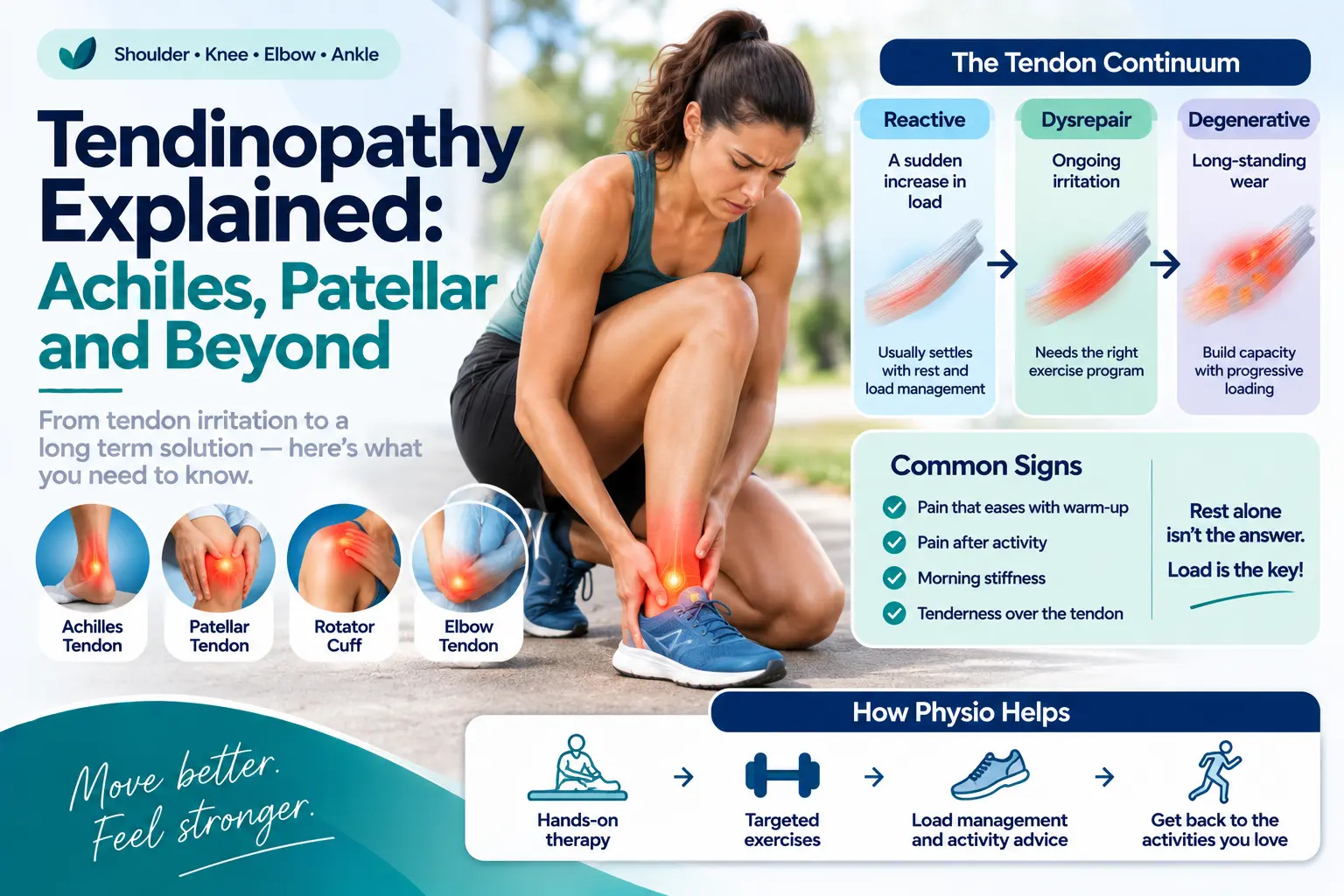
A runner with a sore Achilles, a basketballer whose knee aches at the bottom of a jump, a painter with a nagging elbow, a swimmer whose shoulder grumbles overhead. On the surface these are four different complaints in four different people. Underneath, they are very often the same injury wearing different clothes.
Each is a tendinopathy, an overloaded tendon that has not kept pace with what has been asked of it. Understanding that shared story is genuinely useful, because it means the same principles that settle one tendon tend to settle them all, and the old name most people still use for the problem points them in exactly the wrong direction.
What a tendon does, and what “tendinopathy” actually describes
A tendon is the tough, springy rope that ties a muscle to a bone and transmits the muscle’s pull into movement. It is built to take enormous tensile load and to store and release energy, which is why a healthy Achilles can cope with forces many times your body weight when you run. Tendinopathy is what happens when the load applied to a tendon outruns its capacity to adapt, so the tissue’s structure starts to disorganise and it becomes painful and less able to do its job. The older label, “tendinitis,” assumed the core problem was inflammation.
Decades of tissue studies have overturned that: a persistent tendinopathy is driven far more by failed adaptation and disordered repair than by the hot, swollen inflammation the “itis” implies. That single correction reshapes the whole treatment plan, because a tissue that has failed to adapt to load is rebuilt with load, not rested or injected into recovery.
One condition, many addresses: where tendinopathy shows up
The same process targets whichever tendon is being overloaded, and the usual suspects track the sport or job behind them. The common sites, and who tends to get them:
| Tendon site | Common name | Who tends to get it |
|---|---|---|
| Achilles (back of the ankle) | Achilles tendinopathy | Runners and walkers who ramp up distance or hills |
| Patellar (below the kneecap) | Jumper’s knee | Basketball, volleyball and jumping athletes |
| Rotator cuff (shoulder) | Cuff-related shoulder pain | Swimmers, throwers and overhead workers |
| Outer elbow | Tennis elbow | Trades, DIY and desk-and-mouse users |
| Gluteal (side of the hip) | Gluteal tendinopathy | Women around and after menopause, walkers |
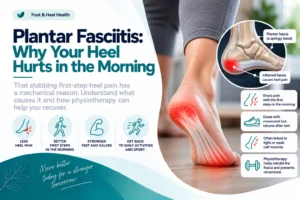
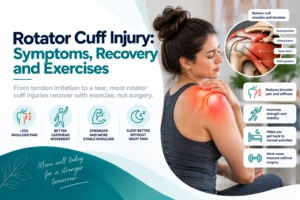
Each of these has its own quirks worth reading up on, from rotator cuff tendon problems at the shoulder to tennis and golfer’s elbow at the arm, and the Achilles among the other tendon causes of heel pain. The plantar fascia under the heel is a close cousin of this family, behaving much like a tendon under the same rules. What unites them is more important than what separates them.
The tendon continuum: reactive, dysrepair and degenerative
Tendons do not simply go from healthy to injured; they move along a spectrum, and knowing roughly where a tendon sits changes what helps. The widely used model describes three overlapping stages (the continuum of tendon pathology):
- Reactive. A sudden spike in load, a new training block or an unaccustomed day on your feet, provokes a short-term swelling response in the tendon. Caught here, it often calms quickly once the load is dialled back.
- Dysrepair. If the overload continues, the tendon’s attempts to heal start to fail and its structure becomes more disorganised. This is the grumbling, in-between stage where many people have been sore for a while.
- Degenerative. In long-standing cases, parts of the tendon become worn and structurally poor. These areas will not fully “heal back,” but the surrounding healthy tendon can be strengthened to carry the load, which is why recovery is still the rule rather than the exception.
A single tendon can even sit in more than one stage at once, a healthy part and a worn part side by side, which is why a tendon can flare acutely yet also carry old, degenerative change. The practical point is that the aim is rarely to “repair” a damaged patch and far more often to build the capacity of the tendon as a whole.
The tell-tale rhythm: the warm-up pattern and the 24-hour rule
Tendon pain has a signature that sets it apart from most joint and muscle problems, and it is remarkably consistent whether the tendon is at the heel or the elbow. Classically it is stiff and sore to get going, eases as the tendon warms up, then bites again afterwards, especially the next morning. That warm-up phenomenon is why a runner can feel fine mid-run yet sore at the first step the following day.
The most useful gauge of whether you are loading a tendon well is its 24-hour response: a tendon that is being challenged appropriately settles back to its usual level by the next day, while one that has been overloaded stays stirred up and stiffer the morning after. Learning to read that next-day signal is often more valuable than chasing pain in the moment, and it is the same rule across every tendon in the body.
Why load, not rest, is the medicine
The instinct with a sore tendon is to stop and let it heal, but tendons respond poorly to pure rest; they lose capacity and are just as unready when you return. What a tendon actually adapts to is graded, progressive load, the mechanical signal that tells the tissue to build and reorganise. In practice that usually starts with controlled strengthening pitched at a level the tendon can tolerate, then steps up as it copes, with the aggravating activity trimmed rather than abandoned.
The exact exercise differs by tendon and stage, which is why the loading program for a jumper’s knee is not the loading program for a cranky Achilles, and a physiotherapist tailors both the starting point and the rate of progression to the individual.
Settling and rebuilding tendons is a core part of our sports injury physiotherapy, and where a sudden jump in training set the problem off, our guide to the training-load errors behind most running injuries explains how to reintroduce load without reigniting it. Injections and shockwave sit behind the loading work for stubborn cases, never instead of it.
What sets tendons back: the common mistakes
A handful of well-meant moves tend to prolong tendon pain rather than fix it:
- Complete rest and waiting it out, which leaves the tendon weak and the pain primed to return the moment you resume.
- Aggressive stretching of a tendon at its bony attachment, which can compress and irritate it, a frequent own-goal with Achilles, hamstring and gluteal tendons.
- Chasing repeated cortisone injections, which can ease pain briefly but tend to leave the tendon worse off over the following year than loading does.
- Doing too much, too soon, piling load back on the day the pain lifts instead of building it up, which is the single most common reason a tendon keeps flaring.
When tendon pain is more than a tendinopathy
Most tendon pain is an overload problem that responds well to the right loading, but a few patterns deserve a prompt assessment rather than a self-managed program. A sudden, sharp pop or giving-way, sometimes with a gap you can feel, can mean a tendon has actually torn or ruptured and needs urgent review. Several tendons becoming painful at once, or tendon pain alongside joint swelling, morning stiffness that lasts for hours, or feeling generally unwell, can point to an inflammatory arthritis rather than simple overload.
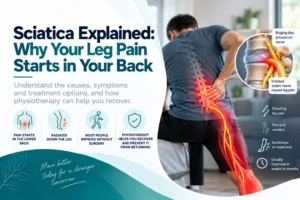
And pain that does not quite fit the tendon, with pins and needles or numbness, may be coming from a nerve. A physiotherapist can sort out quickly which of these you are dealing with and when a medical referral is the right next step.
Rebuilding a stubborn tendon with Befit Physio in Carlingford and North Kellyville
If a tendon has been grumbling for weeks, whether at the heel, knee, shoulder or elbow, an assessment works out which stage it is in and builds the graded loading plan that rebuilds it, rather than leaving you to guess how hard to push. We manage these across every sport and every desk job, and starting the right program early usually means a shorter road back.
You can be seen at our Carlingford physiotherapy clinic or with our North Kellyville physiotherapists, in the clinic or at home.
| Tendon pain that will not settle? Book a one-on-one assessment online, or call Carlingford on 02 9872 2005 or North Kellyville on 02 9624 2047. We will stage the tendon and build the loading plan that rebuilds it. |
Frequently Asked Questions
Is tendinopathy the same as tendinitis?
They refer to the same tendons, but the terms carry different assumptions. “Tendinitis” implies active inflammation, which was the old understanding. Research now shows that persistent tendon pain is driven mainly by failed adaptation and disordered repair rather than classic inflammation, so “tendinopathy” is the more accurate term. The distinction matters, because it is the reason anti-inflammatory approaches tend to fall short and progressive loading does the real work.
Which is the hardest tendon to heal?
Lower-limb tendons that carry high loads and take longer to offload, such as the Achilles and the insertional part of the gluteal and hamstring tendons, tend to be the most stubborn, partly because you cannot easily stop walking on them. That said, “hard to heal” usually reflects how long the problem has been left and how well the load has been managed, more than the tendon itself. Most settle with a consistent, well-pitched program given enough time.
Can you fully recover from tendinopathy?
Usually, yes. Even when part of a tendon has become degenerative and will not fully return to normal structure, the surrounding healthy tendon can be strengthened to take the load, and people routinely return to full activity pain-free. The key is rebuilding capacity gradually and not stopping the loading the moment the pain eases, which is when many recoveries unravel.
How long does a tendinopathy take to settle?
Tendons remodel slowly, so meaningful recovery is usually measured in months rather than weeks, and longer the more entrenched it has become before treatment starts. Pain often improves well before the tendon is fully capable, so the common error is ramping activity back up too early. Acting sooner, while it is still in the reactive stage, generally shortens the whole course considerably.
Why does my tendon pain keep coming back?
Recurrence almost always traces back to load outrunning capacity again, either by returning to full activity before the tendon is ready, stopping the strengthening once the pain fades, or not addressing what overloaded it in the first place, such as a training spike, technique or footwear. Keeping some maintenance loading in place and reintroducing demand gradually is what stops the cycle.
About the author and clinical review
| Author: Anshu Sudan, Principal Physiotherapist and owner, Befit Physiotherapy & Sports Injury Centre (Masters of Physiotherapy, APA member). Clinically reviewed by: a physiotherapist at Befit Physio. Carlingford: Shop 2/1 Post Office St, Carlingford NSW 2118. North Kellyville: 15/21 Hezlett Rd, North Kellyville NSW 2155. |
| Medical disclaimer This article is general information, not personal medical advice, and reflects current evidence as at October 2026. Tendon pain has several possible causes, so see a physiotherapist or doctor for an individual assessment and diagnosis before starting an exercise program. Seek prompt care for a sudden pop or giving-way, an inability to use the limb, or tendon pain with joint swelling, prolonged morning stiffness or feeling unwell. |