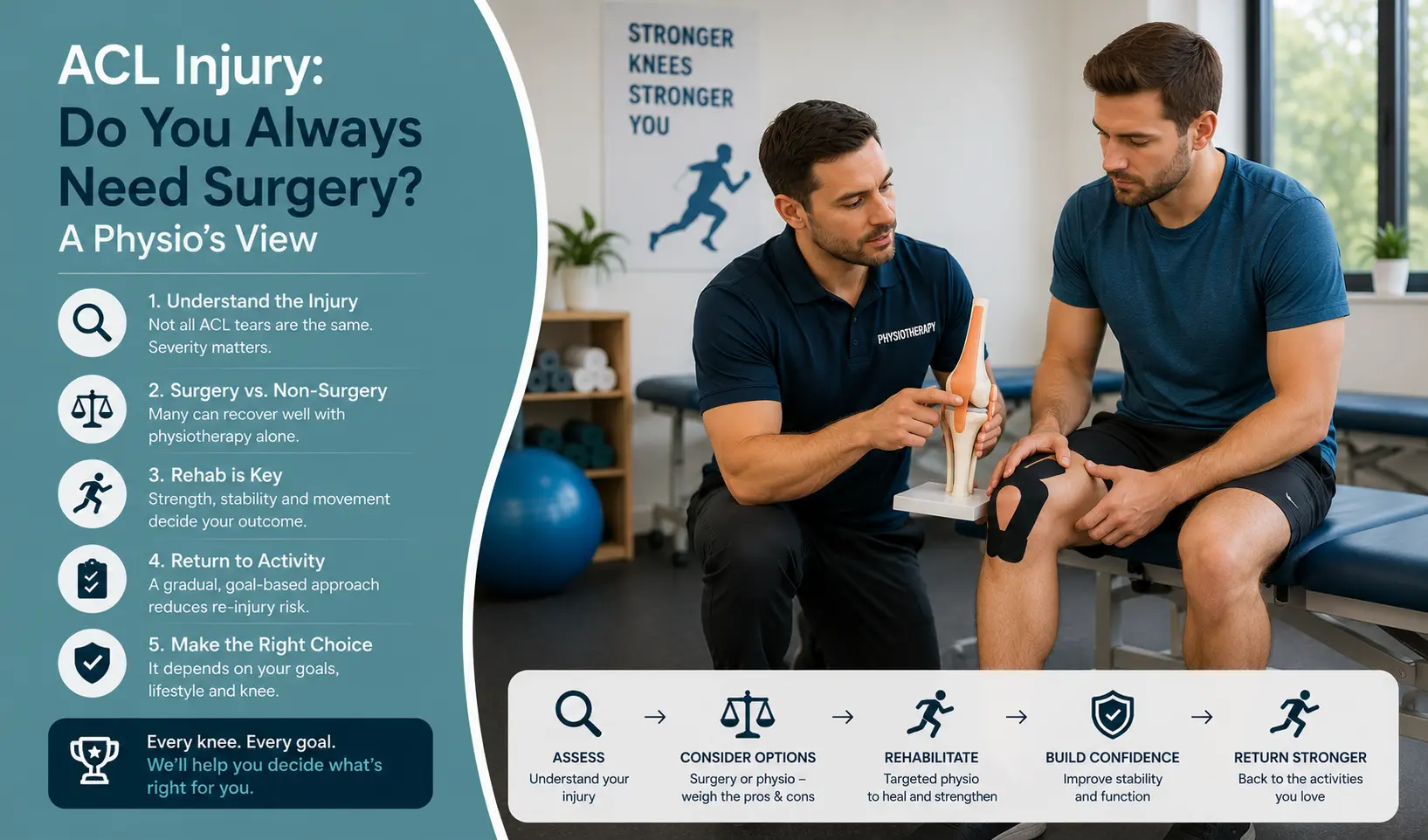
If you have torn your ACL, you have probably been told you need surgery. The honest, evidence-based answer is: not always. In a major trial of active adults with an acute ACL rupture, starting with structured rehabilitation and keeping surgery as an option gave outcomes just as good at two and five years as operating straight away and about half of those who began with rehab never needed the operation (KANON trial evidence). That does not mean surgery is wrong; it means the decision is genuinely yours to weigh, and this article helps you weigh it.
The anterior cruciate ligament (ACL) is one of the main ligaments that stabilises the knee, and a tear often brings sudden pain, swelling and a sense of the knee giving way. What happens next is where the myths creep in, so let us clear those first.
Four myths about ACL surgery, and what the evidence says
- Myth 1: a torn ACL always needs surgery. About half of people who start with guided rehabilitation never need an operation, with similar results to early surgery.
- Myth 2: surgery prevents arthritis. It does not. An ACL injury itself raises the long-term risk of knee osteoarthritis, and reconstruction does not remove that risk (APA).
- Myth 3: rehab first wastes time. Delaying and rehabilitating first gives similar two and five-year outcomes, and you can still choose surgery later if you need it.
- Myth 4: the ACL can never heal. Some ACLs show signs of healing on MRI with non-surgical management, an area of active and promising research.
Two paths to a stable knee
After an ACL tear there are, broadly, two routes, and both aim for the same destination: a strong, stable knee you trust. Reconstruction replaces the torn ligament with a graft, followed by many months of rehabilitation. Rehabilitation-first (sometimes called conservative or non-surgical management) builds the strength and neuromuscular control that let the surrounding muscles stabilise the knee, with surgery kept in reserve if instability persists.
The key insight from the research is that these are not a good option and a bad one; for many people they lead to comparable outcomes, so the right path depends on you.
Surgery or rehab first? What tips the balance
Rather than a blanket rule, physiotherapists and surgeons weigh a set of factors with you. This table shows what tends to point each way.
| Factor | Leans toward rehab first | Leans toward surgery |
|---|---|---|
| Knee stability after early rehab | Feels stable, no giving way (a ‘coper’) | Repeated giving way despite good rehab |
| Your sport and goals | Lower-pivoting activity, or willing to modify | High-level pivoting sport you want back |
| Other knee damage | ACL alone, or a stable meniscus | A meniscus needing repair, or multi-ligament injury |
| Response to a rehab trial | Strength and control returning well | Little progress, ongoing instability |
| Preference and timeline | Prefer to avoid or delay surgery | Prefer a definitive operation and set timeline |
Befit Physio ACL Surgery-or-Rehab Decision Guide v1.0 · 11 July 2026. A shared decision with your physiotherapist and surgeon; rehab first does not rule out surgery later, and outcomes are broadly similar.
Why some people cope without a new ligament
A useful idea here is the coper. Some people, after good rehabilitation, develop enough strength and neuromuscular control that the knee stays stable even without an intact ACL; they are copers. Others continue to feel the knee give way during twisting and pivoting; they are non-copers and tend to do better with reconstruction.
A short trial of progressive rehabilitation is often the fairest way to find out which group you fall into, because it also builds the strength you will need whichever path you take.
| An emerging option: can an ACL heal on its own? Australian research is challenging the old idea that a torn ACL can never mend. In a study of the Cross Bracing Protocol, where the knee is braced at 90 degrees early on and then progressively rehabilitated, around 90% of participants showed signs of ACL healing on MRI at three months. This is promising but still emerging evidence from early studies rather than settled practice, and larger trials are underway. It is worth asking your specialist about, not assuming, and it is not suitable for every tear. |
What rehabilitation looks like, whichever path you choose
Rehabilitation is the common thread. Whether or not you have surgery, the work is the same in principle: restore movement, rebuild strength in the quadriceps, hamstrings and hips, retrain balance and control, and progress through running, jumping and cutting before any return to sport.
Our guide to sports injury rehabilitation and return to play sets out the phases and the criteria that make a comeback durable. And once you are back, the same training that rebuilt the knee helps protect it, which is the focus of our guide to reducing your risk of an ACL injury.
When surgery is more clearly the right call
Reconstruction has a clear role, and it is often the better choice when:
- the knee keeps giving way despite a genuine rehabilitation effort
- there is other damage that needs surgery, such as a meniscus tear requiring repair or more than one torn ligament
- you want to return to a high-level pivoting sport and instability is holding you back
- Even then, rehabilitation before surgery, sometimes called prehabilitation, improves how well you recover afterward, so the two approaches work together rather than in opposition.
How a physiotherapist helps you decide and recover
A physiotherapist is well placed to guide this decision, because it hinges on how your knee responds to loading and rehabilitation. We assess the knee, run a structured rehab trial, test your strength and control and coordinate with a surgeon when one is needed. For the wider context of knee problems and how they are managed, see our guide to the common causes of knee pain, and read how our knee rehabilitation is structured across a course of care.
Talk it through at Befit
- Get assessed. We check the knee, explain your options, and start rehab early whether or not surgery is on the cards.
- Book with us and visit us in Carlingford or visit our North Kellyville rooms, online or by phone.
| Weighing up ACL surgery? Book a one-on-one assessment online, or call Carlingford on 02 9872 2005 or North Kellyville on 02 9624 2047. We will help you understand your knee and your options before you commit to anything. |
Frequently asked questions
Can you live a normal life without ACL surgery?
Many people can. After good rehabilitation, a large share of people regain a stable knee and return to activity without reconstruction, and trial evidence shows similar outcomes to early surgery for many. Whether it suits you depends on your knee’s stability and the demands of your sport, which a rehab trial helps reveal.
Does ACL surgery prevent arthritis?
No. This is a common misunderstanding. An ACL injury itself increases the long-term risk of knee osteoarthritis, and reconstruction does not remove that risk. It is a reason to focus on long-term knee strength and health, whichever treatment path you take, rather than a reason to rush into surgery.
If I try rehab first, can I still have surgery later?
Yes. Starting with rehabilitation keeps your options open, and delaying surgery to trial rehab does not appear to worsen results at two or five years. If instability persists, you can proceed to reconstruction, and the strength you built during rehab helps your recovery afterward.
How long is recovery, with or without surgery?
Either path takes months, not weeks. Return to pivoting sport is commonly around nine to twelve months, and it is guided by meeting strength and control criteria rather than the calendar. Rushing back before the knee is ready is one of the main causes of a second injury.
What is a coper?
A coper is someone whose knee stays stable after an ACL tear once they have built strength and neuromuscular control, so they manage well without reconstruction. A non-coper continues to experience the knee giving way and usually does better with surgery. A short rehab trial helps identify which you are.
About the author and clinical review
| Author: Anshu Sudan, Principal Physiotherapist, Befit Physiotherapy & Sports Injury Centre. Clinically reviewed by: a Befit physiotherapist. Carlingford: Shop 2/1 Post Office St, Carlingford NSW 2118. North Kellyville: 15/21 Hezlett Rd, North Kellyville NSW 2155. |
| Medical disclaimer This article is general information, not personal medical advice, and reflects the evidence as at July 2026. The right treatment for an ACL injury depends on your individual knee, goals and any other damage, and should be decided with your physiotherapist and surgeon. Emerging options such as bracing protocols are still being studied. Seek assessment for any significant knee injury. |