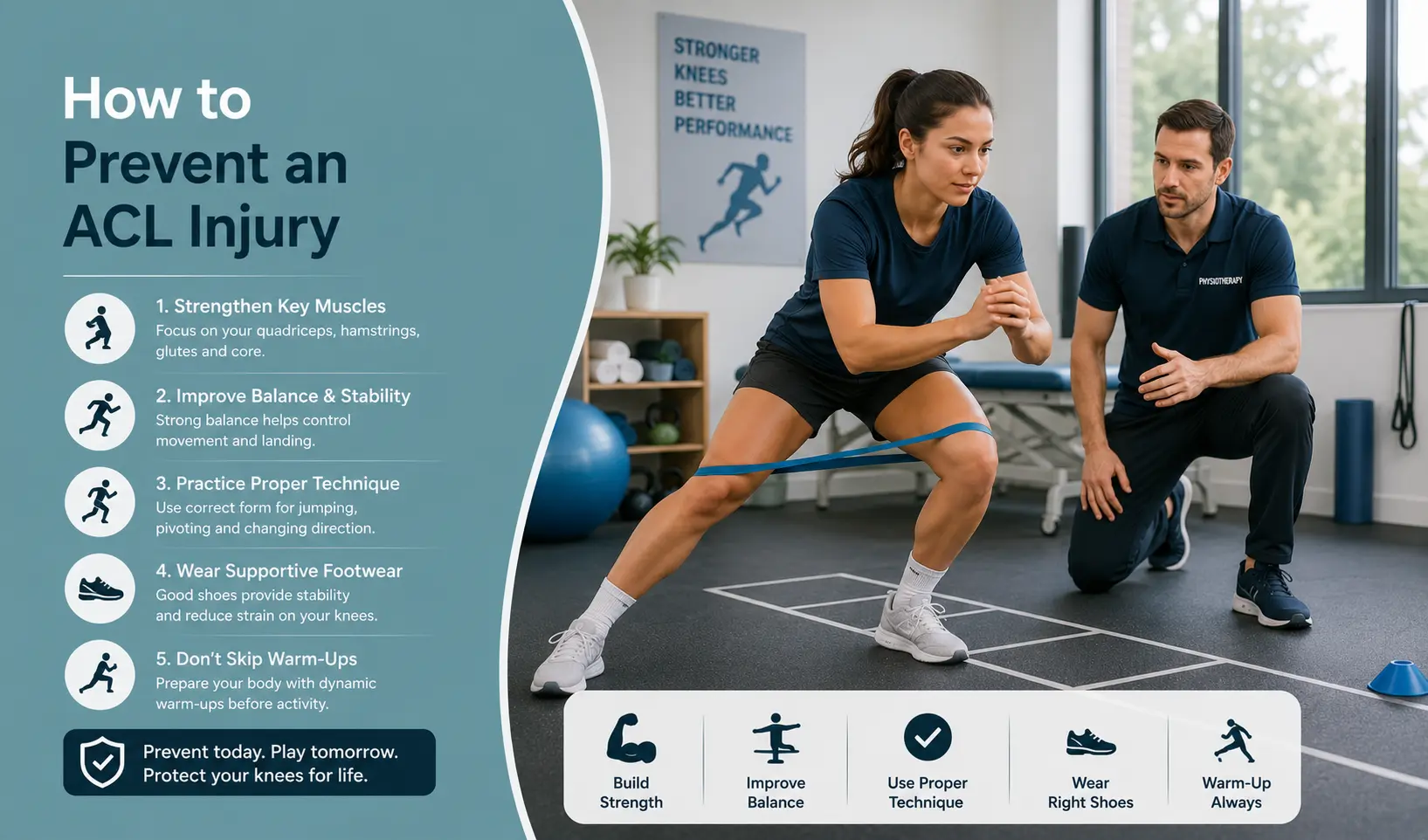
Here is the encouraging part: most ACL injuries can be prevented. The majority happen without any contact, during landing, cutting or pivoting, and structured neuromuscular training reduces the risk by around 50% (meta-analysis).
In other words, a well-designed warm-up done consistently is one of the most effective things a physiotherapist can offer an athlete. This guide explains why the ACL is vulnerable, exactly what training protects it, and a warm-up you can start using this week.
The anterior cruciate ligament (ACL) is a key stabilising ligament inside the knee. A tear is a serious injury that can mean months out of sport, so prevention is well worth the effort, especially in change-of-direction sports like football, netball, basketball and skiing.
Most ACL injuries are non-contact and preventable. A structured warm-up that combines strength, plyometrics, balance and safe landing and cutting technique cuts ACL injury risk substantially, and doing it consistently matters most. Build it into every training session rather than treating it as an add-on.
| An ACL injury is a sprain or tear of the anterior cruciate ligament, one of the main ligaments that stabilises the knee. Most are non-contact, happening as an athlete lands, slows down or changes direction, which is exactly why training the way you move can prevent them. |
Why most ACL injuries are preventable
Unlike a tackle you cannot see coming, the majority of ACL injuries are non-contact. They happen in a split second when an athlete lands from a jump, decelerates, or plants a foot to change direction, and the knee collapses inward under load. Because these are movement faults rather than pure bad luck, they can be trained.
Strengthening the muscles around the knee, and teaching the body to land and cut with the knee aligned over the foot, removes much of the risk. Female athletes are at higher risk, which is one reason prevention programs were first studied closely in women’s sport.
What actually reduces ACL injury risk: neuromuscular training
The evidence here is strong. Pooled trial data shows that neuromuscular training reduces ACL injury risk by about 50% and overall knee injury by around 22% (meta-analysis). Neuromuscular training simply means exercises that improve how your muscles and nervous system control the joint: strength, jumping and landing drills, balance, and change-of-direction technique.
Two findings matter most for getting the benefit. First, the programs that work combine several elements rather than relying on stretching alone. Second, adherence is decisive: athletes who complete at least three-quarters of the sessions get the biggest reduction in risk. A perfect program done occasionally protects no one.
The Befit Physio: ACL-prevention warm-up
This is the structure we use with athletes at our sports injury centre, built from the elements shown to reduce ACL injuries. Run through it as your warm-up, and treat the strength and agility work as its own short sessions across the week.
| Component | Why it protects the ACL | How often |
| Strength (hamstrings, glutes, quads) | Strong muscles absorb landing forces and control the knee | 2 to 3 sessions a week |
| Plyometrics and landing technique | Teaches soft, aligned landings so the knee does not collapse inward | Part of every warm-up |
| Balance and proprioception | Sharpens the knee’s sense of position so it reacts faster | Part of every warm-up |
| Agility and cutting technique | Trains safe change of direction, where most ACL injuries happen | 1 to 2 sessions a week |
| Core and trunk control | A stable trunk keeps the knee tracking over the foot | 2 to 3 sessions a week |
Befit Physiotherapy ACL-Prevention Warm-Up v1.0 · 11 July 2026. Built from the training elements shown to reduce ACL injury in trials. Do it consistently; general guidance, not a substitute for individual coaching.
An Australian program that works: Prep-to-Play
If you want a ready-made, locally proven option, Prep-to-Play, developed by La Trobe University with the AFL, is a good model. It replaces static stretching with a roughly ten-minute warm-up of running, agility, jumping, landing, single-leg balance and strength work.
In the first large trial of injury prevention in women’s and girls’ Australian football, higher use of the program was linked to fewer lower-limb injuries, including ACL ruptures. Sports Medicine Australia publishes similar injury-prevention guidance for community sport.
The details differ by code, but the principle is the same: warm up the way you play, and do it every session.
Other ways to protect your knees
A prevention warm-up does most of the work, but a few habits help too. Build a base of year-round strength so you are not starting from scratch each season. Manage your training load, since sudden spikes in volume or intensity raise injury risk across the board.
Practise your landing and cutting technique when you are fresh, not just when you are tired at the end of a session. And make sure your footwear suits the surface you play on.
| Think you have already injured your ACL? A sudden pop, rapid swelling within a few hours, and a feeling that the knee is giving way are common signs of an ACL injury. If that sounds like you, stop playing and get it assessed. The good news is that not every ACL tear needs surgery: our knee injury treatment covers how physiotherapy rehabilitates the knee either way. |
Get a prevention plan at Befit
Whether you are returning from an injury or want to reduce your risk before the season, a physiotherapist can build a program around your sport and your body.
If you are coming back from a knee injury, our sports injury rehabilitation and return-to-play approach makes sure you go back stronger, not just pain-free.
- Book a screening with our Carlingford physios or the North Kellyville clinic, online or by phone.
- Get your program. We tailor the warm-up and strength work to your sport and any past injuries.
| Play a change-of-direction sport? Book an ACL-prevention screening online, or call Carlingford on 02 9872 2005 or North Kellyville on 02 9624 2047. We will assess your landing and cutting technique and set you up with a program that fits your training week. |
Frequently asked questions
Can you really prevent an ACL injury?
You cannot remove all risk, but you can cut it substantially. Structured neuromuscular training reduces ACL injury risk substantially in pooled trial data. Since most ACL injuries are non-contact, training how you land, cut and stabilise the knee removes much of the danger, provided you do the program consistently.
What exercises help prevent ACL injuries?
A combination works best: strength for the hamstrings, glutes and quads; plyometrics with soft, aligned landings; balance and single-leg control; and safe change-of-direction technique. No single exercise is enough on its own. The mix, done as a regular warm-up, is what lowers risk.
How often should I do a prevention program?
Build it into every training session as your warm-up, with the strength and agility elements a few times a week. Adherence is the biggest factor in whether it works, so aim to do it consistently rather than perfectly now and then.
Are women more likely to tear their ACL?
Female athletes are at higher risk of ACL injury, which is one reason prevention programs were studied closely in women’s sport. The same neuromuscular training that reduces risk in general is especially valuable for female athletes, particularly younger ones in pivoting sports.
Do I need special equipment to prevent ACL injuries?
No. Most of an effective program uses your own body weight, a bit of space and, ideally, a coach or physiotherapist to check your technique early on. Balance work may use an unstable surface, but the core of the program is jumping, landing, cutting and strength you can do at training.
About the author and clinical review
| Author: Anshu Sudan, Principal Physiotherapist, Befit Physiotherapy & Sports Injury Centre. Clinically reviewed by: a Befit physiotherapist. Carlingford: Shop 2/1 Post Office St, Carlingford NSW 2118. North Kellyville: 15/21 Hezlett Rd, North Kellyville NSW 2155. |
| A note on this guide This article is general information, not personal medical advice, and reflects the evidence as at July 2026. Prevention lowers risk but cannot remove it entirely. Start a new training program gradually, and get individual guidance if you have a past knee injury or any concerns. If you think you have injured your ACL, stop and have the knee assessed. |