If you or someone you care for is an NDIS participant, physiotherapy is one of the supports the scheme can fund, and two questions come up almost every time: is it actually covered, and how many sessions do you get? The honest answer to the second one surprises people, because the NDIS does not work like Medicare.
There is no set number of visits to count down. Instead, physiotherapy is paid for out of a budget in your plan, and how far that budget stretches depends on your goals, the funding allocated, and how each session is priced. Once you understand it as a budget rather than a fixed allowance, the whole system makes far more sense.
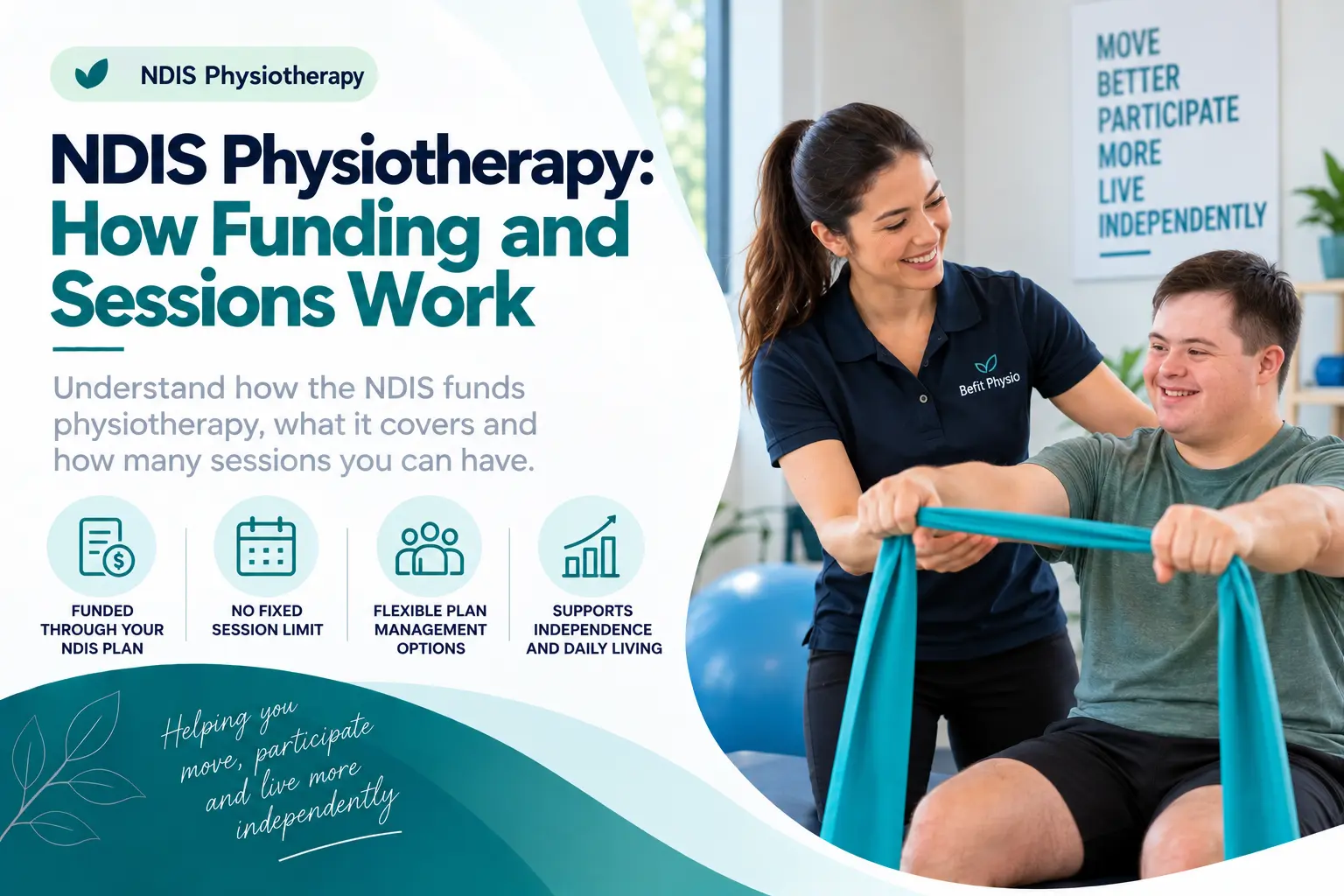
The NDIS funds physiotherapy as a capacity-building support, not a medical rebate
Physiotherapy sits in the part of an NDIS plan called Capacity Building, under the Improved Daily Living budget, where therapy supports live. That placement matters, because it tells you what the funding is for: building your independence, movement and daily function over time, rather than treating a one-off illness or injury. For the NDIS to fund it, the physiotherapy has to be reasonable and necessary and related to your disability, which is the test applied to every support in a plan.
Everyday problems that the health system would ordinarily handle, such as an acute sprain or a chest infection, are not what NDIS therapy funding is for; those belong to Medicare and the hospital system. If you are weighing up the two, the Medicare route is a different pathway with its own rules, set out in our guide to the Medicare pathway for physiotherapy, and the schemes are not meant to pay for the same support twice.
There is no set number of sessions, only a therapy budget
This is the single biggest point of confusion, so it is worth being clear. The NDIS does not approve “ten physio sessions” the way a Medicare care plan approves a capped number of visits. It allocates a dollar figure of therapy funding based on your goals, and the number of sessions is simply that budget divided by what each session costs.
Two people with the same diagnosis can have very different amounts of physiotherapy, because their plans are built around what each of them is trying to achieve.
What each session costs is not open-ended, though. The NDIS sets a maximum hourly price for physiotherapy of $183.99, the national cap under the scheme’s pricing determination for 2026-27 (NDIS pricing arrangements). A provider cannot charge above it. A useful detail most people miss is that this cap applies to plan-managed and agency-managed participants; if you self-manage your funding, you are not bound by the price limit and can agree a rate directly, which cuts both ways.
It also helps to know that the budget covers more than time in the room: a physiotherapist’s report writing, and in some cases travel or telehealth, are legitimate claims against the same funding, which is worth factoring in when you plan how many hands-on sessions you want.
How your plan is managed decides who pays and which physios you can choose
The other question that shapes your physiotherapy is how your plan is managed. There are three options, and they change who handles the money and how much choice you have over your provider (NDIS guide to management options).
| Management type | Who pays your physio | Which physios you can use |
|---|---|---|
| Self-managed | You or your nominee pay and claim it back | Any provider; not bound by the price cap |
| Plan-managed | A plan manager pays your providers for you | Registered or unregistered providers |
| NDIA-managed (agency) | The NDIA pays your providers directly | NDIS-registered providers only |
The practical upshot is that self-managed and plan-managed participants have the widest choice of physiotherapist, while agency-managed plans must use a registered provider.
Because Befit Physio is a registered NDIS provider, we can work with participants under any of the three arrangements, which is worth checking before you book anywhere; you can see how we handle funding and claiming across schemes on our payments page.
Getting physiotherapy into your plan starts with your goals, not a referral
Unlike the Medicare pathway, you do not need a GP referral to use NDIS-funded physiotherapy, because the funding already sits in your plan; the referral question simply does not apply here. What matters instead is that the physiotherapy connects clearly to your plan goals. If independence, mobility, safe movement at home or maintaining function are part of what you are working towards, therapy support is the natural fit, and evidence from an assessment helps show why it is reasonable and necessary.
The best time to get this in is at your planning or plan-review meeting, where you and your planner decide how much Improved Daily Living funding your goals call for. If physiotherapy is not yet in your plan and you think it should be, that meeting, backed by a therapist’s assessment, is where to raise it.
What NDIS physiotherapy actually works on
NDIS physiotherapy looks a little different from a quick injury visit, because the aim is function over the long term rather than a single fix. A physiotherapist assesses how you move and then works on the things that make daily life easier and safer: strength, balance, walking and transfers, joint range, pain that limits activity, and the confidence to keep doing more.
For many participants this happens at home or in an aged-care setting rather than a clinic, which removes the barrier of getting to appointments; that mobile and home and aged care physiotherapy is a core part of what we do. The physiotherapist also becomes part of your wider team, working alongside your other providers and supports so the plan pulls in one direction.
Reports and reviews keep your funding on track
Because NDIS funding is tied to outcomes, what happens after your sessions matters as much as the sessions themselves. Your physiotherapist documents your progress and, ahead of a plan review, writes a report that shows what has changed and what you still need, which is the evidence the NDIA uses to decide future funding. Keeping an eye on your own budget helps too: you can track claims through the participant portal or the my NDIS app, so a course of therapy does not quietly run out before your goals are met.
Approaching each block of physiotherapy with a clear goal, and a report that shows movement towards it, is the most reliable way to keep the support funded.
NDIS physiotherapy with Befit Physio in Carlingford and North Kellyville
As a registered NDIS provider, Befit Physio supports participants across self-managed, plan-managed and agency-managed plans, in the clinic or at home. If you are not sure whether physiotherapy fits your plan or how much of your funding it would use, that is exactly the kind of thing we can talk through before you commit.
You can be seen at our Carlingford physiotherapy clinic or with our North Kellyville physiotherapists, or we can come to you.
| Using the NDIS for physiotherapy? Call Carlingford on 02 9872 2005 or North Kellyville on 02 9624 2047, or get in touch. We will explain how your plan can be used and what to expect. |
Frequently asked questions
Does the NDIS cover physiotherapy?
Yes, when physiotherapy is reasonable and necessary and relates to your disability. It is funded as a therapy support under the Capacity Building, Improved Daily Living part of your plan, aimed at building independence, movement and daily function rather than treating a short-term illness or injury, which the health system covers instead.
How many physiotherapy sessions does the NDIS fund?
There is no fixed number. Rather than approving a set count of visits, the NDIS allocates a therapy budget based on your goals, and the number of sessions is that budget divided by the cost per session. Two participants can receive very different amounts of physiotherapy depending on what their plans are built to achieve.
How much does the NDIS pay for physiotherapy per hour?
The NDIS sets a maximum hourly price for physiotherapy, which is $183.99 nationally under the 2026-27 pricing determination, and providers cannot charge above it. This cap applies to plan-managed and agency-managed participants; self-managed participants are not bound by the price limit and can agree a rate with the provider directly.
Do I need a referral to use NDIS physiotherapy?
No. Because the funding already sits in your plan, a GP referral is not part of the NDIS process the way it is for a Medicare care plan. What matters is that the physiotherapy links to your plan goals, usually supported by a therapist’s assessment, which is discussed at your planning or plan-review meeting.
Can I choose my own physiotherapist on the NDIS?
It depends on how your plan is managed. Self-managed and plan-managed participants can use any suitable physiotherapist, registered or not, while agency-managed plans must use an NDIS-registered provider. Registered providers can work with all three arrangements, so checking a clinic’s registration is a good first step.
Does the NDIS cover physiotherapy at home?
Yes. If getting to a clinic is difficult, physiotherapy can be delivered at home or in an aged-care setting and funded through your plan in the same way. Home visits remove a common barrier to consistent therapy, which is often what makes the difference to reaching a mobility or independence goal.
About the author and clinical review
| Author: Anshu Sudan, Principal Physiotherapist and owner, Befit Physiotherapy & Sports Injury Centre (Masters of Physiotherapy, APA member). Clinically reviewed by: a physiotherapist at Befit Physio. Carlingford: Shop 2/1 Post Office St, Carlingford NSW 2118. North Kellyville: 15/21 Hezlett Rd, North Kellyville NSW 2155. Open Monday to Saturday, with late evenings till 8 PM. |
| A note on NDIS funding This article is general information about how the NDIS funds physiotherapy, not personal, financial or medical advice, and reflects the scheme’s arrangements as at September 2026. NDIS rules, price limits and what is funded in an individual plan change over time and depend on your circumstances, so confirm the detail with your planner, plan manager or the NDIS, and with the clinic, before you rely on it. |