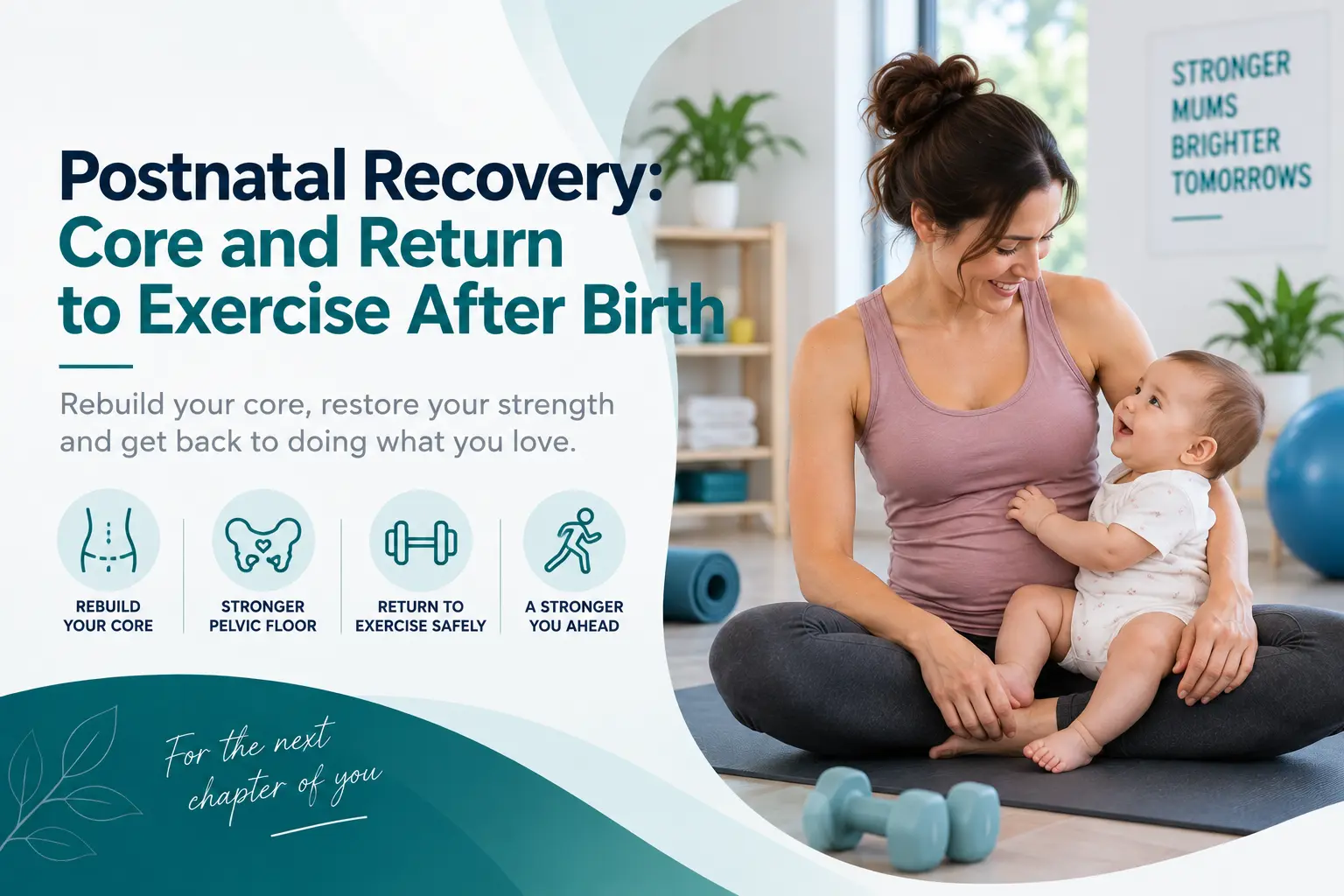
Having a baby is one of the most demanding things a body can do, yet postnatal recovery is often treated as a single appointment at six weeks and a hope that things go back to normal. They can, but not by accident. The abdominal wall has stretched, the pelvic floor has stretched and, if you had a caesarean, healed through surgery, and rebuilding all of that takes a plan.
Postnatal recovery is a graded process of restoring your core, your pelvic floor and your fitness, in that order, and this guide sets out how it works and when it is safe to return to exercise.
The six-week check clears you for daily life, not for high-impact exercise
The most useful thing to understand is what the six-week check actually means. It confirms you are healing well enough for everyday life and, usually, gentle activity, but it is not a green light for running, jumping or heavy lifting. Feeling fine is not the same as being healed: deep tissues recover on their own timeline regardless of how you feel.
This is why sports medicine treats a return to exercise after birth like a return from any significant injury, with the same graduation and rehabilitation rather than a straight jump back to your old routine (RACGP). Rushing it is a common reason women develop leaking, heaviness or back pain months down the track.
Diastasis recti separates the abdominal muscles, and most of it closes over the first year
During pregnancy the two bands of the six-pack muscle drift apart as the connective tissue between them, the linea alba, stretches to make room for the baby. This is diastasis recti, or abdominal separation, and it is normal, not a failing. It is also common and largely self-resolving: separation is present in about 60% of women at six weeks after birth, easing to roughly a third by one year (Sperstad et al., 2016).
The gap itself matters less than how well you can generate tension across it, which is what a physiotherapist assesses and trains, rather than fixating on finger-widths alone. A separation that is not improving by around a year, or that leaves you weak, bulging or in pain, is worth a dedicated assessment rather than continued guesswork at home.
Rebuild the deep core from the inside out, not with crunches
The instinct to attack the postnatal tummy with sit-ups and planks is understandable and usually counterproductive. Those exercises load the midline before it is ready and can make a separation bulge or dome, which sets recovery back.
Real core recovery works from the inside out: first reconnecting the deep abdominal muscle, the transversus, and the pelvic floor and coordinating them with your breath so pressure is managed rather than pushed downward or forward. Only once that foundation holds do you layer on stronger work. Because the pelvic floor is half of this foundation, its own recovery runs alongside, which our guide to pelvic floor physiotherapy covers, and the wider picture of pregnancy care sits in our pregnancy physiotherapy guide.
When to return to running: guidelines advise waiting at least three months
Running, jumping and other high-impact exercise place a heavy, repeated load on a pelvic floor and core that are still recovering, which is why current guidance is to wait at least three months after birth before returning to them, and longer if you have symptoms or a separation.
In the meantime, official advice is to avoid running, sit-ups and heavy weights, and to build up gradually instead (Pregnancy, Birth and Baby). Three months is a floor, not a finish line: the real green light is passing simple load tests, such as being able to hop, jog on the spot and do single-leg work without leaking, heaviness or pain.
A physiotherapist runs these checks so your comeback is built on capacity, not the calendar.
A rough postnatal timeline, from walking to running
Every recovery is individual, so treat this as a map rather than a schedule, and be guided by your body and your physiotherapist.
| Stage | Roughly when | What is usually appropriate |
|---|---|---|
| Early recovery | First 6 weeks | Walking, breathing, and gentle pelvic floor and deep-core activation |
| After the six-week check | From about 6 weeks | Cleared for daily life; build low-impact strength and fitness |
| Return to impact | From about 12 weeks, after checks | Graded return to running and higher-impact exercise once you pass load tests |
If you are an athlete or a keen runner, the same staged logic that guides any return to sport applies here, and easing back into general activity is covered in our safe exercise guide.
| Signs to be checked before you push on Ease off and see a physiotherapist or doctor if, as you build back up, you notice leaking of urine or wind, a feeling of heaviness, dragging or a bulge in the vagina, a visible doming or bulging along the midline of your tummy when you exert, or new pelvic or back pain. These are signs your core and pelvic floor are being loaded faster than they can handle, and they are far easier to address early than to unpick later. Seek prompt medical care for heavy vaginal bleeding, fever, or a hot, painful area in the leg or a caesarean wound. |
Befit Physio guides postnatal recovery in North Kellyville and Carlingford
A postnatal assessment checks your abdominal separation, your pelvic floor and how your core works under load, then turns that into a plan that meets you where you are, whether that is your first weeks at home or a return to the gym or the local running track.
Our physiotherapists provide that postnatal recovery care from our North Kellyville clinic for the Hills and our Carlingford clinic for the surrounding suburbs, with home visits available for the early weeks with a newborn.
- Book an assessment at our North Kellyville clinic or our Carlingford clinic, in the clinic or at home.
- Bring your goal. Whether it is lifting your toddler pain-free or getting back to parkrun, we will build the plan around it.
| Ready to rebuild your core or return to exercise after birth? Call North Kellyville on 02 9624 2047 or Carlingford on 02 9872 2005, or book online. We will assess where you are and map a safe way back. |
Frequently asked questions
When can I start exercising after giving birth?
Gentle movement can start early: walking, breathing and light pelvic floor and deep-core activation in the first weeks, as your recovery allows. The six-week check usually clears you for daily life and low-impact exercise, but not for running or heavy lifting. Building back gradually from that foundation, rather than jumping straight to your old routine, is what makes the return stick.
How soon can I return to running after birth?
Current guidance is to wait at least three months, and longer if you have symptoms or an abdominal separation, because running loads a still-recovering pelvic floor and core. More important than the date is readiness: being able to hop, jog on the spot and do single-leg work without leaking, heaviness or pain. A physiotherapist can run these checks and stage your return so it lasts.
Does diastasis recti go away, and can I fix it?
For most women it improves a great deal on its own over the first year, and it responds well to the right training. What matters most is not the width of the gap but how well you can create tension across it, which deep-core and pelvic-floor rehabilitation builds. A physiotherapist assesses the separation and gives you a program suited to it, rather than generic ab exercises.
Can I do sit-ups or crunches to lose the postnatal tummy?
Not early on. Sit-ups, crunches and full planks load the midline before it is ready and can make an abdominal separation dome or bulge, slowing recovery. The better path is to rebuild the deep core and pelvic floor first, then progress to stronger work once the foundation holds. What looks like stubborn tummy is often a control problem, not a willpower one.
Is it normal to leak urine after having a baby?
It is common, but it is not something you simply have to accept. Leaking signals that the pelvic floor needs rebuilding, and it usually responds well to targeted training. Persistent leaking, or a feeling of heaviness or a bulge, is a clear reason to see a women’s health physiotherapist rather than to push on and hope it settles.
About the author and clinical review
| Author: Anshu Sudan, Principal Physiotherapist, Befit Physiotherapy & Sports Injury Centre. Clinically reviewed by: a physiotherapist at Befit Physio. Carlingford: Shop 2/1 Post Office St, Carlingford NSW 2118. North Kellyville: 15/21 Hezlett Rd, North Kellyville NSW 2155. |
| Medical disclaimer This article is general information, not personal medical advice, and reflects Australian and international guidance current as at July 2026. Every birth and recovery is different. Get clearance from your doctor or midwife before returning to exercise, especially after a caesarean or a complicated birth, and see a physiotherapist for a plan suited to you. Seek prompt medical care for the warning signs above. |