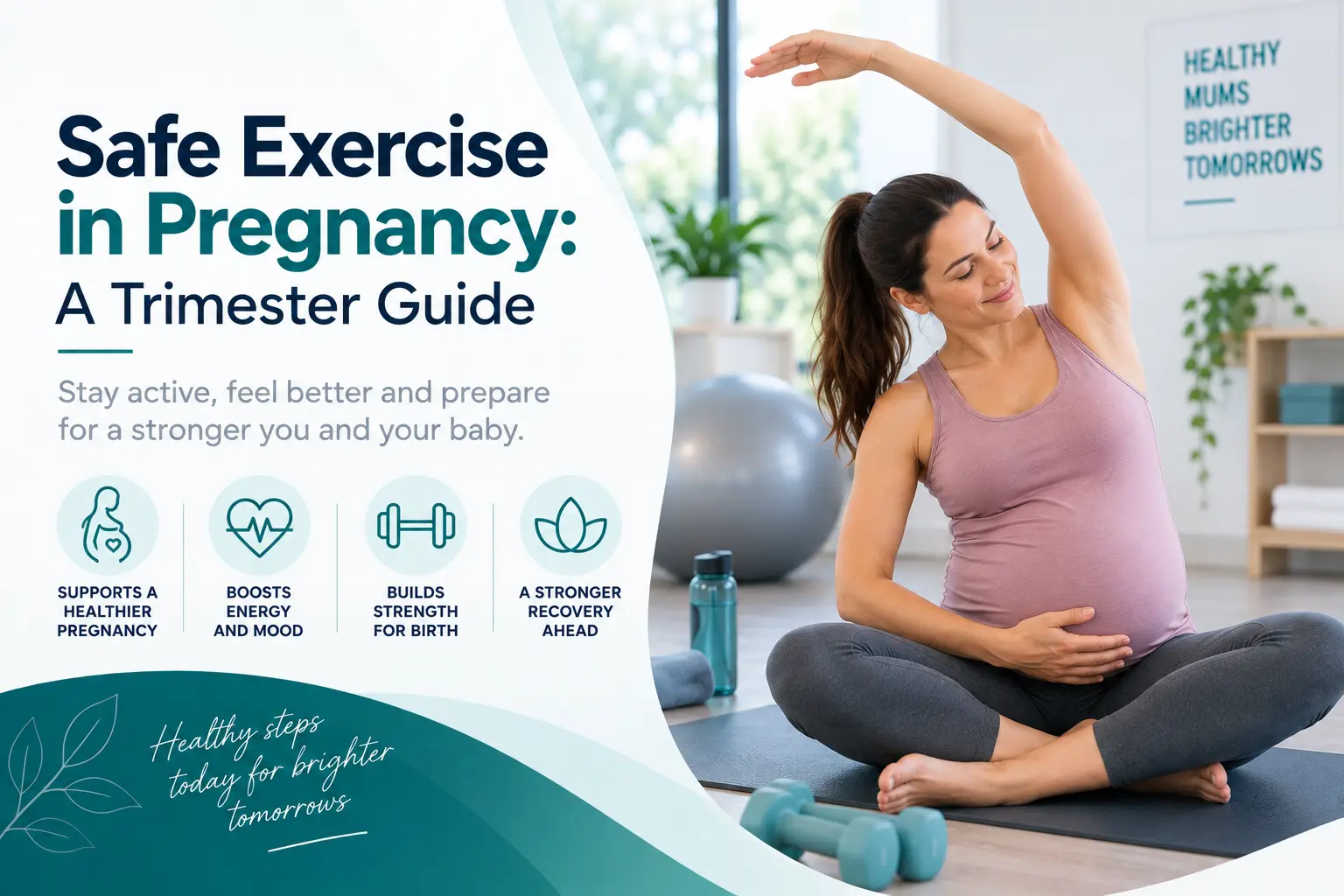
For most women, staying active is one of the best things they can do in pregnancy, not one of the riskiest. Regular movement lifts energy and mood, helps manage weight, and builds the strength that carries you through birth and recovery. The old idea of resting for nine months has been replaced by clear advice to keep moving, sensibly.
As the Royal Women’s Hospital puts it, exercise will not harm your developing baby as long as you exercise at a safe level (Royal Women’s Hospital). This guide explains how much, how hard, and how to adapt your training as your body changes through each trimester.
How much and how hard: 150 to 300 minutes a week at a talk-test pace
Australian guidelines recommend accumulating 150 to 300 minutes, or roughly 2.5 to 5 hours, of moderate-intensity activity across the week, plus muscle-strengthening on at least two days (Australian Government Department of Health).
Spread over most days, that is very achievable: three or four half-hour walks and a couple of light strength sessions will get you there. Intensity is where pregnancy differs. Aim for moderate, judged by the talk test: you should be able to hold a conversation but not sing. If you are too breathless to talk, ease off.
Why exercise helps, from steadier blood sugar to an easier recovery
Beyond feeling better day to day, staying active during pregnancy is linked to lower rates of gestational diabetes, pre-eclampsia and excessive weight gain, and it builds the abdominal, back and pelvic floor strength that supports your growing bump and speeds recovery afterward.
Training the pelvic floor deserves its own attention, which our guide to pelvic floor physiotherapy covers, and the wider picture of staying well sits in our pregnancy physiotherapy guide.
A trimester-by-trimester guide to adapting your training
Your body changes month by month, so what feels right shifts too. This is a guide, not a rulebook; be led by how you feel and by your maternity team.
| Trimester | What is happening | How to adapt your exercise |
|---|---|---|
| First (weeks 1 to 12) | Fatigue and nausea are common; the baby is developing | Keep your usual activity if you feel well, avoid overheating, and rest when you need to |
| Second (weeks 13 to 27) | Energy returns; the bump and centre of gravity start to shift | Avoid exercises lying flat on your back, watch your balance, and swap high-impact for lower-impact options |
| Third (weeks 28 to birth) | The bump is large; joints are looser and balance is harder | Lower the intensity, favour comfort, and focus on walking, water exercise, pelvic floor work and birth preparation |
One specific point is worth flagging: after about 16 weeks, avoid exercising flat on your back, because the weight of the uterus can press on a major blood vessel and leave you light-headed or nauseous.
If back or pelvic pain flares as the bump grows, our guide to pregnancy back and pelvic pain explains how to manage it.
Activities that suit pregnancy, and the ones to sideline
Low-impact, controlled activities are the mainstay. Good options through most of pregnancy include:
- walking and stationary cycling;
- swimming and water exercise, which take the load off your joints;
- prenatal pilates or yoga, for strength, control and breathing;
- light strength training and pelvic floor exercises.
Some activities are best set aside until after birth:
- contact or collision sports and anything with a real risk of tripping or falling, such as horse riding, skiing or gymnastics;
- scuba diving, and exercising in heat such as spas, saunas or hot yoga;
- high-impact activity with twisting, high stepping or sudden stops if it causes joint discomfort.
Strength training deserves its own note, because it is safe and worthwhile in pregnancy but works best with small adjustments. Favour controlled, moderate loads over maximal lifts, and breathe out on effort rather than holding your breath, which spikes downward pressure on the pelvic floor.
Resistance bands, bodyweight moves and supported machines all work well, and as the bump grows you can move away from any exercise that has you lying flat or straining. Good technique matters far more than heavy weight, and a physiotherapist can check yours if you are unsure.
Moderate is a moving target: let your changing body set the pace
Here is the point that a fixed weekly target can hide. Pregnancy is already an aerobic workout, because your heart is enlarging and pumping harder to supply the baby, which narrows the gap between your resting and safe-maximum heart rates.
That means the same run that felt easy before pregnancy is now harder work, so intensity should be judged by how you feel on the day, not by your old numbers. Stay well hydrated, wear light clothing, exercise somewhere cool, and skip your session altogether if you have a fever, because overheating is one of the few exercise-related risks worth taking seriously.
| Warning signs that mean stop and get checked Stop exercising and contact your doctor or midwife if you notice vaginal bleeding, a leak or gush of fluid, regular painful contractions, chest pain, dizziness or faintness, unusual breathlessness, strong pelvic or back pain, calf pain or swelling, or reduced movements from your baby. Some women should not exercise without medical clearance, including those with a low-lying placenta, pre-eclampsia or uncontrolled high blood pressure, and certain other pregnancy conditions (Royal Women’s Hospital). When in doubt, ask before you push on. |
Befit Physio helps you exercise safely through pregnancy in North Kellyville and Carlingford
If you are unsure how to start, how to keep going, or how to modify a routine you love, a physiotherapist can build and adjust a plan for your stage and your health. That is what our support through pregnancy is for, from our North Kellyville clinic for the Hills and our Carlingford clinic for the surrounding suburbs, with home visits available. When it is time to return to exercise after the birth, our postnatal recovery guide takes over.
- Book an assessment at our North Kellyville clinic or our Carlingford clinic, in the clinic or at home.
- Bring your routine. Tell us what you already do, and we will show you how to keep doing it safely.
| Want to stay active safely through your pregnancy? Call North Kellyville on 02 9624 2047 or Carlingford on 02 9872 2005, or book online. We will tailor your exercise to your stage and your body. |
Frequently asked questions
Is it safe to exercise while pregnant, and will it harm my baby?
For most women it is not only safe but recommended, and moderate, regular exercise does not harm a developing baby when done at a safe level. In fact, it lowers the risk of several pregnancy complications. The exceptions are certain medical conditions, such as a low-lying placenta or pre-eclampsia, where you should check with your doctor first before being active.
How much exercise should I do during pregnancy?
Australian guidelines point to a couple of hours or more of moderate activity across the week, spread over most days, plus muscle-strengthening on at least two days. Moderate means you can hold a conversation while you move. If you were inactive before, start slowly and build up; if you were already active, you can usually continue, adapting the intensity as your pregnancy progresses.
What exercises should I avoid in pregnancy?
Avoid contact and collision sports, anything with a real risk of falling such as horse riding or skiing, scuba diving, and exercising in heat like spas or hot yoga. From the middle of pregnancy onward, also avoid exercises lying flat on your back. High-impact activity with twisting or sudden stops is best swapped for lower-impact options if it causes joint discomfort.
Can I keep running or lifting weights while pregnant?
Often yes, especially early on and if you did them before pregnancy, but both usually need adapting. Running may become uncomfortable as the bump grows and the pelvic floor is loaded, and heavy lifting should be scaled back with attention to technique and breathing. A physiotherapist can help you judge when to modify or switch to a gentler alternative rather than stopping altogether.
When should I stop exercising and see a doctor?
Stop and seek advice if you have vaginal bleeding, a leak of fluid, regular painful contractions, chest pain, dizziness, unusual breathlessness, strong pelvic or back pain, calf pain or swelling, or reduced baby movements. These can signal a problem that needs checking. Erring on the side of caution and asking is always the right call in pregnancy.
About the author and clinical review
| Author: Anshu Sudan, Principal Physiotherapist, Befit Physiotherapy & Sports Injury Centre. Clinically reviewed by: a physiotherapist at Befit Physio. Carlingford: Shop 2/1 Post Office St, Carlingford NSW 2118. North Kellyville: 15/21 Hezlett Rd, North Kellyville NSW 2155. |
| Medical disclaimer This article is general information, not personal medical advice, and reflects Australian guidance current as at July 2026. Every pregnancy is different. Talk to your doctor, midwife or a physiotherapist before starting or changing an exercise program, particularly if you have any pregnancy complications, and stop and seek care for the warning signs above. |