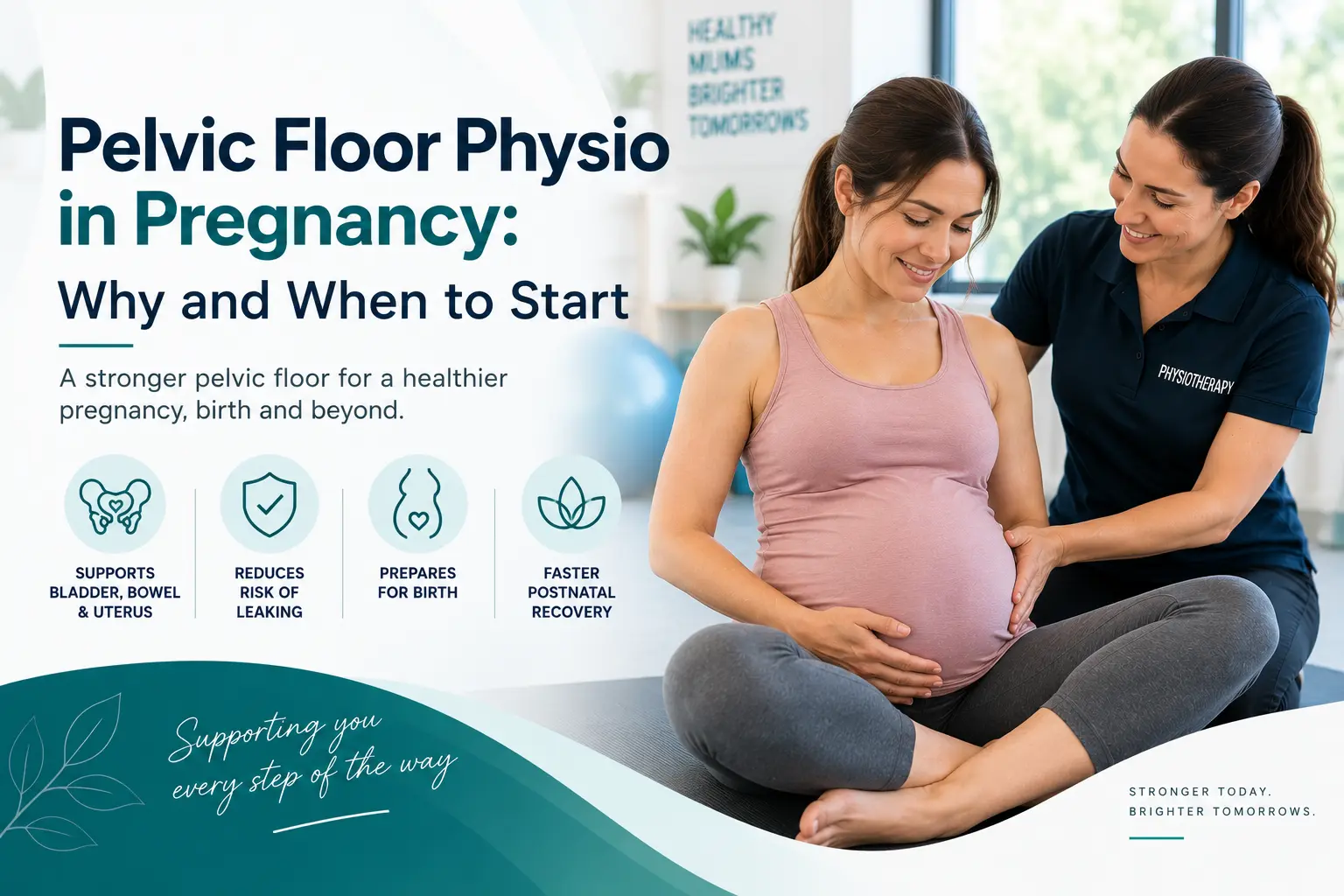
The pelvic floor is the muscular hammock slung across the base of your pelvis, and in pregnancy it becomes one of the hardest-working muscle groups in your body. It holds up a growing baby, keeps your bladder and bowel under control, and then has to stretch to let that baby out.
Pelvic floor physiotherapy in pregnancy trains that muscle group to do all three jobs well, which is why it is quietly one of the most useful appointments an expectant parent can make. Leaking, in particular, is common but not inevitable: almost 4 in 10 women in Australia experience incontinence at some point (Continence Health Australia), and much of it is preventable.
The pelvic floor supports your bladder, bowel and uterus, and pregnancy loads it
These muscles wrap from your pubic bone to your tailbone and support three organs: the bladder, the bowel and, in pregnancy, the uterus. They also close the bladder and bowel openings to keep you continent, and they relax to let you empty, and to give birth. Pregnancy tests every one of those functions, because the baby’s weight presses down on the floor, softened ligaments give it less to anchor to, and birth itself stretches it further.
The broader story of how pregnancy changes the body is in our guide to pregnancy physiotherapy; this article is about the pelvic floor specifically, and why and when to train it. Because these muscles work quietly and out of sight, most of us never think about them until something goes wrong, which is exactly why a little attention during pregnancy pays off later.
Why pregnancy is the time to train the pelvic floor for continence and birth
A well-trained pelvic floor pays off before, during and after birth, in ways that are easy to underrate:
- It protects your continence. Training the pelvic floor during pregnancy lowers the risk of leaking urine, both in late pregnancy and in the early months after birth (Birth Trauma Australia).
- It prepares you for birth. A pelvic floor you can consciously relax and lengthen, rather than only squeeze, gives the baby an easier passage and is part of readying the perineum for delivery.
- It guards against prolapse. Pregnancy and childbirth are the most common causes of pelvic organ prolapse, where an organ such as the bladder bulges into the vaginal wall, and a stronger floor is more resistant to it (healthdirect).
- It speeds your recovery. Knowing how to engage and release the floor before birth makes rebuilding it afterward far quicker.
A strong pelvic floor must also relax: why more Kegels is not always the answer
Here is the point most advice misses. The pelvic floor can be too tight as well as too weak. An over-active, tense pelvic floor is itself a problem: it can cause pelvic pain, difficulty emptying the bladder or bowel, painful sex and, confusingly, leaking, because a muscle held permanently short cannot contract further when you need it to. For birth, that same tightness works against you, since the floor has to lengthen to let the baby through.
This is why blindly doing more squeezes can backfire, and why a physiotherapist assesses whether your pelvic floor needs strengthening, releasing, or better coordination, rather than assuming everyone needs the same thing.
Preparing for birth is as much about letting go as holding on. In the later weeks, a physiotherapist can teach you to lengthen and release the pelvic floor on cue, guide perineal massage to help the tissues stretch, and rehearse birthing positions that take pressure off the floor.
These are practical, learnable skills, and many women say afterward that they wish they had known them before labour rather than working them out during it.
When to start: antenatal training prevents, postnatal rehabilitation restores
You can begin at any stage of pregnancy, and earlier is better because it is preventive. During pregnancy the aim is to learn correct technique, build capacity for the load ahead, and rehearse the relaxation you will use in labour. After birth, the focus shifts to recovery: gently reconnecting with a floor that has been stretched, then rebuilding it as it heals.
Light pelvic floor activation can usually begin soon after birth, while a fuller assessment and a return to impact are generally guided from around the six-week check onward, once you have been cleared.
That postnatal rebuild is part of a wider recovery we cover in our guide to recovering your core after birth, and returning to exercise safely is set out in our safe exercise in pregnancy guide.
What a pelvic floor assessment involves, including the internal examination
Uncertainty about the assessment stops many women booking, so it helps to know what happens. After talking through your history and symptoms, a physiotherapist may offer an internal vaginal examination, which is the most accurate way to assess the pelvic floor because the muscles sit inside the pelvis.
Using a gloved finger, they feel how well the muscles contract, whether they can fully relax, and how they coordinate. Two things matter here:
- It is always your choice. An internal examination is done only with your informed consent, and never during a first visit if you are not comfortable; you can decline and still be assessed.
- There are alternatives. Where an internal exam is not appropriate or not wanted, real-time ultrasound and external techniques can assess the floor instead.
Technique is a large part of the value. Many people squeeze the wrong muscles, holding their breath or tightening the buttocks and stomach while the pelvic floor barely moves, and others never fully let go afterward. Part of the assessment is simply confirming you are activating the right muscles, then coaching the subtle lift-and-squeeze and, just as important, the complete release. Getting this right is what makes every exercise you do at home actually count.
From the findings, your physiotherapist builds a plan that fits your floor, whether that is strengthening, learning to release, or both, with a short home program to practise between visits. Most women need only a handful of sessions, spaced to let the practice take hold, often with a check closer to birth and another once you have recovered.
Signs your pelvic floor may need attention
It is worth booking a check if, during or after pregnancy, you notice any of these:
- leaking urine when you cough, sneeze, laugh, lift or exercise;
- a feeling of heaviness, dragging or a bulge low in the vagina;
- trouble controlling wind or a sudden, hard-to-defer urge to open your bowels;
- pelvic pain, or pain during sex;
- being unable to feel or hold a pelvic floor squeeze at all.
None of these are simply part of pregnancy to put up with, and none are anything to feel embarrassed about. Each is common, and each usually responds well to the right assessment and targeted training.
Befit Physio’s women’s health team assesses the pelvic floor in North Kellyville and Carlingford
You do not need a referral, and you do not need symptoms to benefit, as a preventive check is worthwhile in its own right. Our physiotherapists carry out the assessment, explain what your floor needs, and coach you through it as part of Befit Physio’s pregnancy and pelvic health care, from our North Kellyville clinic for the Hills and our Carlingford clinic for the surrounding suburbs, with home visits available.
- Book an assessment at our North Kellyville clinic or our Carlingford clinic, in the clinic or at home.
- Tell us your stage. Whether you are early in pregnancy, close to birth or recently postpartum, the plan is built around exactly where you are.
| Leaking, heaviness, or just want to prepare your pelvic floor for birth? Call North Kellyville on 02 9624 2047 or Carlingford on 02 9872 2005, or book online. We will assess your pelvic floor and build a plan that fits it. |
Frequently asked questions
Should I see a pelvic floor physio when I am pregnant?
For most women it is worthwhile, even without symptoms. An antenatal check confirms your pelvic floor is working, teaches you to both engage and relax it for labour, and can head off leaking before it starts. If you already notice leaking, heaviness or pain, that is a clear reason to book, because these usually respond well to the right training.
Is an internal examination necessary, and is it common?
An internal vaginal examination is the most accurate way to assess the pelvic floor, so it is commonly offered, but it is never compulsory. It is done only with your informed consent, and you can decline and still be assessed using external techniques or real-time ultrasound. A good physiotherapist explains everything first and works at your pace.
When should I start pelvic floor physio, before or after birth?
Both have a role. Before birth, training is preventive and prepares you for labour, and you can start at any stage. After birth, the focus is recovery, with gentle activation soon after and a fuller assessment usually guided from the six-week check once you are cleared. Seeing the same physiotherapist across both keeps your program consistent.
Can I just do pelvic floor exercises at home instead?
Home exercises help, but many people do them incorrectly, or do the wrong kind entirely, since a tight pelvic floor needs releasing rather than more squeezing. An assessment tells you what your floor actually needs and checks your technique, which makes the exercises you do at home far more effective and avoids reinforcing a problem.
What does a pelvic floor physiotherapy assessment feel like?
It starts with a conversation about your symptoms and history, followed, with your consent, by an assessment of how the muscles contract, relax and coordinate. It is unhurried and led by you. You leave with a clear picture of your pelvic floor and a short, specific plan to work on, rather than generic advice to just do more Kegels.
About the author and clinical review
| Author: Anshu Sudan, Principal Physiotherapist, Befit Physiotherapy & Sports Injury Centre. Clinically reviewed by: a physiotherapist at Befit Physio. Carlingford: Shop 2/1 Post Office St, Carlingford NSW 2118. North Kellyville: 15/21 Hezlett Rd, North Kellyville NSW 2155. |
| Medical disclaimer This article is general information, not personal medical advice, and reflects Australian guidance current as at July 2026. Every pregnancy is different. For an assessment and a plan suited to you, see a physiotherapist, midwife or doctor, and seek prompt care for warning signs such as vaginal bleeding, a sudden heavy vaginal bulge, severe pain, reduced baby movements, or fluid loss. |