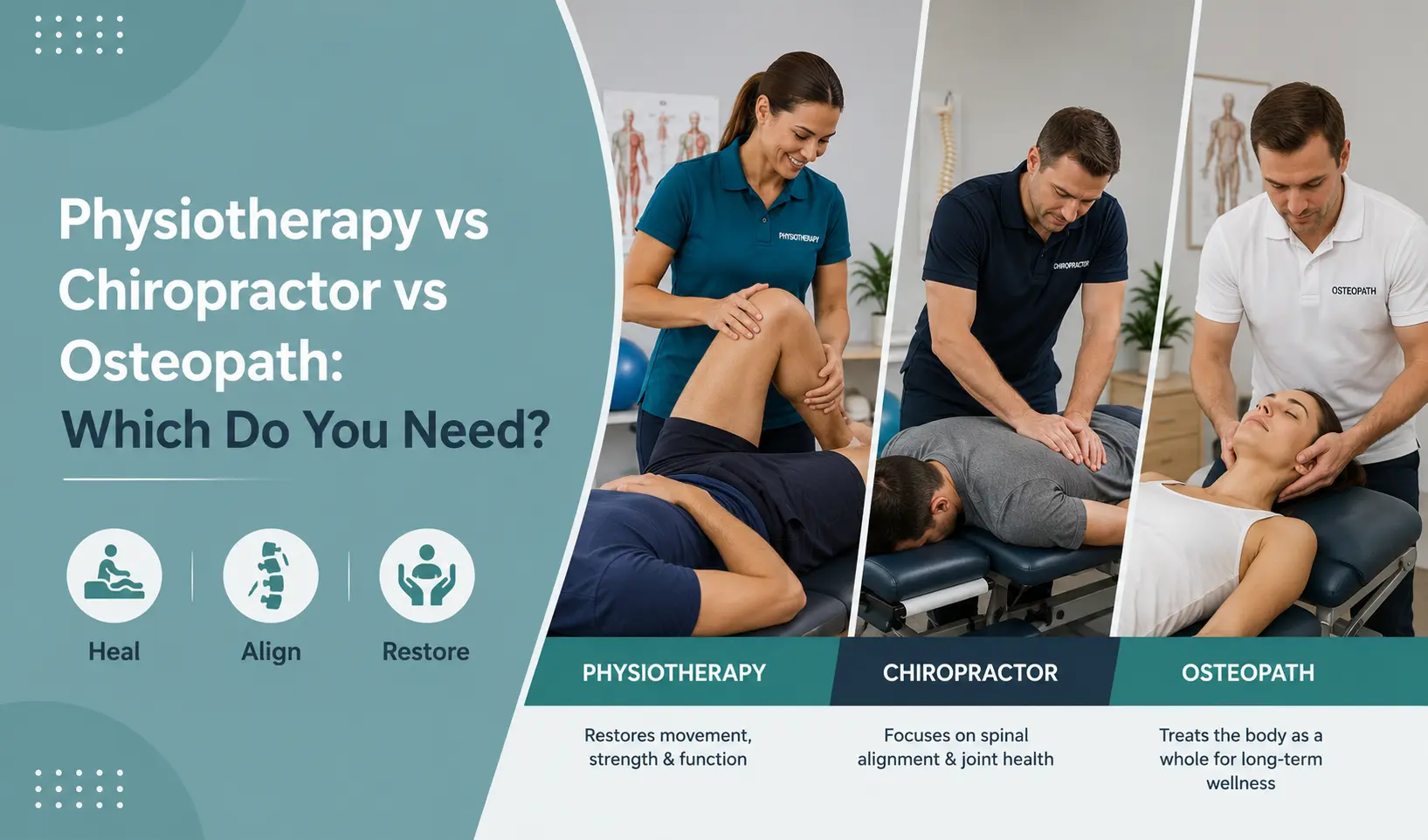
Physiotherapists, chiropractors and osteopaths are all university-qualified and registered with AHPRA, and any of them can help with common aches and pains, so there is no single right choice. The practical difference is focus: physiotherapy centres on movement, exercise and rehabilitation across the whole body; chiropractic centres on the spine and joint mechanics; osteopathy uses whole-body manual techniques. For most everyday musculoskeletal problems, the best pick comes down to your specific issue and whether you prefer a hands-on or an exercise-led approach.
People often shorten these to physio, chiro and osteo, and search for which is better or which to see first. The honest answer is that they overlap more than they differ, and a good practitioner in any of the three will refer you on if your problem sits outside their strength. Below we set out what each one does, how they compare, and a simple way to match the right practitioner to your problem.
Physiotherapy, chiropractic and osteopathy are all AHPRA-registered professions that treat musculoskeletal pain, and none needs a referral to book privately. Physiotherapy leans on exercise and rehabilitation, chiropractic on spinal adjustment, and osteopathy on whole-body manual therapy. Choose by your problem and your preference, not a ranking. All three can be Medicare-subsidised under a GP chronic condition plan.
All three are AHPRA-registered, and none needs a referral to start
In Australia, physiotherapy, chiropractic and osteopathy are each regulated by their own national board under AHPRA, the body that registers health practitioners and sets professional standards. That means every physiotherapist, chiropractor and osteopath you see has met an approved standard of training and is held to national codes of conduct. Physiotherapists register through the Physiotherapy Board of Australia; chiropractors and osteopaths have their own boards under the same scheme.
All three are also primary contact practitioners, so you can book privately without a doctor’s referral. A referral only becomes necessary if you want a Medicare rebate, which we cover further down.
What a physiotherapist focuses on: movement, rehabilitation and the whole body
Physiotherapy is a broad field. Alongside back and neck pain, physiotherapists treat sports injuries, post-surgical recovery, and conditions well beyond the musculoskeletal system, including neurological and cardiorespiratory problems. The emphasis is usually on active, exercise-based care: assessing how you move, finding what drives the problem, then building strength and function with a tailored program, supported by hands-on manual therapy and education. The aim is to treat the cause and reduce the chance of it returning, not only to ease symptoms on the day.
That combination of assessment, diagnosis and staged rehabilitation is the core of the work.
What a chiropractor focuses on: the spine and joint mechanics
Chiropractors specialise in the spine and how joints move. Treatment commonly involves spinal adjustment and manipulation (what many people call having their back or neck adjusted), along with mobilisation, soft-tissue work and exercise advice. Visits are often shorter and more frequent than a physiotherapy course. If your main concern is spinal stiffness or you specifically want hands-on adjustment, a chiropractor is a reasonable place to start.
What an osteopath focuses on: whole-body manual therapy
Osteopaths take a whole-body view of musculoskeletal pain, looking at how muscles, joints, nerves and connective tissue work together rather than treating one spot in isolation. Treatment is largely hands-on, using manipulation, stretching and soft-tissue techniques. In practice the work overlaps a good deal with both physiotherapy and chiropractic, and the differences between individual practitioners can be as large as the differences between the professions.
The three professions compared at a glance
| Feature | Physiotherapy | Chiropractic | Osteopathy |
| Main focus | Movement, exercise, rehabilitation, whole body | The spine and joint mechanics | Whole-body manual therapy |
| Typical techniques | Exercise therapy, manual therapy, education | Spinal adjustment/manipulation, mobilisation | Manipulation, stretching, soft-tissue work |
| Beyond musculoskeletal | Yes: neurological, cardiorespiratory, post-surgical | Primarily spine and musculoskeletal | Primarily musculoskeletal |
| Training | Accredited university degree | Accredited university degree | Accredited university degree |
| AHPRA-registered | Yes | Yes | Yes |
| Referral to book privately | Not required | Not required | Not required |
| Medicare (chronic condition plan) | Yes, with a GP plan | Yes, with a GP plan | Yes, with a GP plan |
| Private health extras | Usually covered | Usually covered | Usually covered |
Registration and boards: AHPRA and the Physiotherapy Board of Australia. Medicare coverage: Services Australia.
Some pain needs a doctor first
Whichever practitioner you consider, certain symptoms need a GP or emergency care before any hands-on treatment. Seek urgent help for loss of bladder or bowel control, numbness around the groin, rapidly worsening weakness in an arm or leg, severe pain after a serious accident, unexplained weight loss with back pain, fever with back pain, or signs of a blood clot. A good physiotherapist, chiropractor or osteopath will screen for these and send you on if needed.
How to choose: match the practitioner to your problem
Rather than asking which profession is best, it helps to ask which approach suits your problem and how you like to be treated. We built this guide from the questions we hear most at reception in Carlingford and North Kellyville. Find your situation, and it points you to the approach that tends to fit.
| Your situation or goal | Approach that often suits | Why |
| Treat the cause and prevent it returning through exercise | Physiotherapy | Exercise-based rehab and movement retraining are physiotherapy’s core focus |
| Recover from surgery, a fracture or a sports injury | Physiotherapy | Physios routinely handle post-operative and sports rehabilitation |
| A neurological, respiratory or complex condition alongside pain | Physiotherapy | Physio training covers neurological and cardiorespiratory care |
| Hands-on spinal treatment and adjustment for stiffness | Chiropractic | Chiropractors focus on the spine and joint function |
| A whole-body manual-therapy approach to muscle and joint pain | Osteopathy | Osteopaths use whole-body manual techniques |
| Unsure, and you want the safest first step | Start with physiotherapy or your GP | A thorough assessment screens for red flags and guides you |
Befit Physiotherapy Practitioner-Match Guide v1.0 · 11 July 2026 · general guidance, not a substitute for advice from your GP. All three professions are AHPRA-registered.
What we tell people who ask us
When someone calls unsure whether to see a physio, a chiro or an osteo, our advice is simple: start with a thorough assessment, from whichever practitioner you trust, and judge it on whether you get a clear explanation and a plan you can follow at home. Good care in any of the three should leave you understanding your problem and less reliant on ongoing visits, not more. If a physiotherapy assessment shows another practitioner would serve you better, we will say so.
Cost is much the same across all three
Money is often the deciding factor, and here the three are treated alike. All of them can be Medicare-subsidised under a GP Chronic Condition Management Plan for people with a chronic condition, up to five shared sessions a year at a $63.40 rebate (Services Australia; MBS item 10960), and private health extras usually cover all three. You can check our physiotherapy fees and rebates for the current figures.
How to book at Befit
- Decide what you want from the visit. For exercise-led rehab and a plan you can follow at home, physiotherapy is a strong first step.
- Book an assessment with our Carlingford physios or with the North Kellyville clinic, online or by phone.
- Bring any relevant history. Scans, past treatment notes, or a GP care plan if you have one help us tailor your program.
Not sure which practitioner you need? Book a one-on-one physiotherapy assessment and we will give you an honest opinion, including whether a chiropractor or osteopath might suit you better. Call Carlingford on 02 9872 2005 or North Kellyville on 02 9624 2047, or book online.
Frequently asked questions
Is a physiotherapist, chiropractor or osteopath better for back pain?
None is automatically better; all three treat back pain and all are AHPRA-registered. Physiotherapy leans on exercise and rehabilitation, chiropractic on spinal adjustment, and osteopathy on whole-body manual therapy. For most back pain, staying active and building strength matters more than the label, so choose by your problem and the approach you prefer.
Do I need a referral to see a physio, chiro or osteo?
No, not to book privately. All three are primary contact practitioners, so you can make an appointment directly. You only need a GP referral if you want a Medicare rebate through a chronic condition management plan. Private health extras generally do not require a referral either.
Can I claim Medicare for a chiropractor or osteopath, not just a physio?
Yes, if you qualify. Physiotherapy, chiropractic and osteopathy are all eligible allied-health services under a GP Chronic Condition Management Plan. That gives up to five subsidised sessions a year, shared across all providers on your plan, at a $63.40 rebate each. Without a chronic condition and a plan, Medicare does not contribute.
What is the difference between a chiropractor and an osteopath?
Chiropractors focus mainly on the spine and joint mechanics, often using spinal adjustment. Osteopaths take a whole-body view, using a wider range of manual techniques across muscles, joints and connective tissue. In practice the two overlap, and the individual practitioner’s style often matters as much as the profession.
Which should I see first if I am not sure?
A physiotherapy assessment, or your GP, is a sensible starting point. A thorough assessment screens for anything serious, explains what is driving your pain, and sets a plan. If another practitioner would suit you better, a good physiotherapist will tell you and refer you on.
About the author and clinical review
| Author: Anshu Sudan, Principal Physiotherapist, Befit Physiotherapy & Sports Injury Centre. Clinically reviewed by: a Befit physiotherapist. Carlingford: Shop 2/1 Post Office St, Carlingford NSW 2118. North Kellyville: 15/21 Hezlett Rd, North Kellyville NSW 2155. |
| Medical disclaimer This article is general information, not personal medical advice, and reflects the position as at July 2026. It describes how the three professions differ in general terms; individual practitioners vary, and the right care depends on your circumstances. Medicare rules and rebate amounts are indexed and can change, so confirm current details with your GP, the clinic, or Services Australia. If you have severe or rapidly worsening symptoms, seek urgent medical care. |