A herniated or bulging disc sounds alarming, but the outlook is genuinely good: most people recover without surgery. Pooled research shows that around two in three herniated discs shrink on their own with non-surgical care (resorption review, 2022), and physiotherapy is the recommended first-line treatment.
This guide explains what a disc herniation actually is, why it presses on a nerve, how long recovery takes, and how physiotherapy helps you get there safely.
A herniated disc, also called a slipped, prolapsed or ruptured disc, is not the same as a bulging disc, though the two are often confused. Both can cause back pain and, when they press on a nearby nerve, pain, numbness or tingling down a leg or arm. The good news is that the same active, evidence-based approach helps both.
A herniated disc is when the soft centre of a spinal disc pushes through its outer wall and can press on a nearby nerve root, causing back pain and often leg pain. Most recover within a few weeks to a few months without surgery, and many herniations shrink on their own over time.
Physiotherapy, built on movement, exercise and education, is the recommended first-line treatment; surgery is reserved for a small number of severe cases.
A spinal disc is a cushion between the bones of your spine, with a tough outer ring (the annulus) and a soft, jelly-like centre (the nucleus). A bulging disc pushes outward beyond its normal border, while a herniated disc is when the soft centre pushes through a tear in the outer ring.
What a herniated disc is, and how it differs from a bulge
Your spine has a disc between each pair of vertebrae, acting as a shock absorber. Each disc has two parts: the annulus fibrosus, a tough outer ring of cartilage, and the nucleus pulposus, a soft gel-like core. A bulging disc is when the disc flattens and spreads beyond its normal edge, a bit like a tyre under load. It is extremely common and often causes no symptoms at all.
A herniated disc goes a step further: the gel-like core pushes through a crack in the outer ring. It is the herniation, and the inflammation around it, that can irritate a nearby nerve.
How a herniated disc compresses a spinal nerve root
The reason a disc problem can send pain down your leg is anatomy. Spinal nerve roots exit the spine right beside each disc. When a disc herniates, the displaced material and the inflammation around it can compress or irritate a nerve root, and that nerve carries signals to and from the leg or arm.
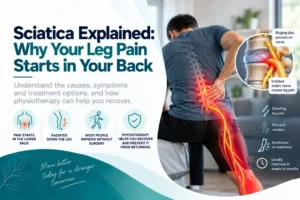
The result is often radiating pain, numbness, pins and needles, or weakness along the path of that nerve, rather than pain only in the back. When a lower-back disc presses on the sciatic nerve pathway, the leg pain that follows is what most people call sciatica.
Why a disc diagnosis is less alarming than it sounds
Here is something that surprises most people: disc bulges and herniations are extremely common in people with no back pain at all. A large systematic review of pain-free adults found that these changes are, to a great extent, a normal part of ageing rather than a guarantee of pain.
| Imaging finding | Pain-free people aged 20 | Pain-free people aged 80 |
| Disc bulge | 30% | 84% |
| Disc protrusion (herniation) | 29% | 43% |
| Disc degeneration | 37% | 96% |
Source: Brinjikji et al., systematic review of imaging in asymptomatic people, American Journal of Neuroradiology 2015 (3,110 people without back pain).
This matters because a scan showing a bulging or herniated disc does not, on its own, explain your pain or predict how you will recover. It is one piece of the picture. That is why physiotherapists assess your movement and symptoms, not just your imaging, and why a disc finding is rarely a reason to panic or to rush into surgery.
Most herniated discs recover without surgery
The body is remarkably good at healing a disc herniation. Pooled data across multiple studies found that around two in three lumbar disc herniations resorb, meaning the herniated material shrinks or is reabsorbed over time, with conservative (non-surgical) treatment (resorption review). Clinically, many people feel substantially better within a few weeks to two or three months, even though the disc itself may take longer to change on a scan. Guidelines put active, non-surgical care first (Low Back Pain Clinical Care Standard), reserving surgery for the minority who have severe or progressive nerve problems or pain that does not settle.
Rare, but urgent: signs to act on immediately
A very small number of disc problems press on the bundle of nerves at the base of the spine and need emergency care. Seek urgent medical help straight away if you have loss of bladder or bowel control, numbness around the groin, buttocks or inner thighs, or weakness spreading in both legs. Sudden or severe weakness such as a dropping foot also needs prompt review. These are red flags, not physiotherapy problems
How physiotherapy helps you recover
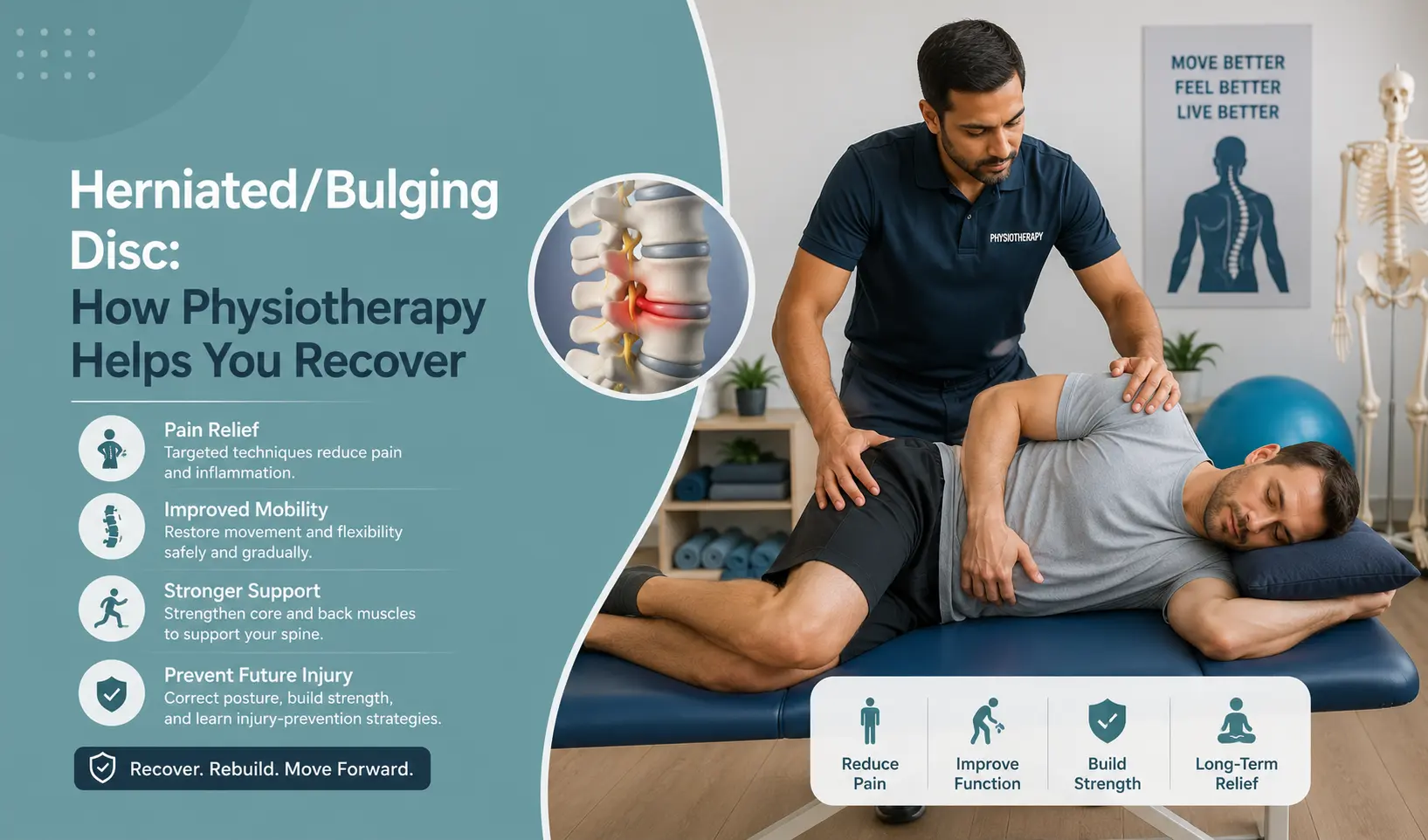
Physiotherapy for a disc herniation is not about forcing the disc back into place, which is a myth. It works by calming the irritated nerve, restoring movement, and rebuilding the strength and control that protect your spine. In the early days, that means pain relief, gentle movement and positions that ease your leg pain, along with nerve-gliding exercises and clear advice about staying active. As symptoms settle, treatment progresses to graded strengthening and a return to the activities that matter to you.
Throughout, education does a lot of the work: understanding that the disc is healing and that movement is safe reduces fear, and less fear means less pain and faster recovery. You can see how our physiotherapy for back and neck pain is structured across a course of care.
Your disc recovery, stage by stage
Recovery from a disc herniation follows a fairly predictable path, and knowing the stages makes the journey far less worrying. This roadmap sets out what is happening, what physiotherapy does, and what you can do at each point. A downloadable copy is attached to this article.
| Stage | What is happening | What physiotherapy does | What you do |
| Acute (weeks 0 to 6) | Inflammation around the disc and nerve causes the worst pain, often into the leg | Settle pain, protect the nerve, gentle movement and nerve glides, advice | Keep gently active, avoid bed rest, use positions that ease leg pain |
| Recovery (weeks 6 to 12) | Pain eases as inflammation settles and the disc begins to resorb | Progressive strengthening, movement retraining, graded return to activity | Build up exercise and daily activity steadily |
| Rebuilding (months 3 to 6) | Most people are much better; many herniations shrink over months | Strength, load tolerance, return to sport or heavier work | Keep up your program and normal activity |
| Persistent (beyond 6 months) | A minority have ongoing symptoms | Reassessment and options, including specialist referral if needed | Stay active and avoid fear of movement |
Befit Disc Recovery Roadmap v1.0 · 11 July 2026. Based on healthdirect and peer-reviewed evidence on disc resorption. General guidance, not a substitute for individual assessment.
When surgery is considered
Surgery has a role, but a limited one. It is generally considered only when there is severe or progressive nerve weakness, the emergency red-flag signs above, or leg pain that remains disabling after a genuine trial of conservative care.
For most people, a course of physiotherapy and time achieves a good result without an operation, which is why guidelines and surgeons alike usually recommend trying non-surgical care first. If your recovery stalls, your physiotherapist can help coordinate the right referral rather than leaving you to navigate it alone.
Start your recovery at Befit
- Get assessed. A physiotherapist can confirm what is driving your symptoms and check for anything that needs a doctor.
- Book an assessment with our Carlingford physios or the North Kellyville clinic, online or by phone.
- Follow your staged plan. Most people improve steadily with the right exercises and advice.
Worried about a disc? Book a one-on-one assessment online, or call Carlingford on 02 9872 2005 or North Kellyville on 02 9624 2047. We will explain your diagnosis in plain terms and start you on a recovery plan that suits your stage.
Frequently asked questions
Can a herniated disc heal on its own?
Yes, most do. Herniated discs commonly shrink or resorb over time with non-surgical care, and many people feel much better within a few weeks to a few months. Physiotherapy supports this natural recovery by easing symptoms and restoring movement and strength.
What is the difference between a bulging disc and a herniated disc?
A bulging disc spreads beyond its normal border but stays intact, and is very common and often painless. A herniated disc is when the soft centre pushes through a tear in the outer ring. A herniation is more likely to irritate a nearby nerve, but both respond to the same active physiotherapy approach.
How long does a herniated disc take to recover?
Many people improve substantially within a few weeks to two or three months, though the disc itself can take longer to change on a scan. Recovery is usually staged: settle the pain, restore movement, then rebuild strength. Staying active and following your program speeds things up.
Should I rest or stay active with a disc herniation?
Stay gently active. Prolonged bed rest tends to slow recovery. Early on you may favour positions that ease your leg pain, but the aim is to keep moving within comfort and gradually build up. Your physiotherapist will guide how much and what kind of activity suits your stage.
Do I need a scan or surgery for a herniated disc?
Usually neither. Scans often show disc changes that are common even in pain-free people, so they rarely change early treatment. Surgery is reserved for severe or progressive nerve problems, the emergency red flags, or pain that does not settle after proper conservative care.
About the author and clinical review
| Author: Anshu Sudan, Principal Physiotherapist, Befit Physiotherapy & Sports Injury Centre. Clinically reviewed by: a Befit physiotherapist. Carlingford: Shop 2/1 Post Office St, Carlingford NSW 2118. North Kellyville: 15/21 Hezlett Rd, North Kellyville NSW 2155. |
| Medical disclaimer This article is general information, not personal medical advice, and reflects the evidence as at July 2026. A disc herniation should be assessed individually, and symptoms vary from person to person. If you have any of the red-flag symptoms above, seek urgent medical care. Speak with your GP or physiotherapist before starting new exercises if you are unsure. |