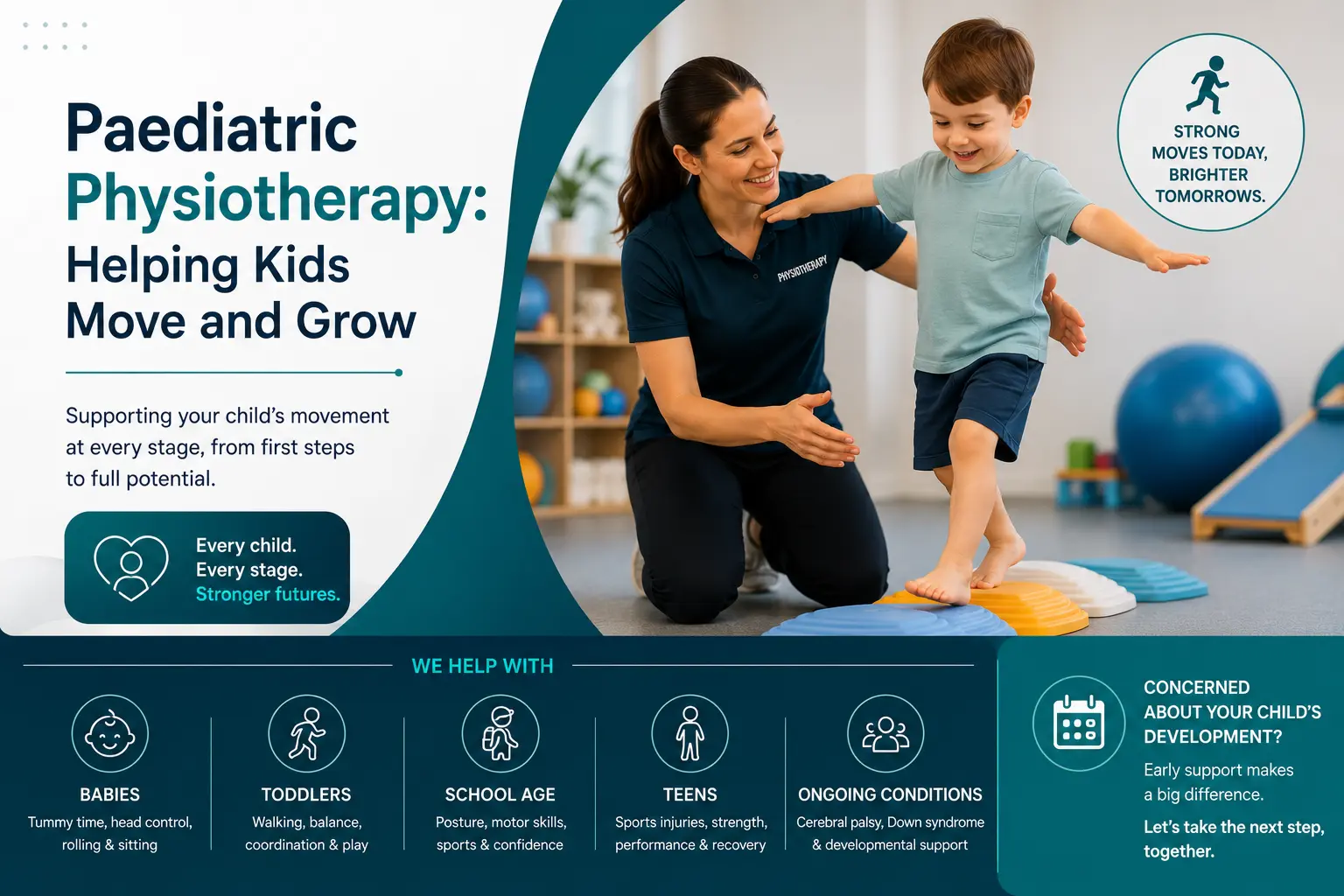
Watching your child learn to roll, crawl and walk is one of the quiet joys of parenting, and also, sometimes, a quiet worry. Are they on track? Should that head tilt have settled by now? Is toe-walking a phase or a problem? Paediatric physiotherapy supports a child’s movement development, from the first weeks of life through the teenage years, and a big part of its job is helping families tell an ordinary variation from something worth a closer look.
Children are not small adults. Their bodies are still building the strength, balance and coordination that adults take for granted, so a children’s physiotherapist works quite differently to one treating a sore back. The aim is not just to fix a problem but to help a child move confidently and join in, at home, in the playground and in sport.
What paediatric physiotherapy is
A paediatric physiotherapist is a university-trained health professional who specialises in children, from newborns through to adolescents. Rather than working alone, they often team up with your GP, child health nurse, occupational therapists, speech pathologists and teachers, so care fits the whole child (Raising Children Network). In Australia every physiotherapist must be registered with the national health practitioner regulator, so you can be confident they are qualified to work with your child.
What it helps with, stage by stage
Children see a physiotherapist for very different reasons at different ages. This table shows the common ones and how physiotherapy tends to help.
| Stage | Why families often come | How a physiotherapist helps |
|---|---|---|
| Babies (0 to 12 months) | Head tilt, a flattened head shape, trouble with tummy time, or not rolling or sitting yet | Gentle positioning, stretches and play to build head control and even, symmetrical movement |
| Toddlers and preschoolers | Late walking, walking on the toes, frequent falls, or floppy, low-tone movement | Play-based activities that build strength, balance and steady, confident walking |
| School-age and teens | Coordination difficulty, growth-related aches, or a sports injury | Coordination and strengthening work, and a safe, staged return to activity |
| Ongoing conditions | Cerebral palsy, Down syndrome and other developmental conditions | Longer-term support for movement, function and independence, alongside other therapists |
Physiotherapists also help children with issues like scoliosis, and with recovery after illness or surgery. Every child is different, so an assessment is what tailors the plan.
A different pace is not the same as a delay
| All babies grow and develop at their own pace, but missing a milestone beyond the usual age may be a sign that your child needs extra support. healthdirect, Developmental milestones in babies and children |
The most useful idea for any worried parent is this: children reach milestones in the same order but not at the same time. One baby walks at ten months and another at fifteen, and both are perfectly normal. What matters is not hitting a date exactly, but whether skills keep building over time. A physiotherapist or child can help you see the difference between a child moving at their own pace and one who could use some extra support, which is where early help is worth the most.
| Movement milestones: when a chat with your GP or child health nurse makes sense These are gentle prompts to check in, not diagnoses. It is worth a conversation if your child:
Regular checks with a doctor or child health nurse help pick up any delay early, when support works best. |
Movement signs adapted from healthdirect’s developmental milestones. If you are ever unsure, your GP or child health nurse is the right first call.
Common worries that often settle on their own
Plenty of things that look alarming are, in fact, ordinary stages of a growing body. It helps to know which usually sort themselves out and which are worth a check.
- Toe-walking. Common in early walkers and often outgrown. Worth checking if it is only on one side, persists past early childhood, comes with tight calves so the heels cannot reach the floor, or with any pain.
- In-toeing and out-toeing. Pigeon-toed or turned-out feet usually improve as a child grows. A check makes sense if it is worsening, only on one side, or causing frequent tripping or pain.
- Flat feet. Normal in young children, whose arches are still forming. Assessment helps if there is pain, or if walking or running seems affected.
- W-sitting. Common and usually fine in short bursts; worth mentioning if your child cannot sit comfortably any other way.
The through-line is simple: a variation that is settling, painless and getting better with time is usually fine to watch, while one that is one-sided, painful, going backwards or not improving is worth a professional look.
What a children’s physio session actually looks like
If you are picturing a clinical, serious appointment, relax. For children it usually looks like play. A physiotherapist watches how your child moves, then uses games, obstacle courses and toys to work on the exact skills that need building, so your child is having fun while they progress. You are part of it too: paediatric physiotherapists want parents involved, and will send you home with simple activities to weave into everyday life. The underlying process is the same careful assessment, reasoning and tailored treatment that guides all good physiotherapy, just delivered at a child’s level.
Getting started, and how it is funded
You do not need a GP referral to see a physiotherapist in Australia, so you can book directly if you have a concern. That said, your GP or physio is a good place to start if you are unsure.. Depending on your child’s situation, support may be available through the NDIS or, for eligible chronic conditions, Medicare, and some physiotherapists offer home visits when getting to a clinic is hard.
Meet the team at Befit
Choosing someone to help your child is a matter of trust as much as skill. You are welcome to get to know our physiotherapy team before you book, and to bring your questions along; our clinics in Carlingford and North Kellyville are set up to make young patients feel at ease.
- Book an assessment at our Carlingford clinic or our North Kellyville clinic, with home visits available where needed.
| Worried about your child’s movement? Call Carlingford on 02 9872 2005 or North Kellyville on 02 9624 2047, or book online. We will listen, assess, and tell you honestly whether it is simply your child’s pace or worth a closer look. |
Frequently asked questions
At what age should my child be walking, and when is late walking a concern?
Most children walk somewhere between about twelve and eighteen months, and a wide spread is completely normal. It is worth a chat with your GP or child health nurse if your child is not walking or trying to walk by around eighteen months, or if other skills are not building alongside it. Late walking on its own is often just pace, not a problem.
Is toe-walking something to worry about?
Usually not in early walkers, as many children try it and grow out of it. It is worth having checked if the toe-walking is only on one side, continues well past the toddler years, comes with tight calf muscles so the heels cannot reach the floor, or with any pain. A physiotherapist can tell whether it needs treatment or simply time.
Do I need a referral to take my child to a physiotherapist?
No. In Australia you can book a physiotherapist directly without a GP referral. A referral is only needed for particular funding pathways, such as a Medicare care plan or some insurance and NDIS arrangements. If you are unsure whether your child needs to be seen, your GP or child health nurse can help you decide.
What happens in a paediatric physiotherapy session?
It mostly looks like play. The physiotherapist observes how your child moves, then uses games and activities to build the specific skills that need work, keeping your child engaged and comfortable. Parents are involved throughout and usually go home with simple activities to practise, because steady progress happens between appointments as much as during them.
Can physiotherapy help a baby with a flat head or a head tilt?
Often, yes. A persistent head turn or tilt, sometimes called torticollis, and the flattening of the head shape that can go with it, frequently respond well to positioning, gentle stretches and tummy-time strategies, especially when started early. If you notice your baby always turning their head one way, it is worth raising with your health professional sooner rather than later.
About the author and clinical review
| Author: Anshu Sudan, Principal Physiotherapist, Befit Physiotherapy & Sports Injury Centre. Clinically reviewed by: a Befit physiotherapist. Carlingford: Shop 2/1 Post Office St, Carlingford NSW 2118. North Kellyville: 15/21 Hezlett Rd, North Kellyville NSW 2155. |
| A note for parents This article is general information, not personal medical advice or a diagnosis, and reflects trusted Australian guidance as at July 2026. Every child is different. If you have concerns about your child’s development or movement, speak with your GP, child health nurse or a physiotherapist, who can assess your child individually. Seek prompt medical care if your child loses skills they previously had, or if you are worried about their health. |