Almost anyone who has seen someone about a sore back, a dodgy knee or a niggling injury has been told to “strengthen your core.” It is good advice that is easy to get wrong, because the core is not a six-pack to be crunched into shape, and bolting on a generic class can sometimes stir up the very problem you are trying to settle.
This is the gap Clinical Pilates is built to fill. It takes the controlled, low-impact movements people recognise from Pilates and puts them in the hands of a physiotherapist, so the exercises are chosen for your body and your injury rather than for a room full of strangers.
Understanding what makes it “clinical,” and being honest about what it can and cannot do, is the difference between it being a genuinely useful rehab tool and an expensive guess.
What makes Pilates “clinical”: a physiotherapist, not just an instructor
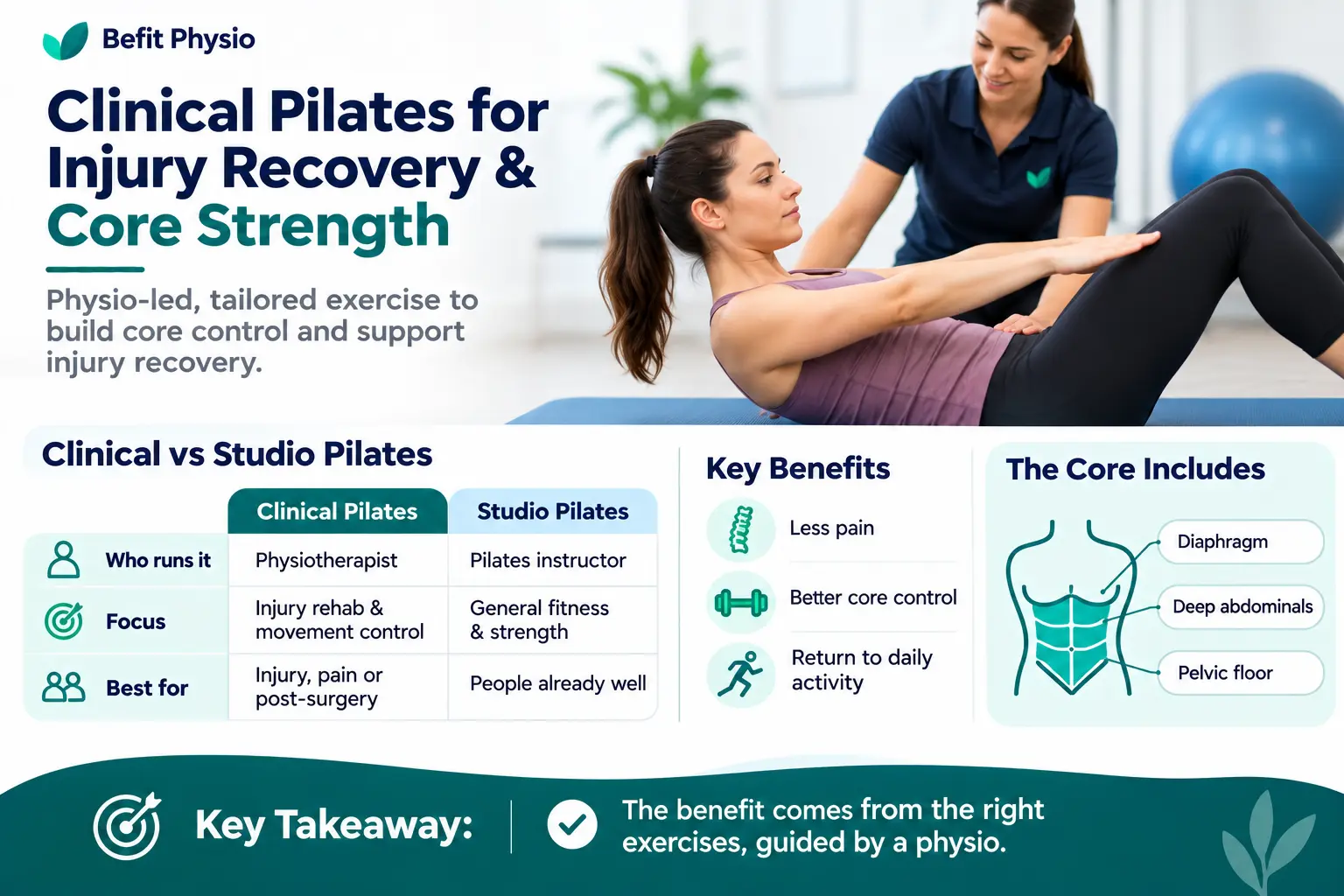
The word “clinical” is doing a lot of work here, and it is the key to the whole idea. Ordinary studio Pilates is a group fitness class led by a certified instructor, working through a standard repertoire on a mat or a reformer. Clinical Pilates is prescribed and supervised by a physiotherapist and starts from an assessment of your movement, not a class timetable.
A physiotherapist looks at how you move, where your pain is triggered and which muscles are not pulling their weight, then selects and grades specific Pilates-based exercises to target exactly that. Same family of movements, very different starting point: one is built around general fitness, the other around your diagnosis. That is why it sits inside a rehabilitation plan rather than alongside it.
Clinical versus studio Pilates: where they part ways
Both can be worthwhile, and neither is “better” in the abstract; they are aimed at different jobs. The distinction matters most when you are recovering from an injury, where individual tailoring counts.
| Clinical Pilates | Studio / fitness Pilates | |
|---|---|---|
| Who runs it | A physiotherapist or under their direct supervision | A certified Pilates or fitness instructor |
| Starting point | An individual movement and injury assessment | A general class or fitness intake |
| The program | Tailored to your symptoms, graded as you progress | A standard group repertoire for all levels |
| Main goal | Motor control, pain management and injury recovery | General strength, flexibility and fitness |
| Best suited to | People in pain, post-injury or post-surgery | People already well who want a workout |
If you are fit and simply want to move well, a good studio class is fine. If a specific injury or a persistent pain is the reason you are considering it, the tailoring is the point, and that is what the clinical version adds.
The “core” is deeper than a six-pack: the muscles it retrains
When physiotherapists talk about the core, they do not mean the showy outer abdominals. They mean the deep layer that works quietly to stabilise the spine and pelvis: the transversus abdominis that wraps around the trunk like a corset, the multifidus running alongside the spine, the pelvic floor below and the diaphragm above. Together these form a kind of internal cylinder, and in many people with back pain the problem is not that these muscles are weak so much as that they fire at the wrong time or not quite when needed.
Clinical Pilates is really a form of motor control training, teaching this deep system to switch on and coordinate smoothly during movement, which is why the focus is on precision and breathing rather than on grinding out repetitions.
Worth clearing up a common myth: the goal is not to brace your stomach hard all day. A tense, permanently clenched core is its own problem; what you are after is control that comes on when you need it and relaxes when you do not.
What the evidence actually says, and what it does not
Here is where honesty matters more than hype. Pilates-based exercise genuinely helps people with ongoing low back pain, reducing pain and disability and improving function compared with doing little or nothing. What the research does not show is that it is magic. When an individualised clinical Pilates program is compared head to head with other well-designed exercise, the two tend to produce similar improvements in pain, disability and quality of life (clinical Pilates versus general exercise trial).
The sensible takeaway is that the benefit comes from doing the right exercise consistently and under good guidance, not from the Pilates brand itself. That is reassuring rather than disappointing: it means the value of the clinical version lies in the assessment, the tailoring and the supervision that make sure you are doing the right exercise at the right dose.
For persistent back pain in particular, it slots neatly alongside the broader non-surgical approaches to lasting back pain, and the simple daily habits in our tips for easing lower-back pain sit comfortably underneath it (overview of Pilates in rehabilitation).
Where clinical Pilates earns its place in injury recovery
Because the loading is gentle, controlled and easy to grade, clinical Pilates is especially useful in the stages of recovery where heavier training would be too much. A physiotherapist will often reach for it when someone is:
- Rebuilding after a back or neck episode, where confident, controlled movement needs to be restored before heavier loading.
- Recovering from surgery or a significant injury, when a low-impact, closely supervised start is safer than jumping back into the gym.
- Pregnant or newly postnatal, when the deep core and pelvic floor need gentle, specific retraining.
- Older or deconditioned, and needing to build strength, balance and confidence at a manageable pace.
At Befit Physio, this thinking runs through our physio-led Exercise to Be Fit classes, which are designed by physiotherapists and draw on Pilates techniques, with your program reassessed and adjusted as you improve rather than left on repeat. A physiotherapist decides when Pilates-based work is the right next step and when something else, such as progressive strength work, will serve you better, so it is one tool in a plan rather than the whole plan.
What clinical Pilates is not: the honest limits
For all its usefulness, clinical Pilates is not a cure-all, and overselling it does no one any favours. It will not, on its own, rebuild the high loads a sprinter’s hamstring or a jumper’s knee needs to tolerate, which take dedicated, heavier strengthening. It does not fix a problem that is really about footwear, training load or technique, and it is not a reason to avoid getting a painful injury properly diagnosed first.
Think of it as an excellent way to restore control, confidence and a stable base, often early in a recovery or as a long-term habit that keeps you resilient, rather than as the single answer to every ache. Used for the right person at the right stage, it is a genuinely valuable part of rehabilitation; used as a one-size-fits-all fix, it disappoints.
Starting clinical Pilates with Befit Physio in North Kellyville and Carlingford
If you are weighing up Pilates to recover from an injury or to build a steadier core, the most useful first step is an assessment, so the exercises are matched to your body rather than guessed at.
Our physiotherapists can tell you honestly whether Pilates-based work is the right fit for where you are, and build it into a wider plan if it is. You can start with our North Kellyville physiotherapists or at our Carlingford clinic, in the clinic or at home.
| Thinking about Pilates for recovery or core strength? Book a one-on-one assessment online, or call North Kellyville on 02 9624 2047 or Carlingford on 02 9872 2005. We will check what suits you and build it into your plan. |
Frequently Asked Questions
Is clinical Pilates worth it for injury recovery?
For the right person at the right stage, yes. Its strengths are controlled, low-impact movement and individual tailoring, which make it well suited to the phases of recovery where heavier training would be too much, such as after a back episode or surgery. The value comes from the physiotherapist matching the exercises to your injury and progressing them as you improve, rather than from Pilates itself being uniquely powerful. For a straightforward problem that needs heavy strengthening, it may be only part of the plan.
Does clinical Pilates work for back pain?
It helps. Pilates-based exercise reduces pain and disability in people with ongoing low back pain compared with little or no activity, and it improves function and confidence with movement. Head to head, it performs about as well as other well-designed exercise programs, so the benefit lies in doing the right exercise consistently under guidance. For persistent back pain, a physiotherapist will usually fold it into a broader plan rather than relying on it alone.
What is the difference between clinical Pilates and reformer Pilates?
They are not opposites. “Reformer” refers to the spring-loaded apparatus the exercises are done on, and both clinical and studio Pilates can use it or a simple mat. The real difference is who is running it and why: clinical Pilates is prescribed by a physiotherapist from an assessment and aimed at your specific injury, while a general reformer class is a group fitness session on the same equipment. The apparatus matters less than the tailoring.
Do I need to be fit or flexible to start?
No. Clinical Pilates is scaled to you, which is much of the point. Exercises can be pitched very gently for someone in pain, recovering from surgery or deconditioned, and made harder only as you cope, so you do not need existing strength or flexibility to begin. A physiotherapist sets the starting level from your assessment, which is safer than walking into a general class pitched at the room’s average.
How many sessions before I notice a difference?
It varies with the problem and how consistent you are, but many people feel more in control of their movement within a handful of sessions, with strength and confidence building over the weeks that follow. Like any exercise-based rehabilitation, the gains come from steady practice rather than a quick fix, and keeping some of it going once you feel better is what tends to hold the improvement in place.
About the author and clinical review
| Author: Anshu Sudan, Principal Physiotherapist and owner, Befit Physiotherapy & Sports Injury Centre (Masters of Physiotherapy, APA member). Clinically reviewed by: a physiotherapist at Befit Physio. North Kellyville: 15/21 Hezlett Rd, North Kellyville NSW 2155. Carlingford: Shop 2/1 Post Office St, Carlingford NSW 2118. |
| Medical disclaimer This article is general information, not personal medical advice, and reflects current evidence as at November 2026. Pain and injuries have several possible causes, so see a physiotherapist or doctor for an individual assessment before starting a new exercise program, including Pilates. Stop and seek advice if an exercise sharply increases your pain, and have any undiagnosed or worsening injury assessed first. |