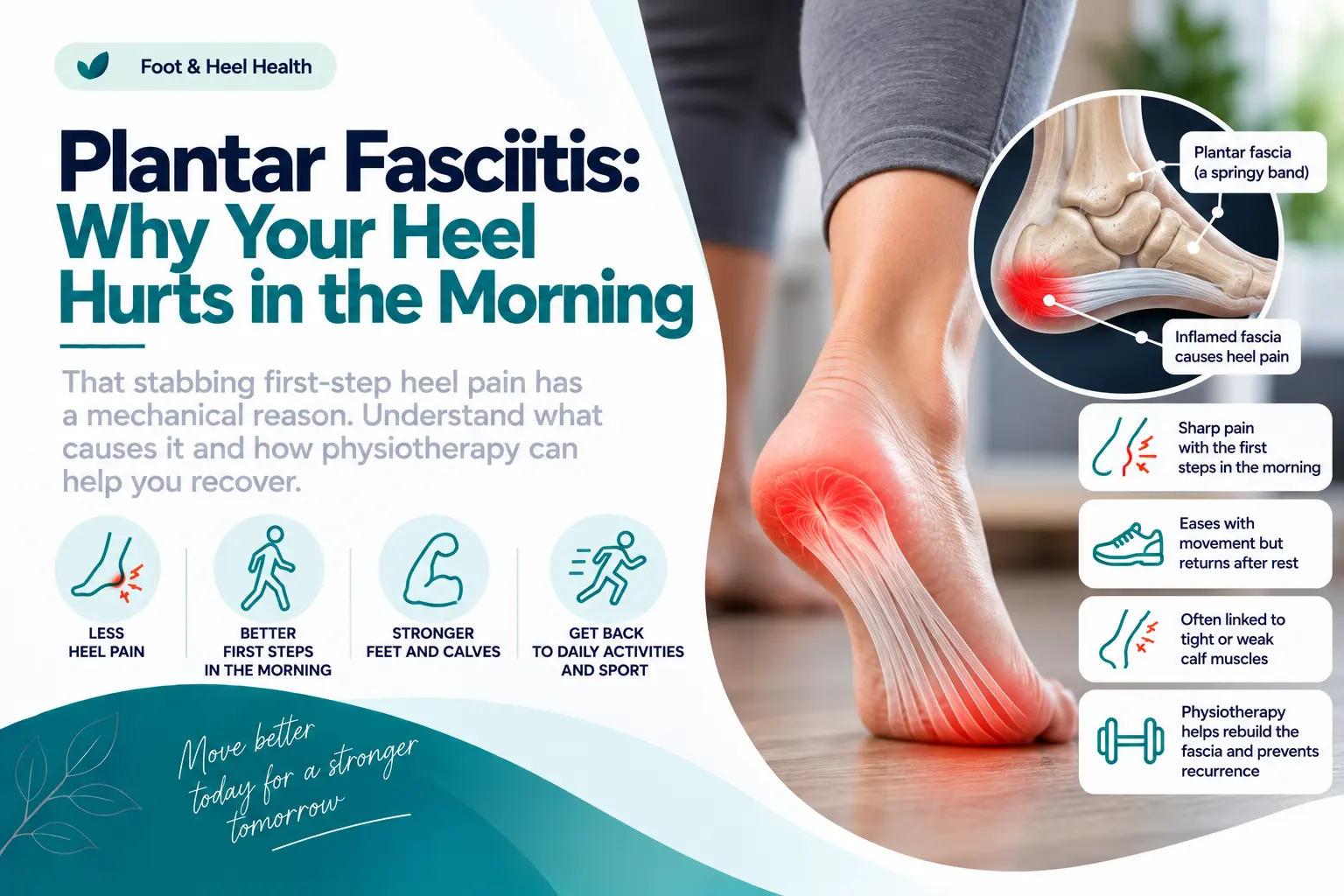
You know the feeling before your foot even lands. The first step out of bed drives a sharp, stabbing pain into the underside of the heel, enough to make you hobble to the bathroom on the side of your foot.
A few minutes later it has eased to a dull background ache, and by mid-morning you have half forgotten it, until you stand up after lunch and it bites again. That very specific timing, worst on the first steps and easing as you move, is not a coincidence or bad luck.
It is the mechanical signature of plantar fasciitis, and once you understand the simple physics behind it, both the pain and the path out of it make sense.
The plantar fascia: a springy cable that holds up your arch
Along the sole of your foot runs a thick, fibrous band called the plantar fascia, anchored at the heel bone and fanning out to the base of the toes. Its job is to act like a bowstring under the arch: it stores and returns energy with every step, keeping the arch from collapsing as your body weight rolls over the foot.
Because it takes your full weight thousands of times a day, it is built to handle load, but like any cable under tension, it can be overworked. When the fascia is irritated where it attaches to the heel, that attachment point becomes the sore spot you can press on, right at the front-inner edge of the heel.
Why the first steps hurt most: the windlass and an overnight-stiff fascia
Here is the part most explanations skip. While you sleep, your foot rests pointed slightly downward and your calf and fascia sit in a shortened position for hours, so the tissue tightens and the overnight healing attempts leave it stiff and fragile. Then you stand, and your toes bend upward as you take that first step. Bending the toes up winds the fascia tight around the ball of the foot, exactly the way turning a handle winds a rope around a drum.
Anatomists literally call this the windlass mechanism, picturing the fascia as a cable running from the heel to the toe joints (the windlass mechanism explained). First thing in the morning, that sudden winding yanks hard on a stiff, tender attachment, and you feel the stab.
As you walk, the tissue warms, lengthens and desensitises, so the pain fades, then creeps back after any long spell of rest. Clinicians call this post-static pain, and it is the single most recognisable feature of the condition.
Not really an “itis”: overload and wear, not simple inflammation
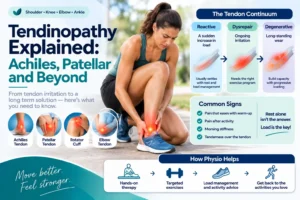
The name suggests a hot, inflamed tissue, and for a long time that was the assumption. Closer study tells a different story: in most long-standing cases the fascia shows degeneration and disorganised repair rather than classic inflammation, much like an overloaded tendon, which is why many clinicians now prefer the term plantar fasciopathy.
This is not hair-splitting. If the problem were pure inflammation, rest and anti-inflammatories would fix it; because it is really a tissue that has been overloaded faster than it could adapt, the lasting answer is to rebuild its capacity with the right kind of load. That shift in understanding is the reason modern treatment looks less like “stop and ice it” and more like a structured loading program.
What tips the fascia into overload
Plantar fasciitis is a load problem, so it tends to show up when the demand on the fascia suddenly outpaces what it is used to. The common drivers sit behind most cases:
- A tight or weak calf. A stiff calf and Achilles pull on the heel and limit how the ankle bends, forcing the fascia to absorb more, which is why calf health is central to the fix.
- A spike in load. A jump in running, a new standing job, or a holiday of walking in flat sandals can all outrun the tissue’s capacity, a pattern we see constantly in runners.
- Hours on hard floors. Nurses, teachers, retail and hospitality workers who stand all day load the fascia for long, unbroken stretches.
- Footwear and body weight. Flat, unsupportive or worn-out shoes and extra body weight both raise the tension the fascia must handle with every step.
None of these act alone; it is usually a tired, under-prepared fascia meeting a sudden rise in demand. That is also why the fix is rarely a single gadget and almost always a change in load plus a rebuild of capacity.
What genuinely helps: load it, don’t just rest it
The instinct to rest a sore heel is understandable, but complete rest leaves the fascia just as weak when you return to activity. The evidence points the other way: the fascia responds to being loaded well. The standout exercise is a heavy, slow calf raise performed with the toes propped up on a rolled towel, which bends the toes back and loads the fascia through that same windlass position, building its tolerance rather than just stretching it (high-load strength training for plantar fasciitis).
Around that sit the supporting measures that make the loading stick: calf and fascia stretching to restore ankle movement, supportive footwear or a temporary orthotic to ease tension through the day, and a sensible cap on the activities that keep flaring it.
A physiotherapist works out which of these your foot needs and how hard to push, then progresses the load as the heel settles, which is the heart of our foot, ankle and heel physiotherapy. Injections and shockwave have a place for stubborn cases, but they sit on top of the loading work, not instead of it.
Calming it day to day: what settles the heel and what stirs it up
Recovery is as much about the ordinary hours between exercises as the exercises themselves. These habits tip the daily balance the right way:
| Tends to settle the heel | Tends to stir it up |
|---|---|
| Supportive, cushioned shoes, even indoors | Going barefoot on hard floors, especially first thing |
| Easing into the first steps and warming the foot up | Leaping straight into a run or long walk cold |
| Spreading standing and walking across the day | Long unbroken hours on your feet, then nothing |
| Progressing load gradually as pain allows | Pushing through sharp pain to “work it off” |
The theme is steadiness. The fascia copes with a lot when the load is predictable and built up over time; it flares when demand swings sharply, which is why the quiet, consistent days are the ones that move recovery forward.
Realistically this is a slow problem: many heels take several months, sometimes six to twelve, to settle fully, and the people who recover fastest are usually the ones who stop chasing a quick fix and keep the loading consistent.
When heel pain is not plantar fasciitis
The morning-pain pattern is fairly specific, but not everything under the heel is fasciitis. Pain that steadily worsens the more you do, rather than easing as you warm up, can point to a stress fracture and warrants a prompt check. Burning, tingling or numbness suggests a nerve rather than the fascia.
A deep, central bruise-like ache can be the heel’s fat pad. And heel pain can even be referred down from an irritated nerve in your lower back, which is why the location and behaviour of the pain matter. If your symptoms do not fit the first-step picture, our rundown of the other common causes of heel pain helps you place them.
See someone promptly if you cannot put weight on the heel, the pain followed a specific injury, or the heel is hot, red and swollen.
Settling stubborn heel pain with Befit Physio in Carlingford and North Kellyville
If the first step out of bed has become the worst moment of your day, an assessment pins down what is loading the fascia and builds the loading plan that rebuilds it. We treat this constantly, and starting the right program early usually means a shorter, less frustrating recovery than waiting for it to pass on its own.
You can be seen at our Carlingford physiotherapy clinic or with our North Kellyville physiotherapists, in the clinic or at home, and if a spike in training set it off, our guide to why most running injuries are load errors is a useful companion read.
| Hobbling on your first steps each morning? Book a one-on-one assessment online, or call Carlingford on 02 9872 2005 or North Kellyville on 02 9624 2047. We will find what is overloading the fascia and build the plan that settles it. |
Frequently Asked Questions
Can a physiotherapist fix plantar fasciitis?
Yes, and physiotherapy is the first-line treatment. A physiotherapist identifies what is overloading the fascia, such as a tight calf, a load spike or unsupportive footwear, then builds a progressive loading program around it, adds stretching and footwear advice, and adjusts the plan as the heel settles. The great majority of cases resolve with this approach without injections or surgery, though it takes consistency over weeks rather than days.
What is the single most effective exercise for plantar fasciitis?
The most-supported exercise is a heavy, slow calf raise done with the toes propped up on a rolled towel, so the toes bend back and load the fascia through its windlass position. Done every second day with a slow, controlled tempo and gradually increasing load, it builds the fascia’s tolerance rather than just stretching it. Stretching the calf and fascia helps too, but loading is what rebuilds capacity, which is what lasts.
How long does plantar fasciitis take to heal?
It is usually a slow recovery. Many heels take several months, often in the range of six to twelve, to settle fully, because the fascia has to rebuild capacity rather than simply calm down. Pain tends to ease well before the tissue is fully strong again, so the common mistake is stopping the loading too early and letting it return. Starting the right program sooner generally shortens the overall course.
What is the worst thing you can do for plantar fasciitis?
Two things tend to prolong it: complete rest, which leaves the fascia weak for when you return, and the opposite error of pushing through sharp pain to work it off, which keeps re-irritating the attachment. Repeatedly going barefoot on hard floors, especially first thing, is another common aggravator. The sweet spot is steady, progressive load with supportive footwear, not total avoidance and not pushing into sharp pain.
Do I need orthotics or shockwave for plantar fasciitis?
Not for most people. A supportive shoe or a temporary off-the-shelf orthotic can ease daytime tension and make loading more comfortable, but it is a support to the program, not a cure on its own. Shockwave and injections are options for stubborn cases that have not responded to a genuine loading program, so they sit on top of the exercise work rather than replacing it. A physiotherapist can advise when they are worth considering.
About the author and clinical review
| Author: Anshu Sudan, Principal Physiotherapist and owner, Befit Physiotherapy & Sports Injury Centre (Masters of Physiotherapy, APA member). Clinically reviewed by: a physiotherapist at Befit Physio. Carlingford: Shop 2/1 Post Office St, Carlingford NSW 2118. North Kellyville: 15/21 Hezlett Rd, North Kellyville NSW 2155. |
| Medical disclaimer This article is general information, not personal medical advice, and reflects Australian guidance current as at October 2026. Heel pain has several possible causes, so see a physiotherapist or doctor for an individual assessment and diagnosis before starting an exercise program. Seek prompt care if you cannot weight-bear on the heel, the pain followed a specific injury, or the heel is hot, red and swollen. |