There is a very particular way a shoulder with impingement announces itself. Reaching up to a shelf, pulling on a seatbelt, or lifting your arm out to the side brings a sharp catch of pain somewhere in the middle of the movement, and it often nags at night when you roll onto that side. Curiously, the pain frequently eases if you can get your arm all the way overhead, which is a clue to what is going on underneath.
Shoulder impingement is one of the most common reasons people develop a painful shoulder, and once you understand why the pain lands where it does in the lift, both the diagnosis and the fix make a lot more sense.
The pain lives in a tight space under the point of your shoulder
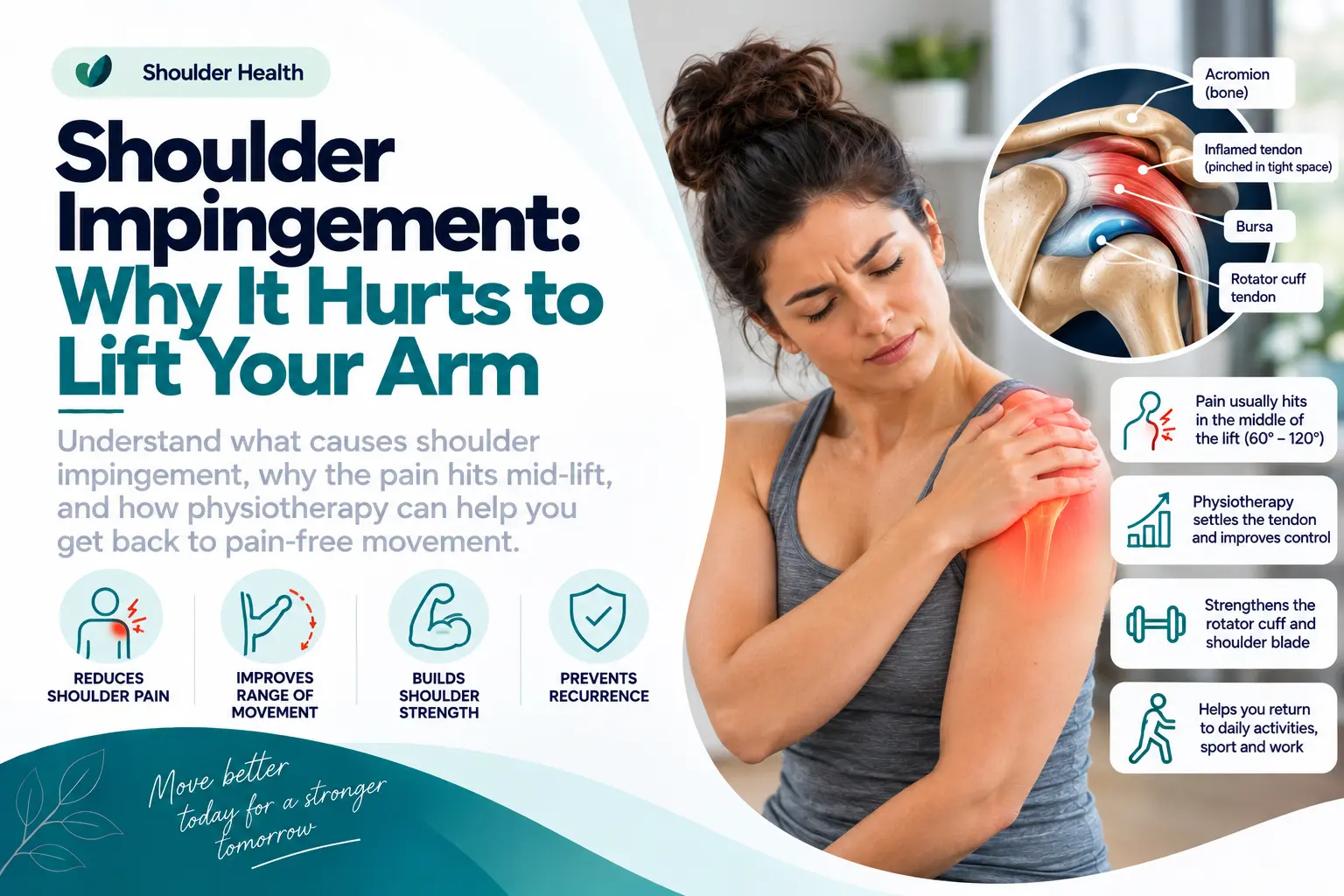
Just under the bony tip of your shoulder, the acromion, there is a narrow gap called the subacromial space, and running through it are the tendons of the rotator cuff and a small fluid-filled cushion called a bursa. In a healthy shoulder there is just enough room for everything to glide freely. When one of those rotator cuff tendons becomes irritated and a little swollen, the space effectively shrinks, and lifting the arm squeezes the sore tendon against the bone above it.
That compression of an already-tender tendon is what produces the pain, which is why impingement is so closely tied to the health of the rotator cuff itself (healthdirect).
The painful arc: why it hurts in the middle of the lift
The signature of impingement is where in the movement the pain strikes, and it is specific enough to be a clue in itself. As you raise your arm out to the side, the subacromial space is at its tightest through the middle of the range, roughly between 60 and 120 degrees, which is exactly where the irritated tendon gets pinched. Below that, the arm has not yet closed the gap; above it, the mechanics change and the tendon clears the bone.
The result is a painful arc: comfortable at the start of the lift, sharply painful through the middle, and often easier again near the top. If that pattern sounds familiar, especially with overhead tasks, it points strongly towards impingement rather than, say, a joint that is stiff in every direction.
It also explains why the small, repeated movements of everyday life, reaching, dressing, carrying, keep provoking it.
Is it really a ‘pinch’? The reframe that changes the treatment
The word “impingement” conjures an image of a bone physically crushing a tendon, and for years the logical fix seemed to be surgery to shave the bone and make more room. The understanding has moved on. In most cases the problem is not that your anatomy is grinding itself down, but that the tendon has been overloaded and irritated, and the way the shoulder blade and cuff control the movement has slipped, so the tendon is both more sensitive and less well-managed through the arc.
For that reason many clinicians now prefer the term subacromial pain syndrome, because it describes an irritable, overloaded tendon rather than a purely mechanical trap.
This is not a word game; it changes what helps. If the issue is load and control rather than a bone that needs cutting, then settling the tendon and retraining the shoulder does more than an operation, which is the thread running through our guide to rebuilding a painful shoulder without surgery.
What tips a healthy shoulder into impingement
Impingement rarely comes from nowhere. It usually builds when the load on the tendons outruns their capacity, or when the shoulder stops moving as cleanly as it should. The usual contributors:
| What contributes | Why it tips the shoulder over |
|---|---|
| A spike in overhead load | A sudden increase in overhead sport or work asks more of the tendons than they have adapted to |
| A weak or tired rotator cuff | The cuff cannot keep the ball centred, so the tendons sit closer to the bone through the lift |
| Poor shoulder-blade control | If the shoulder blade does not rotate well as you raise your arm, the space above the tendon fails to open |
| A rounded, forward posture | Slumped shoulders narrow the subacromial space before you have even started to lift |
The shoulder blade earns a special mention, because it is the moving base the whole shoulder works from; if it does not tilt and rotate at the right moment, the space for the tendon never fully opens.
That connection is why problems here often travel with pain around the shoulder blade, and why rehabilitation almost always includes the upper back as well as the shoulder itself. Overhead athletes and tradespeople are the classic candidates, which is also where managing overhead training load matters most.
How impingement settles: calm the load, then rebuild control
The encouraging news is that most impingement settles well without surgery, and often within a few months, when it is treated as what it usually is: an irritable tendon that needs its load managed and its control restored. The first move is to ease off the specific movements that keep provoking it, particularly repetitive overhead work, rather than stopping using the arm altogether. As the tendon calms, the real work is progressive strengthening of the rotator cuff and the shoulder-blade muscles, pitched carefully so it loads the tendon without flaring it, which rebuilds both the capacity and the control that were missing.
Research supports this exercise-led approach, with hands-on treatment a useful addition for some people (manual therapy and exercise for subacromial pain). A corticosteroid injection can help settle a very painful shoulder enough to get rehabilitation going, and surgery sits right at the back of the queue, for the small number who do not respond to a genuine, well-run program. The detail of that staged strengthening is physiotherapy at its most useful, and it is the core of our physiotherapy for a painful shoulder.
When to have the shoulder assessed rather than wait
Impingement itself is not dangerous, and gentle self-management is a reasonable start, but a few signs mean it is worth getting an assessment sooner than later:
- The pain is not improving after a few weeks of easing the aggravating activities, or it is getting worse.
- There is real weakness, not just pain, when you try to lift or hold the arm out, which can suggest a rotator cuff tear.
- You cannot raise the arm at all after a fall or sudden injury, or the shoulder is hot, swollen or came with a fever.
A physiotherapist can confirm whether it is impingement, a cuff tear or something else, and start you on the right loading program rather than leaving you to guess which exercise is safe at this stage.
Settling a painful shoulder with Befit Physio in Carlingford and North Kellyville
If lifting your arm has become a daily wince, an assessment works out exactly why and sets you on a plan to calm the tendon and rebuild the control around it. We see this problem constantly, and getting on top of it early usually means a shorter, smoother recovery. You can be seen at our Carlingford physiotherapy clinic or with our North Kellyville physiotherapists, in the clinic or at home.
| Sharp pain when you lift your arm? Book a one-on-one assessment online, or call Carlingford on 02 9872 2005 or North Kellyville on 02 9624 2047. We will confirm what it is and build the plan that settles it. |
Frequently asked questions
What is the painful arc in shoulder impingement?
The painful arc is the hallmark of impingement: pain that appears as you raise your arm out to the side through the middle of the range, roughly between 60 and 120 degrees, and often eases both below and above that band. It happens because the space under the tip of the shoulder is tightest through the mid-range, pinching an already-irritated tendon. The pattern is a useful clue that the problem is impingement rather than a stiff or arthritic joint.
Can physiotherapy fix shoulder impingement?
Yes, and it is the first-line treatment. Most impingement settles with a program that eases the aggravating overhead load and then progressively strengthens the rotator cuff and shoulder-blade muscles to restore control through the lift. Research supports this exercise-led approach, and the majority of people recover well without injections or surgery. A physiotherapist tailors the loading to the stage your shoulder is at so it improves without flaring.
What is the best exercise for shoulder impingement?
There is no single best exercise, because the right ones depend on how irritable your shoulder is and where the control has slipped. Early on, gentle rotator cuff and shoulder-blade work that stays below your painful range is the priority; later, progressive strengthening through more of the range rebuilds capacity. Because the wrong exercise at the wrong time can aggravate it, having the program matched to your shoulder beats copying a generic routine.
How long does shoulder impingement take to heal?
Many shoulders improve noticeably over several weeks to a few months with consistent, well-pitched rehabilitation, though it depends on how long and how severely the tendon has been irritated. Pain usually settles before full strength returns. Easing the overhead load early and keeping up the strengthening are what shorten the course, while pushing through sharp pain tends to drag it out.
Do I need surgery or an injection for shoulder impingement?
Usually not. The large majority of impingement settles with load management and exercise, without any procedure. A corticosteroid injection is sometimes used to calm a very painful shoulder enough to begin rehabilitation, and surgery is reserved for the small number who do not improve with a genuine course of conservative treatment, as the evidence no longer supports operating as a routine first step.
About the author and clinical review
| Author: Anshu Sudan, Principal Physiotherapist and owner, Befit Physiotherapy & Sports Injury Centre (Masters of Physiotherapy, APA member). Clinically reviewed by: a physiotherapist at Befit Physio. Carlingford: Shop 2/1 Post Office St, Carlingford NSW 2118. North Kellyville: 15/21 Hezlett Rd, North Kellyville NSW 2155. |
| Medical disclaimer This article is general information, not personal medical advice, and reflects current evidence as at October 2026. Shoulder pain has several possible causes, so see a physiotherapist or doctor for an individual assessment and diagnosis before starting an exercise program. Seek prompt assessment for marked weakness, an inability to lift the arm after an injury, or a hot, swollen shoulder with fever. |