If your shoulder hurts, the good news is that most shoulder pain improves without surgery. For the common problems, rotator cuff-related pain, impingement, frozen shoulder and bursitis, guided exercise and load management are the recommended first-line treatment, and for many people they are the only treatment needed.
Surgery has an important role in specific situations, but it is rarely the starting point, and often not the destination either. That is not wishful thinking; it is what the highest-quality research shows.
This guide explains why physiotherapy comes first for shoulder pain, how it actually rebuilds a painful shoulder, which problems it helps, and the smaller number of situations where surgery genuinely earns its place.
Why physiotherapy comes first for shoulder pain
For years, keyhole ‘clean-up’ surgery (subacromial decompression) was a common answer for shoulder pain. Then it was properly tested. In a large placebo-controlled trial, the surgery worked no better than a placebo operation and no better than exercise, for ordinary subacromial shoulder pain (CSAW trial, The Lancet).
Reviews of rotator cuff disease have reached the same conclusion. The practical message is simple: for the most common shoulder problems, an exercise-based program gives you the same result as an operation, without the risks and recovery of surgery.
| Subacromial decompression surgery probably provides little or no clinically important benefit compared with placebo. |
Common shoulder problems, and whether they need surgery
Shoulder pain is not one thing, so the answer to ‘do I need surgery’ depends on the diagnosis. This table sets out the common problems, how likely each is to need an operation and what physiotherapy does for it.
| Shoulder problem | Usually needs surgery? | How physiotherapy helps |
|---|---|---|
| Rotator cuff-related pain | Rarely, for degenerative cases | Progressive rotator cuff and shoulder-blade strengthening |
| Subacromial (impingement) pain | No; exercise works as well as surgery | Load management and shoulder-blade control |
| Frozen shoulder | Rarely | Pain management, graded stretching and movement |
| Bursitis or tendinopathy | No | Settle the load, then rebuild capacity |
| Traumatic full-thickness tear | Sometimes, if young and active | Rehab, with or after a surgical repair |
| Instability or dislocation | Sometimes, if recurrent | Strengthening for control; surgery if it keeps dislocating |
How physiotherapy rebuilds a painful shoulder

Recovering a shoulder is less about resting it and more about loading it well. A physiotherapist first works out which structure is irritated and why, then settles the most painful movements before progressively strengthening the rotator cuff and the muscles that control the shoulder blade, which together keep the joint moving smoothly.
Alongside the exercises comes education: understanding that a sore shoulder is usually safe to move, within limits, takes away the fear that keeps people stiff and guarded.
That combination of graded loading, movement retraining and reassurance is what our restoring shoulder movement is built around.
A special case: frozen shoulder
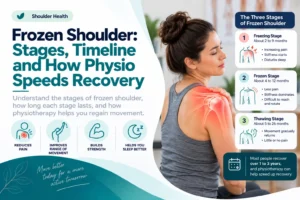
Frozen shoulder deserves its own mention because it behaves differently. It moves through three stages, a painful freezing phase, a stiff frozen phase, then a gradual thawing and it is self-limiting: most shoulders recover their movement over time, though the full course can take up to two to three years (frozen shoulder overview).
Physiotherapy will not force a frozen shoulder to thaw overnight, but it manages the pain, keeps as much movement as possible and speeds the return to normal use, which is why it is worth starting rather than simply waiting it out.
When surgery is the right call
Surgery is valuable in the right situation. It is more likely to be recommended when:
- a full-thickness rotator cuff tear happens suddenly in a younger, active person
- the shoulder keeps dislocating despite good rehabilitation
- there is significant, progressive weakness rather than just pain
- a genuine, well-run course of physiotherapy has not helped a specific structural problem
Even in these cases, physiotherapy before and after surgery improves the result, so the two work together rather than as rivals.
| ⚠ Shoulder pain that is an emergency Not all shoulder pain comes from the shoulder. Shoulder pain with chest tightness, shortness of breath, sweating or nausea can be a sign of a heart attack, so call 000 immediately (healthdirect). Also seek prompt care for shoulder pain after a significant fall or accident, an obvious deformity, a hot and swollen joint with fever, or sudden weakness or numbness in the arm. These need urgent medical assessment rather than physiotherapy. |
Start your shoulder recovery at Befit
- Get assessed. We identify what is driving the pain and whether it is one of the many problems that respond well without surgery.
- Book with us at our Carlingford physiotherapy team or our North Kellyville physiotherapy team, online or by phone.
| Sore shoulder you want to fix without rushing to surgery? Book a one-on-one assessment online, or call Carlingford on 02 9872 2005 or North Kellyville on 02 9624 2047. We will diagnose the problem and build an exercise-based plan to get your shoulder moving again. |
Frequently asked questions
Can shoulder pain get better without surgery?
Yes, and usually it does. The most common shoulder problems, rotator cuff-related pain, impingement, bursitis and frozen shoulder, are managed first with exercise and load management, and most people recover well without an operation. Surgery is reserved for specific situations rather than being the default.
Is physiotherapy or surgery better for a rotator cuff problem?
For degenerative rotator cuff pain without a large sudden tear, high-quality trials show exercise-based physiotherapy achieves outcomes comparable to surgery, without the operative risks and recovery. A traumatic full-thickness tear in a younger, active person is the main situation where surgery is more likely to be considered.
How long does shoulder pain take to settle with physio?
It depends on the cause. Many rotator cuff and impingement problems improve noticeably over several weeks of consistent rehabilitation, while a frozen shoulder follows a longer natural course. The key is progressing your loading at the right pace, which a physiotherapist guides rather than leaving to guesswork.
Should I rest my shoulder or keep using it?
Mostly keep using it, within comfortable limits. Complete rest tends to leave a shoulder stiff and weak, whereas guided movement and progressive strengthening rebuild it. You may ease off the most painful movements early on, but the aim is to return to normal use rather than protect the shoulder indefinitely.
About the author and clinical review
| Author: Anshu Sudan, Principal Physiotherapist, Befit Physiotherapy & Sports Injury Centre. Clinically reviewed by: a Befit physiotherapist. Carlingford: Shop 2/1 Post Office St, Carlingford NSW 2118 North Kellyville: 15/21 Hezlett Rd, North Kellyville NSW 2155 |
| Medical disclaimer This article is general information, not personal medical advice, and reflects the evidence as at July 2026. Shoulder pain has many causes, so get an individual assessment for a diagnosis and a plan. If you have shoulder pain with chest tightness or breathlessness, or any of the warning signs above, seek urgent medical care. |