Frozen shoulder is one of the most frustrating conditions a shoulder can develop, because it arrives slowly, overstays badly, and then, eventually, lets go on its own.
It usually begins as a deep ache that makes reaching behind your back or sleeping on that side miserable, and over weeks the shoulder quietly loses its range until lifting your arm or rotating it out becomes genuinely hard.
The good news, and it is worth holding on to through a long recovery, is that frozen shoulder is a well-understood condition that follows a predictable course and almost always thaws in the end. What changes the experience most is understanding the stage you are in, because the treatment that helps in one stage can set you back in another.
Frozen shoulder is the joint capsule itself gripping tight
The medical name, adhesive capsulitis, describes the problem precisely. Your shoulder sits inside a sleeve of connective tissue called the joint capsule, and in frozen shoulder that capsule becomes inflamed, thickened and scarred, so it contracts and grips the joint, which is why both pain and stiffness are so prominent and why losing the ability to rotate the arm outward is such a classic sign (healthdirect).
It is not a muscle or tendon tear, which is part of why it behaves so differently from most shoulder problems. It most often appears between the ages of 40 and 60, affects women more than men, and is strongly linked with diabetes, as well as thyroid conditions and spells where the arm has been kept still after an injury or surgery. Frequently, though, it turns up for no clear reason at all.
The three stages, and roughly how long each one lasts
Frozen shoulder moves through three stages, and knowing which one you are in explains both what you are feeling and what will help. The timings vary a great deal between people, but the ranges below give a realistic sense of the journey.
| Stage | What it feels like | Roughly how long |
|---|---|---|
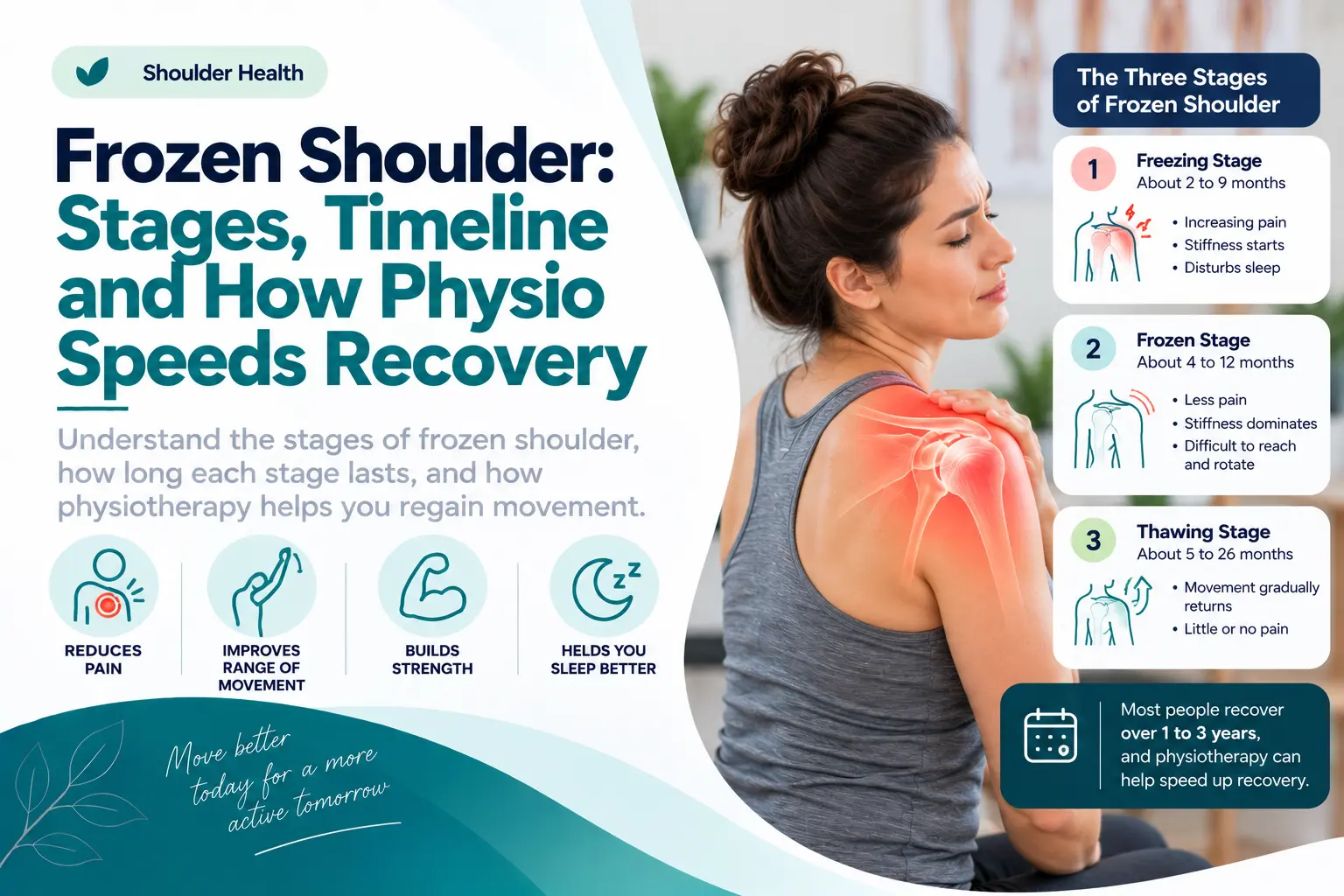
| Freezing (painful) | Increasing pain, even at rest, that worsens with movement and disturbs sleep, as the range slowly drops | About 2 to 9 months |
| Frozen (stiff) | Pain starts to ease, but stiffness dominates; reaching behind you or rotating the arm out is hard | About 4 to 12 months |
| Thawing | Stiffness gradually lets go and movement returns, with little or no pain | About 5 to 26 months |
Added together, a frozen shoulder commonly runs its full course over one to three years, and the stages overlap rather than switching cleanly from one to the next (review of physical therapy in frozen shoulder).
That sounds daunting, but most of that time is a gradual return to normal, and good treatment makes the painful early months more bearable and the stiff middle months shorter.
The one rule that changes everything: match the treatment to the stage
If there is a single idea to take from this, it is that frozen shoulder is treated by stage, and the most common mistake is attacking an angry, freezing shoulder with aggressive stretching. In the painful freezing stage the capsule is inflamed, and forcing range into it tends to flare the pain and make things worse, not better.
In the frozen and thawing stages, when the inflammation has settled and stiffness is the main barrier, that same hands-on stretching and loading becomes exactly what the shoulder needs. The art of good care, and the reason it speeds recovery, is reading the stage correctly and pitching the treatment to match, which is far more effective than pushing hard throughout or doing nothing and waiting it out.
How physiotherapy helps at each stage
Physiotherapy is most valuable once a frozen shoulder reaches the frozen and thawing stages, but it has a role from the start, and what it involves shifts as you move through the course.
In the freezing stage, the goal is to calm the pain and keep what movement you have
Early on, the aim is comfort and protection rather than gains in range. A physiotherapist focuses on gentle, pain-free movement to stop the shoulder stiffening further than it must, advice on positioning and sleep so the nights are less brutal, and strategies to manage the load on the arm through the day.
This is also the stage where a corticosteroid injection, arranged through your doctor, can be most useful, because settling the inflammation early can take the edge off the worst of the pain.
In the frozen and thawing stages, the focus turns to regaining range and strength
Once the pain has eased and stiffness is the main problem, the handbrake comes off. This is where hands-on joint mobilisation and progressive stretching do their work, restoring the range the capsule has been holding back, followed by strengthening as the shoulder thaws so it returns to full, confident use rather than staying weak and cautious. Throughout, the guiding principle is that treatment should not stir up lasting pain; a good program nudges the shoulder forward without provoking it.
For the bigger picture of how shoulders recover and why most never need an operation, our guide to why most shoulder pain settles without surgery puts frozen shoulder in context.
Where injections and surgery fit in
Beyond physiotherapy, a couple of other options have a place for the right person. A corticosteroid injection is the most common, and works best in the early, inflamed stage to ease pain. A procedure called hydrodilatation, where the joint is gently stretched from the inside with injected fluid, is sometimes used to help a stubbornly frozen capsule.
Surgery, usually a keyhole release or a manipulation under anaesthetic, is reserved for the minority of shoulders that remain severely stiff and painful despite a genuine trial of conservative care, generally only after six to twelve months. For most people, none of this is needed; the shoulder thaws with time, and physiotherapy makes that time easier and quicker to get through.
Getting the diagnosis right, because not every stiff shoulder is frozen
It is worth having a painful, stiff shoulder properly assessed rather than assuming, because a few other problems can look similar in the early stages, including rotator cuff trouble and shoulder arthritis, and they are managed differently. Frozen shoulder has a telltale pattern, a loss of movement in every direction, especially rotating the arm outward, that a physiotherapist or doctor can usually identify from examination alone, so scans are often unnecessary.
See a doctor if your pain is severe, so that pain relief can be sorted out, and seek prompt medical advice if the shoulder pain follows a significant injury, comes with fever, or is accompanied by numbness or weakness in the arm, which point away from a simple frozen shoulder.
Managing a frozen shoulder with Befit Physio in Carlingford and North Kellyville
A frozen shoulder is a long road, but it is a far smoother one with a plan that matches your stage and someone to guide the progressions. An assessment pins down where you are in the course and sets up treatment that eases the pain now and restores the movement as the shoulder thaws, which is the heart of our shoulder pain treatment.
If it is your first visit, here is what to expect at your first appointment, and you can be seen at our Carlingford physiotherapy clinic or with our North Kellyville physiotherapists.
| Shoulder stiffening up and painful at night? Book a one-on-one assessment online, or call Carlingford on 02 9872 2005 or North Kellyville on 02 9624 2047. We will work out your stage and build a plan that fits it. |
Frequently Asked Questions
How long do the stages of a frozen shoulder last?
The freezing, painful stage commonly lasts around two to nine months, the stiff frozen stage about four to twelve months, and the thawing stage anywhere from five to twenty-six months as movement returns. The stages overlap rather than switching cleanly, and the whole course often runs one to three years. The timings vary widely between people, which is why a stage-matched plan matters more than the calendar.
Can physiotherapy cure a frozen shoulder?
Frozen shoulder resolves on its own in time, so the real question is not whether physiotherapy cures it but whether it makes the course easier and quicker, and it does. Matched to the stage, it helps settle pain in the early phase and rebuild range and strength as the shoulder thaws, so you spend less time severely limited. Pushing too hard in the painful stage, by contrast, can set recovery back.
What exercises help a frozen shoulder, and which should I avoid?
It depends entirely on the stage. In the painful freezing stage, gentle, pain-free movements such as pendulum swings are enough, and aggressive stretching should be avoided because it flares the inflamed capsule. In the frozen and thawing stages, stretching and range-of-motion work, then strengthening, are what help. Because the wrong exercise at the wrong stage slows you down, it is worth having them matched to you rather than guessing.
Does a cortisone injection help frozen shoulder?
It can, particularly in the early, inflamed stage, where a corticosteroid injection arranged by your doctor can meaningfully reduce pain and make the freezing phase more bearable. It does not cure the condition, but easing the pain early can help you keep the shoulder moving and sleep better. It is one option among several, and whether it suits you is a conversation for your doctor and physiotherapist.
Do I need surgery for a frozen shoulder?
Rarely. The large majority of frozen shoulders settle with time, pain management and stage-matched physiotherapy, without any operation. Surgery, such as a keyhole capsule release or manipulation under anaesthetic, is reserved for shoulders that stay severely stiff and painful despite a genuine course of conservative treatment, usually only considered after six to twelve months.
About the author and clinical review
| Author: Anshu Sudan, Principal Physiotherapist and owner, Befit Physiotherapy & Sports Injury Centre (Masters of Physiotherapy, APA member). Clinically reviewed by: a physiotherapist at Befit Physio. Published 12 October 2026. Last reviewed 12 October 2026. Carlingford: Shop 2/1 Post Office St, Carlingford NSW 2118. North Kellyville: 15/21 Hezlett Rd, North Kellyville NSW 2155. |
| Medical disclaimer This article is general information, not personal medical advice, and reflects Australian guidance current as at October 2026. A stiff, painful shoulder has several possible causes, so see a physiotherapist or doctor for an individual assessment and diagnosis before starting treatment. Seek medical advice for severe pain, or for shoulder pain after a significant injury, or with fever, numbness or weakness in the arm. |