A rotator cuff problem announces itself in a few familiar ways: a nagging ache in the shoulder and upper arm, a jab of pain and weakness when you reach overhead to a high shelf or wash your hair, and the particularly unwelcome habit of waking you when you roll onto that side at night. The phrase “rotator cuff injury” sounds dramatic, and a scan report mentioning a “tear” sounds worse, but the reality is more reassuring than the language suggests.
Rotator cuff trouble runs along a spectrum from mild tendon irritation to a genuine tear, the great majority improves with the right exercise rather than surgery, and a tear is far from the end of the road. This guide walks through what the rotator cuff is, how to tell what you are dealing with, and the staged exercises that rebuild it.
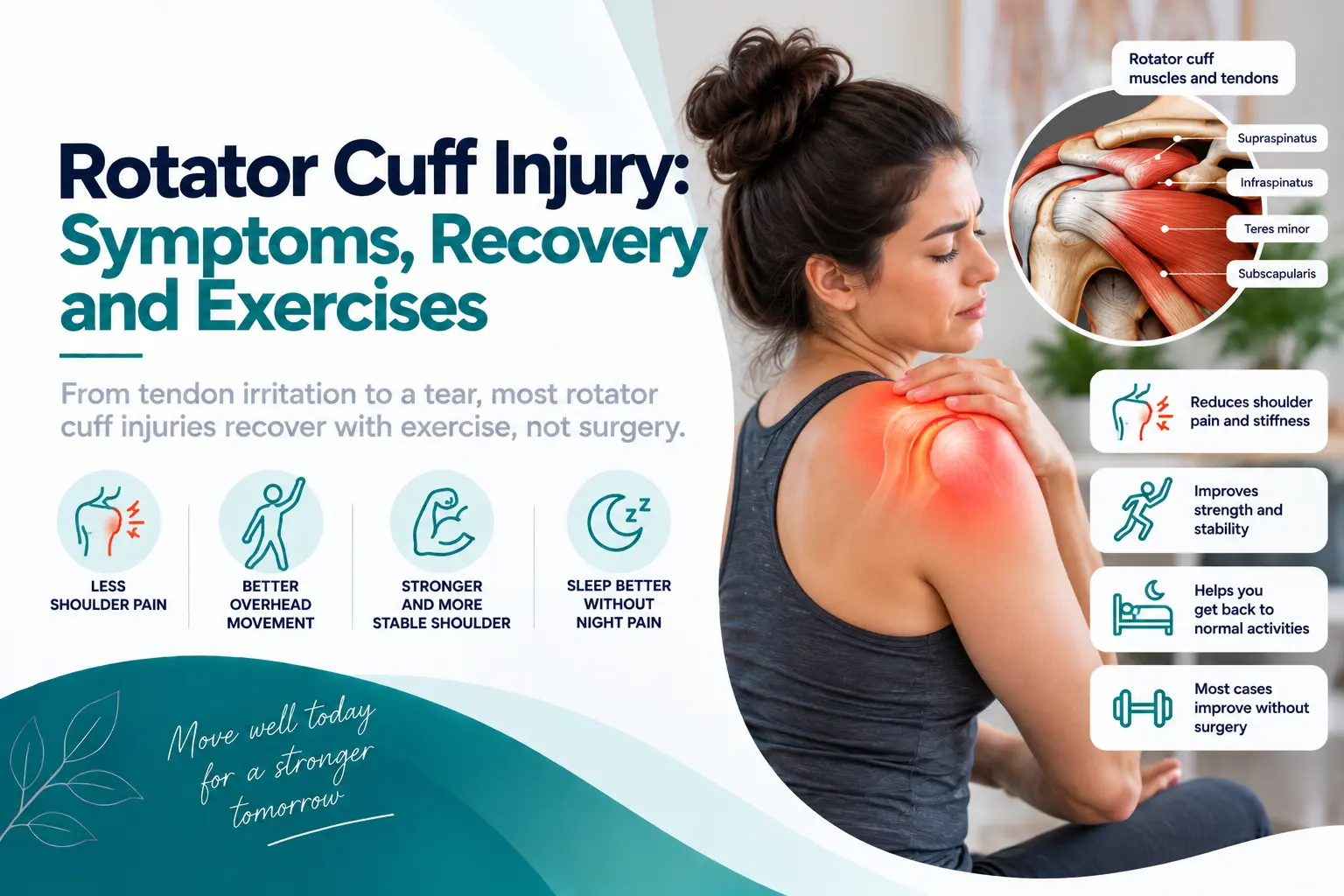
The rotator cuff is four muscles that steer and steady your shoulder
To make sense of the injury, it helps to picture the structure. The rotator cuff is a group of four muscles and their tendons that wrap around the ball at the top of your upper arm bone, forming a cuff that holds the ball centred in its shallow socket while letting the shoulder move through its enormous range (healthdirect).
That dual job, stability and movement at the same time, is why a cuff problem produces its signature mix of symptoms: pain, a feeling of weakness, and difficulty with overhead or reaching tasks.
When one of these tendons, most often the one on top, becomes irritated or torn, the shoulder loses a little of its steering and complains, especially under load and at night.
From irritation to tear: the spectrum of rotator cuff injury
“Rotator cuff injury” is really an umbrella term, and where your problem sits on the spectrum shapes how it behaves and how it is treated. Most cases are not the full tear people fear.
| Type | What it is | Who it tends to affect |
|---|---|---|
| Tendinopathy | An overloaded, irritated cuff tendon, with no actual tear | The most common; overhead workers, gym-goers, gradual overuse |
| Partial tear | Some fibres of a tendon are torn, but it is still largely intact | Often age-related wear; usually responds well to exercise |
| Full-thickness tear | A tendon is torn all the way through | Degenerative with age (often few symptoms), or traumatic from a fall |
The distinction that matters most is not simply tear versus no tear, but whether the injury came on gradually through wear or suddenly through trauma.
A tendon that has frayed slowly over years behaves very differently from one torn in a fall and the two are managed differently, which is one reason an accurate assessment is worth more than a label.
A tear on a scan is not always the cause of your pain
Here is the piece of information that changes how people feel about a rotator cuff diagnosis. Rotator cuff tears become increasingly common with age, and many cause no symptoms at all; full-thickness tears are present in around a quarter of people in their sixties, and rising numbers beyond that, yet it is common to have one and never know it.
That means a tear seen on an ultrasound or MRI is not automatically the source of your pain, and treating the scan rather than the person leads people astray. It also explains why imaging is often unnecessary at first, and is usually reserved for shoulders that are not improving or where a significant traumatic tear is suspected. Just as importantly, the goal of rehabilitation is not to “close” a tear, because a degenerative tear rarely knits back together.
Instead it does something more useful: building up the surrounding muscles and retraining how the shoulder moves, so the joint works well and the pain settles even with the tear still there. For most degenerative and partial-thickness tears, that is enough to get back to normal life.
Exercises that rebuild a rotator cuff, stage by stage
Rehabilitation is where a rotator cuff actually recovers, and it works best as a progression rather than a fixed set of moves. Pushing heavy strengthening on an angry tendon flares it, while staying too gentle for too long leaves it weak, so the art is matching the load to the stage.
The sequence below is the shape a physiotherapist builds around your particular shoulder.
| Stage | The aim | The kind of work involved |
|---|---|---|
| 1. Settle | Calm the pain and protect the irritated tendon | Gentle isometric holds, and easing off the overhead loads that flare it |
| 2. Restore movement | Regain comfortable, confident range | Pendulum swings, assisted range-of-motion, and posture work |
| 3. Build strength | Progressively reload the cuff and shoulder blade | Resisted external and internal rotation, rows, and controlled reaching |
| 4. Return to load | Rebuild capacity for your sport, work or hobbies | Graded, functional loading toward the specific demands you want back |
Two things make or break this. The first is consistency: tendon and muscle respond to regular loading over a period of months, not a burst of effort over a fortnight. The second is pitching the exercises at the right stage, which is exactly what an assessment sorts out, because the same exercise that helps one shoulder will aggravate another a stage behind it.
Getting the strength of the shoulder blade and upper back into the plan matters too, since the cuff works far better on a stable base, a theme our guide to pain around the shoulder blade picks up.
How long recovery takes, and when surgery enters the conversation
Tendons are slow tissue, so honest expectations help. A tendinopathy or a manageable partial tear typically improves over a few months of consistent rehabilitation rather than a few weeks, with the pain usually easing well before the full strength returns. Most people get there without an operation, and reviews of exercise-based rehabilitation for rotator cuff tears support that non-surgical path for the majority. Surgery has a clear role for a smaller group, chiefly a sudden, traumatic full-thickness tear in a younger, active person, or a shoulder that has had a genuine, well-run course of rehabilitation and not responded.
Weighing up that decision is its own topic, and our guide to recovering shoulder pain without surgery sets out what the evidence says about when an operation is, and is not, worth it. Because a rotator cuff so often flares from doing too much too soon, the principles of managing load sensibly are also part of keeping it settled once it is better.
When a rotator cuff problem needs prompt assessment
Most rotator cuff pain is safe to begin managing with activity changes and sensible loading, but a few situations are worth getting looked at sooner rather than later:
- You cannot lift your arm at all after a fall or sudden injury, which can point to a large acute tear.
- There is marked or worsening weakness, not just pain, when you try to raise or rotate the arm.
- The pain is not improving after a few weeks of sensible self-management, or it is steadily getting worse.
- A physiotherapist can quickly work out where on the spectrum your shoulder sits, flag the uncommon case that needs a doctor or a scan, and start you on the right stage of rehabilitation rather than guessing.
Rebuilding your shoulder with Befit Physio in Carlingford and North Kellyville
If reaching overhead or sleeping on your shoulder has become a daily battle, an assessment works out exactly what your rotator cuff needs and sets you on a staged plan to rebuild it. That hands-on, exercise-led care is part of our physiotherapy for shoulder pain, and you can be seen at our Carlingford physiotherapy clinic or with our North Kellyville physiotherapists.
| Shoulder sore reaching overhead or at night? Book a one-on-one assessment online, or call Carlingford on 02 9872 2005 or North Kellyville on 02 9624 2047. We will find where your rotator cuff sits and build the exercise plan that rebuilds it. |
Frequently Asked Question
Can you heal a torn rotator cuff with exercise?
For most degenerative and partial-thickness tears, exercise-based physiotherapy restores a pain-free, functioning shoulder, even though it does not necessarily close the tear itself. It works by strengthening the surrounding muscles and retraining how the shoulder moves, so the joint copes well with the tear present. A sudden, traumatic full-thickness tear in a younger, active person is the main situation where surgery is more likely to be considered.
Is physiotherapy good for rotator cuff injuries?
Yes, and it is usually the first-line treatment. Whether the problem is tendon irritation or a partial tear, a graded program of movement and strengthening is what the evidence supports, and most people recover well without an operation. A physiotherapist tailors the exercises to the stage your shoulder is at, which is the key to progressing without flaring it.
What are the best exercises for a rotator cuff injury?
There is no single best exercise, because the right ones depend on the stage of your injury. Early on, gentle isometric holds and comfortable range-of-motion work settle the shoulder; later, resisted external and internal rotation, rows and controlled reaching rebuild strength, alongside shoulder-blade control. Because the same exercise can help one shoulder and aggravate another, it is worth having them matched to you rather than guessing from a video.
How long does a rotator cuff injury take to heal?
Expect months rather than weeks for a full recovery, because tendons are slow to adapt, though the pain often eases well before the strength is fully back. Tendinopathy and partial tears usually respond over a few months of consistent rehabilitation. The timeline depends on the type and severity of the injury and how steadily you keep up the exercises.
Do I need a scan for a rotator cuff injury?
Often not. A rotator cuff problem can usually be diagnosed from your history and a physical examination, and imaging is reserved for shoulders that are not improving or where a significant traumatic tear is suspected. Because tears are common with age and frequently painless, a scan can also reveal harmless findings that are not the cause of your pain, so an assessment comes first.
About the author and clinical review
| Author: Anshu Sudan, Principal Physiotherapist and owner, Befit Physiotherapy & Sports Injury Centre (Masters of Physiotherapy, APA member). Clinically reviewed by: a physiotherapist at Befit Physio. Carlingford: Shop 2/1 Post Office St, Carlingford NSW 2118. North Kellyville: 15/21 Hezlett Rd, North Kellyville NSW 2155. |
| Medical disclaimer This article is general information, not personal medical advice, and reflects current evidence as at October 2026. Shoulder pain has several possible causes, so see a physiotherapist or doctor for an individual assessment and diagnosis before starting an exercise program, especially after a fall or if you cannot lift your arm. Seek prompt assessment for sudden, significant weakness or an inability to raise the arm, which can indicate a large tear. |