The strange thing about whiplash is how often it creeps up on you. In the hours after even a modest rear-end bump, the adrenaline fades and the neck quietly tightens, until by that evening or the next morning it is stiff, sore and hard to turn.
That delayed arrival catches people out, but the underlying picture is usually reassuring: most whiplash is a soft-tissue injury that recovers well, and recovers faster when you treat it early and actively rather than waiting and protecting it.
In New South Wales there is a second piece of good news, which is that the treatment you need after a motor accident is generally covered, so cost should not be the thing that delays your recovery.
First, though, a word on safety: if the accident was serious, or you have any of the warning signs further down, that comes before everything else.
Whiplash is a soft-tissue neck injury, and its symptoms can be slow to arrive
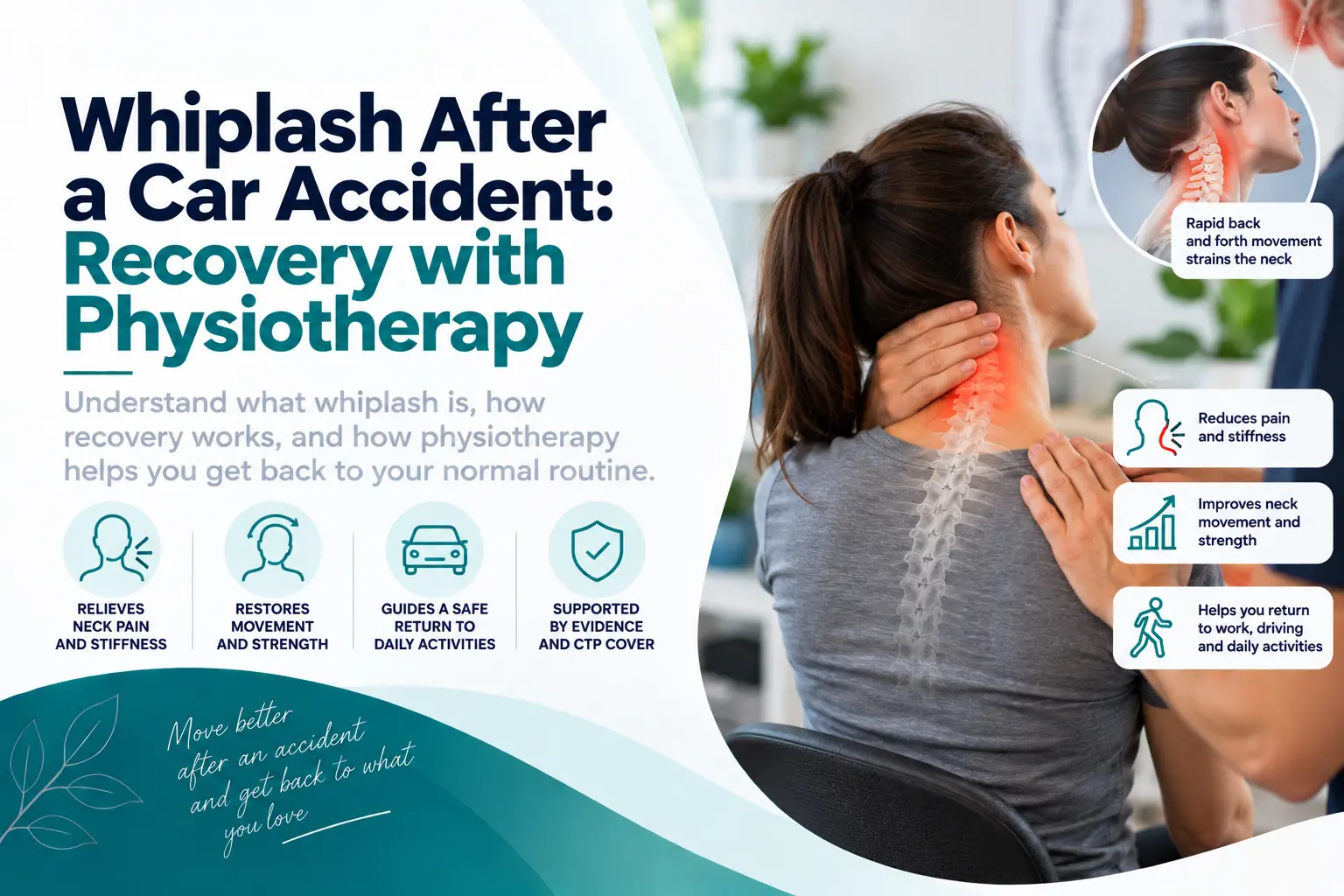
Whiplash happens when your head is thrown suddenly in one direction and snapped back, most commonly in a car accident, forcing the neck past its normal range. That rapid acceleration and deceleration sprains the muscles, tendons and other soft tissues of the neck, which is where the pain, stiffness and difficulty turning come from.
The medical name is a whiplash-associated disorder, and understanding it as a soft-tissue strain rather than a broken neck is the first step to recovering calmly.
One feature genuinely matters to know in advance: symptoms can be delayed, appearing hours or even days after the crash (healthdirect), so feeling fine at the roadside does not mean you escaped it. Alongside neck pain and headache, some people notice shoulder and upper-back ache, and a smaller number get dizziness, pins and needles, or trouble concentrating, which are worth mentioning to whoever assesses you.
Not all whiplash is the same: the grades that guide recovery
Clinicians sort whiplash into grades, because how it is treated and how it is likely to go depend on how much is involved. The great majority of cases sit in the lower grades, which are soft-tissue injuries with a good outlook; the higher grades are where closer medical attention is needed.
| Grade | What it involves | What it usually means |
|---|---|---|
| I | Neck pain, stiffness or tenderness, with no physical signs on examination | Soft-tissue irritation; settles well with active care |
| II | Neck pain plus musculoskeletal signs, such as reduced movement and tender spots | The most common presentation; good recovery with early physiotherapy |
| III | Neck pain plus nerve signs, such as altered reflexes, numbness or weakness | Needs careful assessment; recovery is usually still good |
| IV | Neck pain with a fracture or dislocation | A serious injury and a medical emergency |
Most people who walk into a clinic after a crash have a grade I or II injury, which is exactly the kind that responds to movement and time. Part of a good assessment is simply confirming which grade you are dealing with, so that the rare serious one is not missed and the common one is not over-treated.
The evidence is clear: stay active, rather than rest or brace the neck
The old advice to rest a whiplashed neck in a soft collar has been firmly overturned. The approach that now has the weight of evidence behind it, and that Australia’s health service advises, is to stay active and keep moving the neck within comfort, adapting activities rather than stopping them.
Immobilising the neck tends to leave it stiffer, weaker and slower to recover, whereas gentle early movement settles the pain and restores confidence. For most people a scan is not part of this, because imaging is usually normal in a soft-tissue whiplash and does not change what needs doing; it is reserved for suspected fractures or nerve injury.
This is where physiotherapy does its most useful work. A physiotherapist guides that early movement safely, uses hands-on joint mobilisation and other physiotherapy techniques for neck pain to ease a guarded, painful neck, and then builds a progressive exercise program to restore strength and movement.
The aim is not passive comfort but active recovery, returning your neck to full, confident function rather than nursing it indefinitely.
How recovery usually unfolds, and why a few necks take longer
For most people, whiplash improves steadily over a few weeks, though it can take some months to feel completely back to normal, and the majority recover fully. A minority, though, develop pain that lingers beyond the expected timeframe, and it is worth being honest about why. Persistent whiplash is rarely about ongoing tissue damage; by then the tissues have usually healed.
It has more to do with the nervous system staying sensitised and on alert, and with the stress, worry and disrupted sleep that a frightening accident can bring, all of which turn up the volume on pain.
That is one of the strongest reasons to treat whiplash early and actively: getting moving, staying confident and keeping life as normal as possible is what lowers the chance of a short-term injury settling into a long-term problem.
Getting treated under a CTP claim in New South Wales
Because cost stops many people seeking care, it helps to know how treatment is funded after a motor accident in NSW. Injuries from a car crash are covered by the compulsory third-party (CTP, or green slip) scheme, overseen by the State Insurance Regulatory Authority.
Under that scheme, you can generally access statutory benefits for treatment and care in the early months regardless of who was at fault, which means you can start physiotherapy without waiting for blame to be sorted out.
The practical steps are to see your GP soon after the accident for the certificate the scheme requires, and to lodge your claim promptly; lodging within 28 days protects the earliest income entitlements, and otherwise the claim is generally made within three months. Once your claim is in train, a clinic can bill the insurer directly, so there is usually no out-of-pocket cost for your sessions.
At Befit Physio we treat motor-accident patients under CTP, and how we handle insurance and accident claims is set out on our payments page, so you can focus on recovering rather than paperwork.
One thing worth being clear about: questions of compensation or a lump-sum payout are legal matters, not physiotherapy ones, so for those a solicitor or the SIRA resources above are the right place to turn. Our role is to get your neck better.
When whiplash needs urgent medical care, not just physiotherapy
Whiplash is usually straightforward, but a serious neck injury can hide behind it, and some signs should never wait. If the accident was significant, call triple zero (000) for an ambulance, and do not move someone with suspected serious neck injury unless they are in danger.
After any crash it is wise to be checked by a doctor even if you feel well, because symptoms can surface later. Seek urgent medical care if, after an accident, you have:
Seek urgent care after a crash if you have:
|
These can point to nerve, spinal cord or bony injury rather than a simple soft-tissue strain, and they need prompt assessment. The ordinary whiplash that physiotherapy helps is painful and stiff but steadily improving, without these features.
Recovering from whiplash with Befit Physio in Carlingford and North Kellyville
If a car accident has left your neck stiff and sore, early assessment gets you moving sooner and lowers the risk of lingering pain, and if you are claiming through CTP we can treat you under it.
Confirming the injury, guiding safe early movement and building your recovery program is part of our neck and back injury rehabilitation, and you can be seen at our Carlingford physiotherapy clinic or with our North Kellyville physiotherapists.
| Neck sore after a car accident? Book a one-on-one assessment online, or call Carlingford on 02 9872 2005 or North Kellyville on 02 9624 2047. We treat whiplash under CTP claims and will get you moving safely. |
Frequently Asked Questions
How long does whiplash take to heal?
Most whiplash improves over a few weeks, though it can take some months to feel completely back to normal, and the majority of people recover fully. Starting gentle movement and physiotherapy early tends to shorten that and lower the chance of ongoing pain, while resting and bracing the neck tends to slow it down. If pain is not easing on the expected path, it is worth being reassessed.
Can whiplash symptoms be delayed?
Yes, and commonly so. The pain and stiffness of whiplash often appear several hours or even a day or two after the accident, once the initial adrenaline wears off, which is why you can feel fine at the scene and sore the next morning. Because of this, it is sensible to be checked after any crash even if you have no symptoms immediately, as some more serious injuries can also surface late.
Should I wear a neck collar after whiplash?
Generally no. The evidence does not support resting a whiplashed neck in a soft collar, and immobilising it tends to leave it stiffer, weaker and slower to recover. The better approach is to keep the neck gently moving within comfort and begin guided exercise early. A collar is only used in specific situations where a healthcare professional has advised one, such as a suspected fracture.
Is whiplash treatment covered by CTP in NSW?
Usually, yes. Injuries from a motor accident in NSW are covered by the compulsory third-party scheme, and you can generally access treatment benefits in the early months regardless of who was at fault. You will need to see your GP for the required certificate and lodge your claim, after which a clinic can bill the insurer directly. For the exact entitlements and any compensation questions, SIRA and a solicitor are the right sources.
Do I need a scan for whiplash?
Usually not. Imaging is generally normal in an ordinary soft-tissue whiplash and does not change the treatment, so it is not routinely needed. A scan such as an x-ray, CT or MRI is arranged when a doctor suspects a fracture, dislocation or nerve or spinal cord injury, which is why a proper examination after a crash matters more than rushing to a scan.
About the author and clinical review
| Author: Anshu Sudan, Principal Physiotherapist and owner, Befit Physiotherapy & Sports Injury Centre (Masters of Physiotherapy, APA member). Clinically reviewed by: a physiotherapist at Befit Physio. Carlingford: Shop 2/1 Post Office St, Carlingford NSW 2118. North Kellyville: 15/21 Hezlett Rd, North Kellyville NSW 2155. Open Monday to Saturday, with late evenings till 8 PM. |
| Medical and claims disclaimer This article is general information, not personal medical, financial or legal advice, and reflects Australian guidance current as at October 2026. After a motor accident, see a doctor for an individual assessment, and call triple zero (000) for a serious crash or for numbness, weakness, or loss of bladder or bowel control. CTP entitlements, timeframes and any compensation depend on your circumstances and the NSW scheme rules, so confirm these with SIRA or a solicitor. |