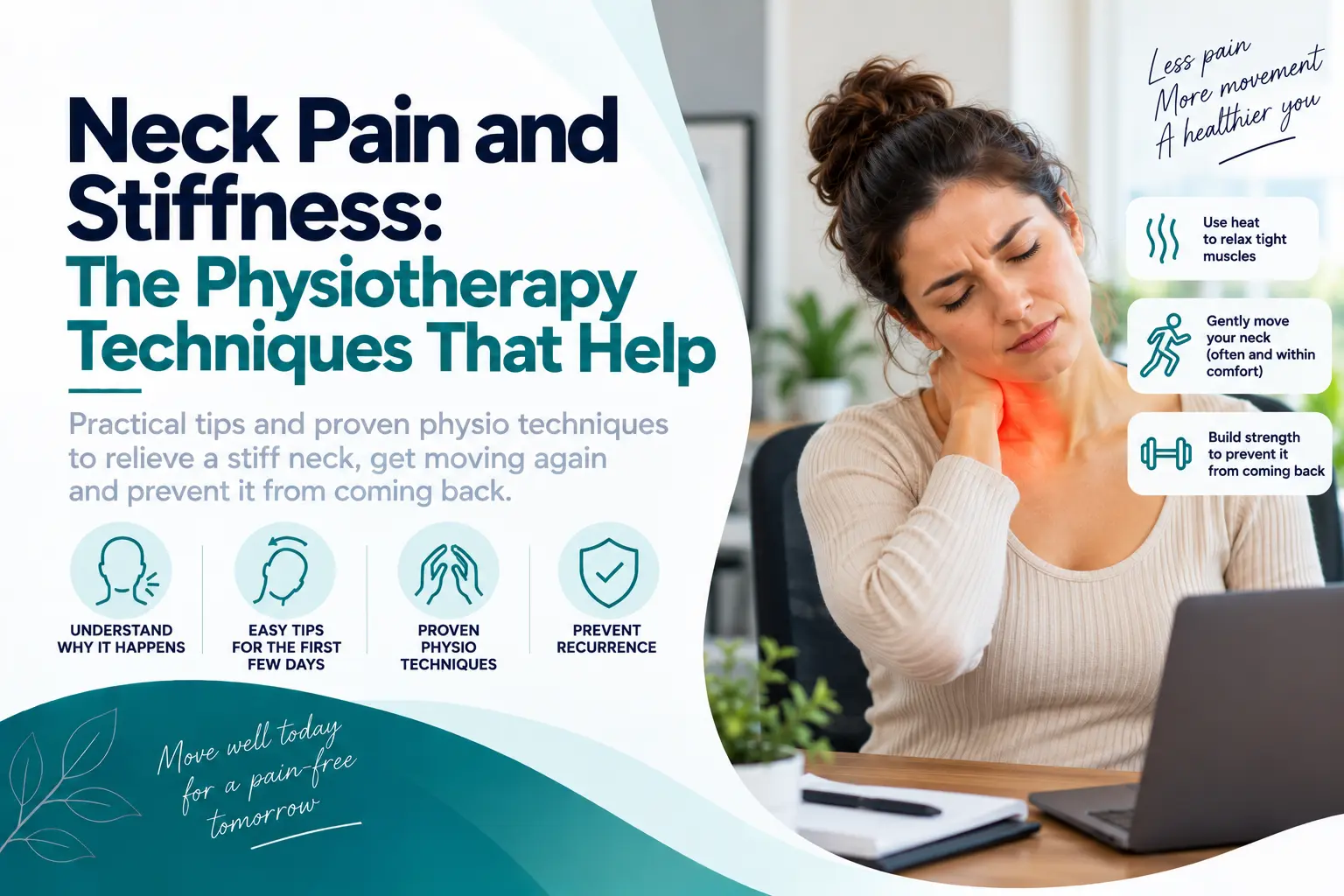
Few things set off a morning like turning your head and finding it will not go. A stiff, locked, painful neck feels alarming, especially when it arrives out of nowhere after a night’s sleep, and the instinct is to hold it rigidly still and fear the worst.
Here is the reassurance that changes how you handle it: the vast majority of neck pain is a short-lived mechanical problem, not a sign of damage, and it settles on its own, usually within a few weeks and often much sooner.
Knowing that, and knowing the few genuine warning signs to watch for, lets you treat the common stiff neck calmly and get moving again rather than seizing up around it.
Most neck pain is a short-lived mechanical problem, not a sign of damage
Neck pain is one of the most common complaints there is, and it will affect most people at some point in life (healthdirect). The reassuring pattern behind that is that most of it is non-specific, meaning it comes from the ordinary soft tissues and joints of the neck being irritated or overworked rather than from anything sinister.
It tends to turn up in a few recognisable ways: the classic woke-up-stiff neck that will not turn, a tension-type ache that builds through a long day, and the kind that keeps coming back in people who sit for hours.
Because it is mechanical and irritable rather than damaged, it responds to movement and time, which is also why, for an everyday stiff neck, scans are usually unnecessary and rarely change what needs doing.
What sets it off is often mundane too, an awkward sleeping position, a stressful week, or hours folded over a screen, which our guide to desk posture and neck pain looks at in more depth.
The ‘can’t turn my head’ neck: what to do in the first few days
The sudden, one-sided stiff neck that locks you up overnight has a name, acute wry neck, and it is as benign as it is dramatic. A small joint or muscle in the neck becomes irritated and guards hard, so turning that way is sharply limited and painful, yet there is no serious damage underneath. The most important thing is not to freeze it in place. Gently and often, move the neck as far as comfort allows in every direction, a little more each time, because that movement is what coaxes the guarding to let go.
Warmth over the tight muscles helps them relax, simple pain relief can take the edge off so you can move, and keeping up your normal day rather than lying still speeds things along. Left to settle with this kind of gentle care, an acute wry neck typically eases over about 7 to 10 days (healthdirect), and often sooner.
The myths that quietly slow a stiff neck down
Much of the folk wisdom around a sore neck actually works against it. The research-backed picture is simpler than the gadgets suggest: keep it moving, keep it warm, and give it time. The table sorts what genuinely helps from what tends to drag recovery out.
| Tends to help | Tends to slow it down |
|---|---|
| Gentle movement within comfort, through the day | Holding the neck rigidly still, or resting it completely |
| Heat, or ice if that feels better, over the tight area | Relying on a neck collar or brace to hold your head up |
| Simple pain relief to let you move more freely | Chasing a scan for an ordinary, mechanical stiff neck |
| Carrying on with normal daily activity | Fearing that moving the neck will cause damage |
The point about collars is worth underlining, because they feel protective: for ordinary neck pain they are not recommended, and propping the head up tends to let the supporting muscles switch off, which leaves you stiffer. Movement, not immobilisation, is the medicine.
The physiotherapy techniques that help, and when they are worth it
Most stiff necks settle without any formal treatment, but physiotherapy earns its place when a neck is very painful, slow to improve, or keeps returning. The approach pairs hands-on work to restore movement with exercise to keep it, rather than relying on either alone. In practice a physiotherapist tends to combine a few things:
- Gentle joint mobilisation to ease a stiff, guarded neck joint and restore its range, which our guide to joint mobilisation for a stiff neck explains in detail.
- Specific exercises and strengthening for the deep neck and shoulder-blade muscles, so the neck holds up better once the pain settles.
- Soft-tissue work and advice to settle a flare and change the daily habits feeding it, part of the wider set of drug-free techniques for neck and spine pain a physiotherapist draws on.
- The common thread is that the lasting fix for a recurring stiff neck is rarely a single treatment done to you; it is restoring movement, then building the capacity that keeps it there.
When a stiff neck needs more than patience
A serious cause of neck pain is uncommon, but a handful of signs mean it is not the ordinary kind and should be acted on rather than waited out. Some are genuine emergencies. Call triple zero (000) if neck pain follows a significant accident or fall, or if it comes on with chest pain, shortness of breath or sweating, which can be a sign of a heart problem rather than the neck at all. Seek urgent medical care, not a physiotherapy booking, if a stiff neck comes with any of these:
Seek urgent medical care if neck pain comes with:
|
Short of these, it is still worth seeing a doctor or physiotherapist if the pain is severe, is getting worse, or has not eased after a few weeks. Ordinary neck pain does none of the above; it is stiff and mechanical, it changes with position, and it is already heading in the right direction within days.
Getting a stubborn neck looked at by Befit Physio in Carlingford and North Kellyville
If your neck has been stiff or sore for more than a couple of weeks, keeps locking up, or is getting in the way of work and sleep, an assessment works out what is driving it and sets up the movement-and-exercise plan that settles it for good.
That hands-on, active approach is part of our neck and spine physiotherapy, and you can be seen at our Carlingford physiotherapy clinic or with our North Kellyville physiotherapists.
| Neck stuck, stiff or sore and not settling? Book a one-on-one assessment online, or call Carlingford on 02 9872 2005 or North Kellyville on 02 9624 2047. We will find what is behind it and get your neck moving freely again. |
Frequently Asked Questions
How long does a stiff neck last?
Most ordinary neck pain and stiffness improves within a few weeks, and the common sudden, one-sided ‘wry neck’ usually eases over about seven to ten days. Gently keeping the neck moving, using heat and carrying on with normal activity tends to shorten that, while holding it rigidly still tends to stretch it out. If it has not improved after a few weeks, it is worth getting assessed.
I woke up and can’t turn my head. What should I do?
This is usually an acute wry neck, which is painful but harmless. Rather than freezing it in place, move the neck gently and often, as far as comfort allows in each direction, and build the range up a little at a time. Warmth over the tight muscles and simple pain relief help you move more freely, and keeping up your normal day speeds recovery. It typically settles within a week or so.
Should I wear a neck collar or brace for a stiff neck?
Generally no. Neck collars and braces are not recommended for ordinary neck pain, and should only be used short-term if a healthcare professional has specifically advised one. Propping the head up tends to let the supporting muscles switch off, which can leave the neck stiffer and slow recovery. Gentle movement does far more good than immobilising it.
Is a physiotherapist or chiropractor better for neck pain?
Both are regulated professions that treat neck pain, and for an ordinary stiff or sore neck either can offer short-term relief. What matters more than the title is the approach: the strongest evidence for lasting neck recovery is active care, specific exercise, restoring movement and building capacity, rather than passive treatment alone. Choose a practitioner who assesses you properly, explains what is going on, and sends you away with a plan and exercises, not an open-ended schedule of appointments. If your neck pain comes with any warning signs, see a doctor first regardless of who you plan to see.
Do I need a scan for neck pain?
Usually not. Imaging is not needed for most people with neck pain, because an ordinary mechanical stiff neck does not show up as anything that changes treatment, and scans often reveal harmless age-related changes that can cause needless worry. A scan is reserved for cases with warning signs, a significant injury, or pain that is not following the expected path.
When is neck pain serious?
Seek urgent care if neck pain follows a significant accident, or comes with chest pain and breathlessness, with a fever and headache and dislike of bright light, with numbness or weakness in a limb, with dizziness or changes to vision or speech, or with bladder or bowel problems. These are uncommon, but they point to something beyond an ordinary stiff neck and need prompt medical attention.
About the author and clinical review
| Author: Anshu Sudan, Principal Physiotherapist and owner, Befit Physiotherapy & Sports Injury Centre (Masters of Physiotherapy, APA member). Clinically reviewed by: a physiotherapist at Befit Physio. Carlingford: Shop 2/1 Post Office St, Carlingford NSW 2118. North Kellyville: 15/21 Hezlett Rd, North Kellyville NSW 2155. |
| Medical disclaimer This article is general information, not personal medical advice, and reflects Australian guidance current as at October 2026. Neck pain has several possible causes, so see a physiotherapist or doctor for an individual assessment and diagnosis if your pain is severe, worsening, or not settling. Call triple zero (000) for neck pain after a serious accident, or neck pain with chest pain, breathlessness or sweating, and seek urgent care for fever with a stiff neck, or numbness or weakness in a limb. |