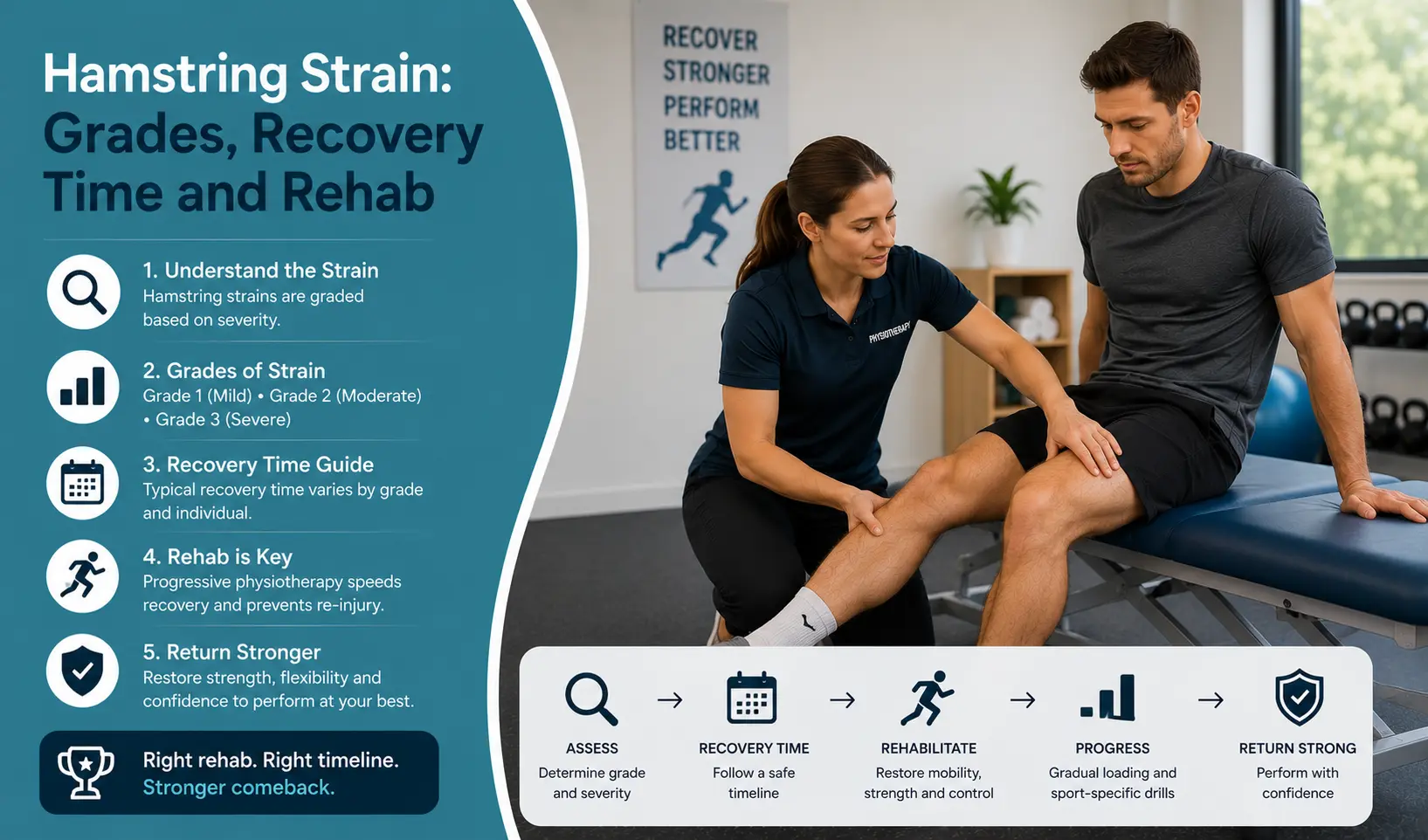
A hamstring strain is one of the most common injuries in running and change-of-direction sport, from the football codes to netball and athletics. How long it keeps you out depends almost entirely on how badly the muscle fibres are torn, which is what the grading system measures.
A mild strain can settle in a few weeks; a severe one takes months. This guide explains the grades, realistic recovery times for each and how rehabilitation works.
There is a catch worth naming up front, though. The hardest part of a hamstring injury is often not the first tear but avoiding the next one, because hamstrings have a stubbornly high recurrence rate.
Getting the rehabilitation and the return to sport right is what breaks that cycle, so this article gives as much attention to preventing reinjury as to healing the first strain.
| The hamstrings are a group of three muscles at the back of the thigh, the biceps femoris, semitendinosus and semimembranosus, that bend the knee and extend the hip. A strain is a tear of one of these muscles, usually during fast running or a sudden stretch and people often describe a sharp pain or a ‘pop’ at the back of the thigh. |
The three grades of hamstring strain
Hamstring strains are graded one to three by how much muscle is torn, and the grade is the single best guide to recovery time. A downloadable copy of this table is attached to this article.
| Grade | What has happened | Common signs | Recovery guide |
|---|---|---|---|
| Grade 1 (mild) | Overstretch with minimal fibre tearing | Tightness and mild pain, often after activity; walking usually possible | About 3 weeks |
| Grade 2 (moderate) | A partial tear of the muscle | More immediate pain, reduced strength, a limp, pain bending the knee against resistance | At least 4 to 8 weeks |
| Grade 3 (severe) | A severe or complete rupture | Sudden sharp pain, sometimes a lump or gap, painful walking, later bruising | Around 3 months, sometimes surgery |
Grade descriptions and recovery guide: Sports Medicine Australia hamstring fact sheet. Individual timeframes vary with the person and the injury.
| Premature return to sport and inadequate rehabilitation increase the risk of reinjury. Sports Medicine Australia |
Why hamstrings re-tear and how to stop it
That quote captures the central challenge. In elite Australian football, where hamstring strains are among the most common injuries, recurrences make up roughly a quarter of all hamstring injuries and the biceps femoris is the muscle torn in about 84% of cases (JOSPT epidemiology of AFL hamstring injuries).
The strongest warning sign for a future strain is a recent one, so the weeks just after you feel better are exactly when the risk is highest. That is why finishing rehabilitation properly, rather than stopping when the pain fades, matters so much.
How hamstring rehabilitation works
Good rehabilitation moves through clear phases. In the first days the aim is to protect the healing muscle and calm the pain, then the focus shifts quickly to gentle movement and progressive loading, because muscle heals stronger when it is loaded, not rested indefinitely.
From there you rebuild strength, especially eccentric strength (the muscle working as it lengthens, which is where hamstrings usually fail), then add running, speed and sport-specific drills.
This staged approach is the same backbone we describe in our guide to the phases of sports injury rehabilitation. Rushing any phase is the classic route to a re-tear.
The exercise that nearly halves the risk
If there is one thing worth building into training, it is the Nordic hamstring exercise, a slow, controlled lowering that trains eccentric strength. Done consistently, it reduces hamstring injury risk by around half (exercise and hamstring injury meta-analysis).
The key word is consistently: the benefit depends on actually keeping it in your weekly program through the season, not just early on. For anyone with a history of hamstring trouble, it is one of the highest-value exercises in sport.
When is it safe to return to sport?
Returning too early is the main driver of recurrence, so base the decision on what your leg can do, not on the calendar. Before full return, you should have:
- full, pain-free range of motion in the hamstring
- strength close to your other leg, including eccentric strength
- completed full-speed running and sport-specific drills, such as accelerating, decelerating and changing direction, without pain
- confidence to sprint and cut without hesitation
One quick clarification: a sudden hamstring strain is not the same as proximal hamstring tendinopathy, a gradual, nagging pain high at the sit-bone that builds with load over time.
The two are managed differently, so if your pain came on slowly rather than in one moment, our guide to how tendinopathy differs from a strain will fit better.
| ⚠ Signs that need prompt assessment Most strains are managed well without imaging, but get assessed promptly if you felt a sudden severe tear with a lump or gap in the muscle, cannot walk or bear weight, have a large or spreading bruise, or have numbness or pins and needles in the leg. A severe (Grade 3) rupture occasionally needs surgical repair, so it is worth confirming the grade early. |
Rehab your hamstring at Befit
A physiotherapist can grade the injury, set realistic timeframes and guide the loading and return-to-sport testing that keep you from re-tearing. It is exactly what our athletic injury treatment is built for.
- Book an assessment with the physiotherapists at our Carlingford clinic or our North Kellyville clinic, online or by phone.
- Start loading early. The sooner rehab begins, the sooner you build the strength that protects the muscle.
| Pulled a hamstring, or keep re-tearing one? Book a one-on-one assessment online, or call Carlingford on 02 9872 2005 or North Kellyville on 02 9624 2047. We will grade it, set a timeline and build the strength that stops it coming back. |
Frequently asked questions
How long does a hamstring strain take to heal?
It depends on the grade, which is why grading matters. A mild strain often settles in a few weeks, a moderate one in one to two months, and a severe rupture can take several months and occasionally surgery. The grades table above gives the specific guides. Rushing the timeline is the main cause of re-tears.
Should I rest or move a strained hamstring?
Protect it for the first day or two, then start moving and loading it under guidance. Muscle heals stronger when it is progressively loaded rather than rested for weeks, so gentle movement early, building to strength and running work, is the modern approach. A physiotherapist sets the right pace for your grade.
Why do hamstring injuries keep coming back?
Because people often return before the muscle has regained full strength and speed tolerance, and a recent strain is itself the strongest risk factor for another. The fix is finishing rehabilitation, meeting objective return-to-sport criteria, and keeping up eccentric strength work like the Nordic exercise long after the pain has gone.
Do I need a scan for a hamstring strain?
Usually not. Most strains are diagnosed and graded clinically by a physiotherapist. Imaging is reserved for severe injuries, when a complete rupture is suspected, or when the recovery is not going as expected and the information would change your treatment or timeline.
About the author and clinical review
| Author: Anshu Sudan, Principal Physiotherapist, Befit Physiotherapy & Sports Injury Centre. Clinically reviewed by: a Befit physiotherapist. Carlingford: Shop 2/1 Post Office St, Carlingford NSW 2118. North Kellyville: 15/21 Hezlett Rd, North Kellyville NSW 2155. |
| Medical disclaimer This article is general information, not personal medical advice, and reflects Australian guidance as at July 2026. Hamstring injuries vary, so get an individual assessment for a diagnosis and a plan. If you have signs of a severe rupture or any of the warning signs above, seek prompt care. |