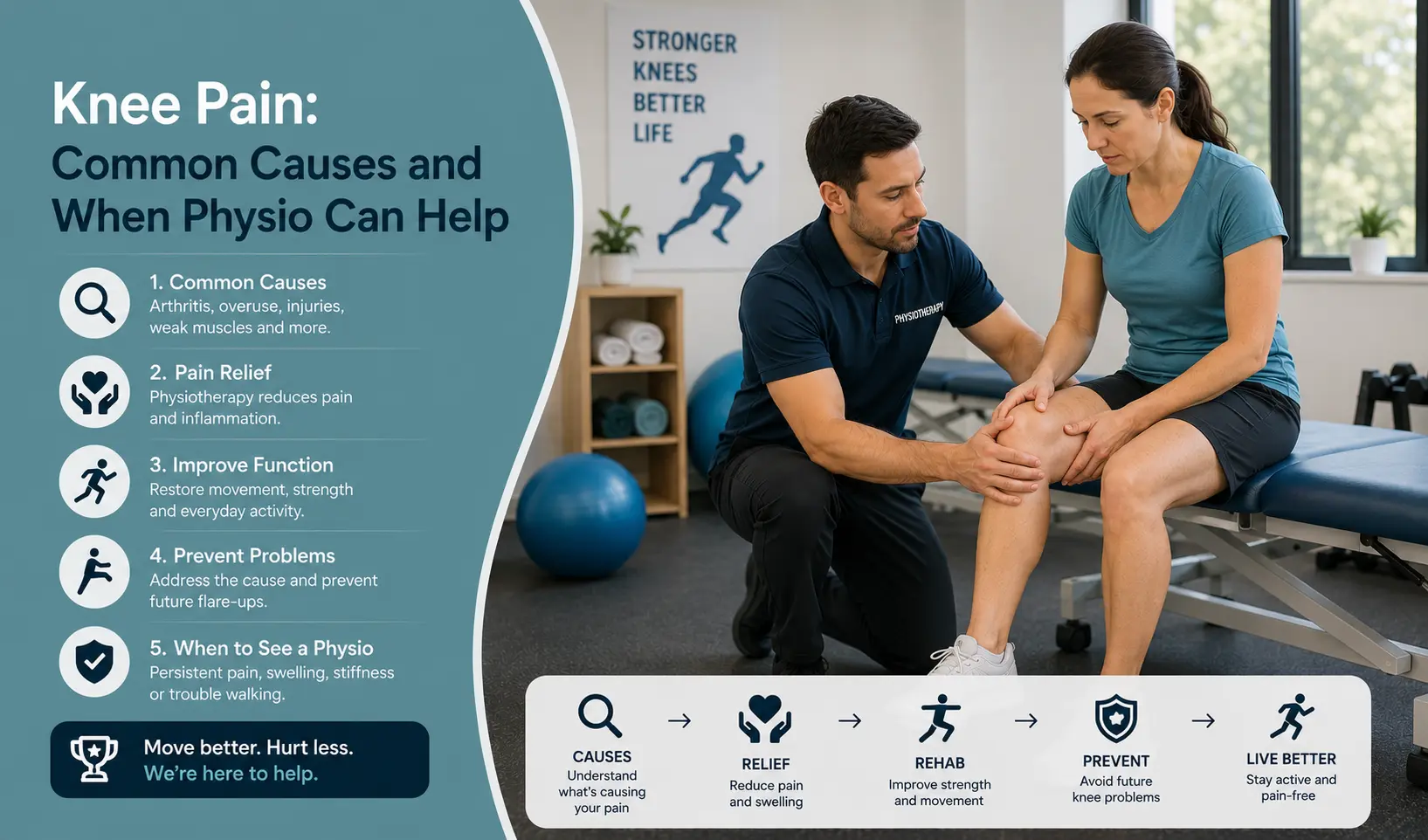
Knee pain is one of the most common reasons people see a physiotherapist, and it becomes more likely as we age: around one in five Australians aged 65 and over report knee pain, and population studies put it in roughly a third of adults (AIHW).
The knee is a hard-working hinge where the thigh bone, shin bone and kneecap meet, cushioned by cartilage and held by ligaments and tendons, so pain can come from any of those parts. The reassuring news is that most knee pain is mechanical and manageable and the great majority improves without surgery.
This guide helps you make sense of your own knee. It shows how to use the location of your pain to narrow the likely cause, walks through the common culprits, and explains when a physiotherapist can help and when a knee needs urgent care.
First, was it sudden or gradual?
The single most useful clue is how your pain started, because it points to two very different groups of causes:
- Sudden, after a specific moment. A twist, awkward landing, tackle or fall points toward an injury such as a ligament sprain, a meniscus tear, or a kneecap problem.
- Gradual, with no clear trigger. An ache that creeps in over weeks or months points toward overuse or wear, such as osteoarthritis, patellofemoral pain, or a tendinopathy.
Hold that distinction in mind as you read on, because it changes what is likely and what helps.
Where does it hurt? Using pain location to narrow the cause
Where your knee hurts is a genuinely useful shortcut, because different structures sit in different places. Find the row that matches your pain to see the usual suspects.
Use it to orient yourself, not to self-diagnose; a physiotherapist confirms the cause with a hands-on assessment.
| Where it hurts | Likely causes | A typical clue |
|---|---|---|
| Front, around the kneecap | Patellofemoral pain (runner’s knee), patellar or quadriceps tendinopathy | Aches with stairs, squatting or long sitting |
| Inner (medial) side | Medial osteoarthritis, medial meniscus, MCL sprain | Pain on the inside, after a twist or with wear |
| Outer (lateral) side | Iliotibial band syndrome, lateral meniscus, LCL sprain | Common in runners and cyclists, with activity |
| Back of the knee | Baker’s cyst, hamstring or calf issues, posterior meniscus | Tightness or fullness behind the knee |
| Deep or all over, with swelling | Osteoarthritis, inflammation, or a significant internal injury | Stiffness, grinding, or a swollen joint |
| Locks, gives way or will not straighten | Meniscus tear or ligament injury | A catching, locking or unstable feeling |
Befit Knee-Pain Locator v1.0 · 11 July 2026. A guide to narrow the likely cause; confirm it with an assessment. General knee-pain information: healthdirect.
The common causes of knee pain, at a glance
Most knee pain traces back to one of a handful of causes. Here is how they usually present and what helps first.
| Cause | What it often feels like | Who tends to get it | First-line help |
|---|---|---|---|
| Osteoarthritis | Stiff and achy, worse with use, morning stiffness that eases | Adults over 45, and after past injury | Exercise, strength and weight management |
| Patellofemoral pain | Dull ache at the front, worse on stairs and squatting | Runners, active teens and young adults | Load management and targeted strengthening |
| Meniscus tear | Pain on twisting, sometimes catching or locking | Sports players, and older adults with wear | Rehabilitation first for most cases |
| Ligament injury | Sudden pain, swelling, a sense of giving way | Change-of-direction sports | Rehab, with or without surgery |
| Tendinopathy | Pain at the tendon with jumping or loading | Jumping and running athletes | Progressive loading exercise |
| Bursitis | Swelling and tenderness over one spot | Kneeling occupations, older adults | Managing load and irritation |
A closer look at the causes that matter most
Osteoarthritis: wear that responds to movement
Osteoarthritis is the gradual thinning of the smooth cartilage that lines the joint, and it is the most common cause of persistent knee pain with age. It tends to feel stiff and achy, worse after use and often stiff first thing in the morning.
The word can sound like a sentence to a life of decline, but the evidence points the other way: exercise and strengthening reduce osteoarthritis pain and improve function and they benefit more than the joint alone (JOSPT).
Patellofemoral pain: the front-of-knee ache
Patellofemoral pain, often called runner’s knee, is felt around or behind the kneecap and flares with stairs, squatting, running and long periods of sitting. It usually reflects how load is distributed across the kneecap rather than any damage, which is why it responds so well to targeted strengthening of the hip and thigh and to sensible load management, rather than rest alone.
Meniscus and ligament injuries: the twist-and-swell group
The meniscus is a C-shaped cartilage cushion, and a tear, whether from a sporting twist or age-related wear, can cause pain, catching or locking. Ligaments such as the ACL and MCL stabilise the knee and a sprain or tear typically brings sudden pain, swelling and a feeling of the knee giving way.
Both often recover well with rehabilitation and surgery is far from automatic.
| Two things worth knowing Scans can mislead. Cartilage changes and meniscus tears show up on the scans of plenty of people with no pain at all, so an image alone rarely explains your symptoms or decides your treatment. Keyhole surgery is not the answer for wear. For uncomplicated knee osteoarthritis, arthroscopy (keyhole surgery) is not recommended, because it offers little or no benefit; exercise, education and weight management come first (Osteoarthritis of the Knee Clinical Care Standard). |
When to see a physiotherapist and when to get urgent care
See a physiotherapist if your knee pain is limiting you, not settling or keeps coming back. It is worth booking when:
- the pain has lasted more than a couple of weeks or keeps returning
- it is limiting stairs, walking, sport or sleep
- the knee feels unstable, keeps giving way, or catches and locks
- you want a clear diagnosis and a plan rather than guessing
| Seek urgent care if you cannot put weight on the leg after an injury, the knee is hot, red and very swollen (which can signal infection or gout), you have a fever with a painful joint, or the knee is locked and will not straighten. These need prompt medical assessment rather than watchful waiting. |
How physiotherapy helps your knee
Whatever the cause, physiotherapy starts with a proper assessment to pinpoint which structure is driving the pain and why. From there, treatment is mostly active: targeted strengthening, movement retraining and graded loading, supported by hands-on techniques and clear advice on activity.
For osteoarthritis and most overuse problems this is genuinely first-line care and for injuries it is what rebuilds a stable, confident knee, with or without surgery. You can read how our non-surgical knee care is structured across a course of treatment.
Get your knee assessed at Befit Physio
- Book an assessment with the Carlingford clinic or our Kellyville-area physios, online or by phone.
- Bring the story. How it started, what makes it worse, and any scans help us tailor your plan.
| Not sure what is causing your knee pain? Book a one-on-one assessment online, or call Carlingford on 02 9872 2005 or North Kellyville on 02 9624 2047. We will identify the cause and set you up with the right plan for your knee. |
Frequently asked questions
What is the most common cause of knee pain?
It depends on age and activity. In adults over 45, osteoarthritis is the most common cause of persistent knee pain, while in active younger people patellofemoral pain (runner’s knee) and sports injuries such as ligament and meniscus problems are more common. Where the pain sits, and whether it came on suddenly, helps narrow it down.
Should I rest my knee or keep moving?
For most knee pain, gentle movement and gradually building activity beat prolonged rest. For osteoarthritis and overuse problems, exercise is first-line treatment, not something to avoid. After a fresh injury you may protect the knee briefly, but even then the aim is to return to movement as soon as it is safe.
Do I need a scan for knee pain?
Usually not straight away. Scans often show cartilage or meniscus changes even in people without pain, so they rarely change early treatment. A physiotherapist can diagnose most knee pain from your history and an examination, and will recommend imaging only if it would alter your management.
Can physiotherapy fix knee pain without surgery?
Very often, yes. Most knee pain, including osteoarthritis, patellofemoral pain and many meniscus and ligament injuries, is managed well without surgery. Physiotherapy uses exercise, load management and hands-on care to reduce pain and rebuild strength, and surgery is reserved for the cases that genuinely need it.
About the author and clinical review
| Author: Anshu Sudan, Principal Physiotherapist, Befit Physiotherapy & Sports Injury Centre. Clinically reviewed by: a Befit physiotherapist. Carlingford: Shop 2/1 Post Office St, Carlingford NSW 2118. North Kellyville: 15/21 Hezlett Rd, North Kellyville NSW 2155. |
| Medical disclaimer This article is general information, not personal medical advice, and reflects Australian guidance as at July 2026. Knee pain has many causes and varies from person to person, so use this as a guide and get an individual assessment for a diagnosis. If you have any of the urgent signs above, seek prompt medical care. |