The operation repairs the structure; the movement you do afterward is what turns it into a working shoulder. In the first weeks that movement is deliberately gentle, because the tissue needs to be protected while it heals. Done well, early exercise reduces stiffness and swelling and sets up your later strength, and it does so without putting the repair at risk.
Before any exercise, one rule matters more than the rest: your surgeon’s protocol governs what you do and when. Timelines differ by operation, so the safe early exercises after a keyhole decompression are not the same as those after a rotator cuff repair or a stabilisation.
The exercises below are the gentle, early-stage movements commonly cleared after many shoulder surgeries, offered as a guide to understand, not a substitute for your own written plan.
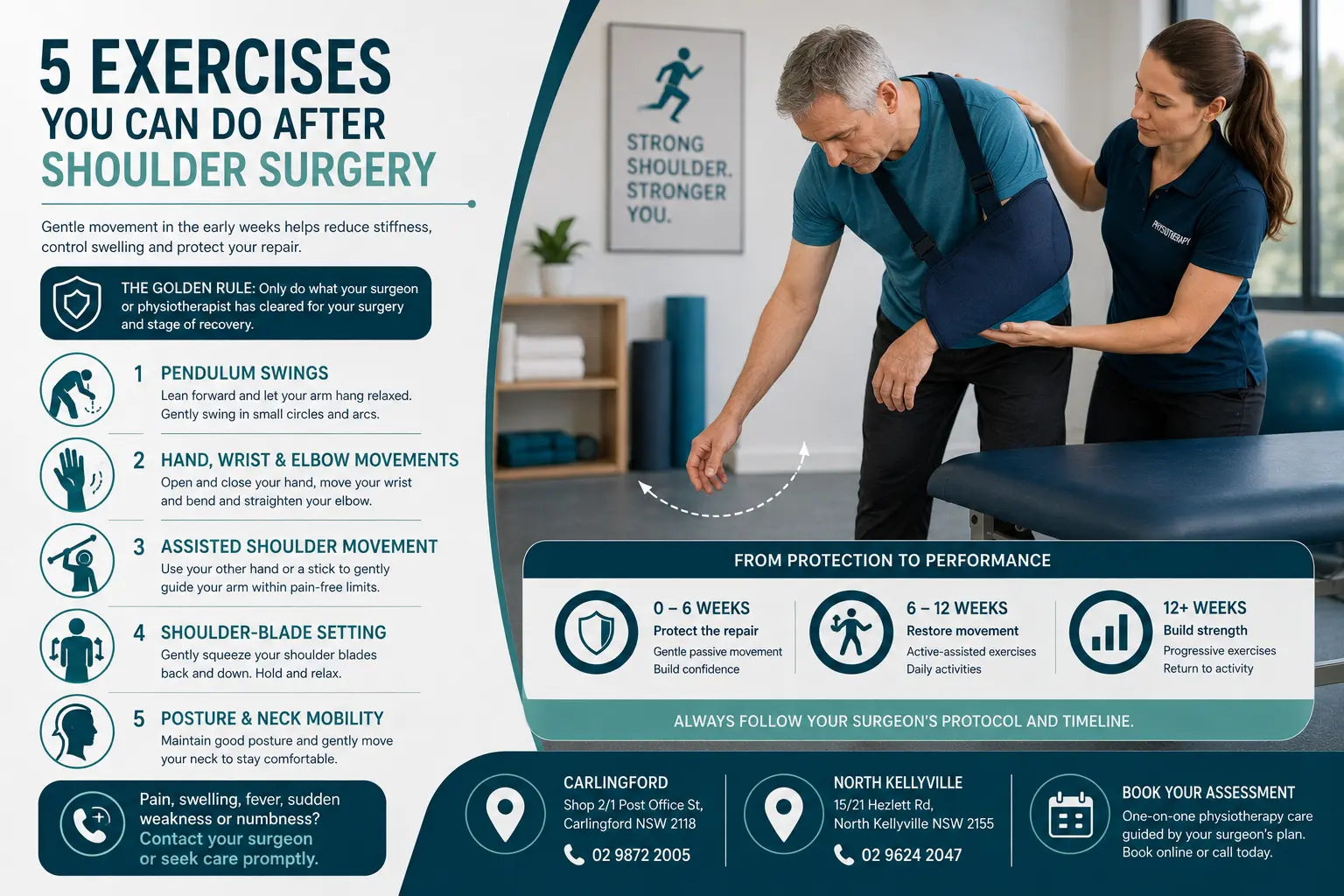
| The golden rule before you start Only do what your surgeon or physiotherapist has cleared for your specific surgery and stage. After a rotator cuff repair, for example, movement is usually passive only, with no active lifting or reaching for about the first six weeks, and a sling is worn to protect the repair. If an exercise causes sharp pain, stop it and check with your team. |
It is tempting to think that doing more, sooner, means healing faster. For a freshly repaired shoulder the opposite can be true: pushing into active movement too early can strain the repair, and studies comparing early aggressive rehabilitation with a more conservative approach have found the gentler path can give better results (conservative versus aggressive rehabilitation study). Gentle and consistent, guided by your protocol, beats rushing every time.
| Care should be taken by all patients to understand their operation and the precautions set by their surgeon. |
The type of surgery shapes your exercises
Shoulder operations are not all the same, and the differences decide what is safe early on. A rotator cuff repair reattaches tendon to bone and needs the most protection, which is why active lifting waits. A subacromial decompression removes a little bone or soft tissue to ease impingement and often allows earlier movement.
A stabilisation or labral repair usually limits outward rotation for a time to protect the mend, and a shoulder replacement follows its own staged plan. Knowing which operation you had is the key to knowing which movements are safe, and when.
This is also why generic exercise videos can be risky after surgery: a movement that is fine after one procedure can strain another. Your written protocol accounts for your operation, your tissue and your progress, so treat it as the final word and use the exercises here to understand the why behind it.
Five gentle exercises for the early weeks
1. Pendulum swings
The classic first exercise. Leaning forward with your good arm supported on a table, let the operated arm hang and relax, then gently shift your body weight so the arm swings in small circles and back-and-forth arcs.
The movement comes from your body, not your shoulder muscles, which is why it counts as passive motion: it eases stiffness and keeps the joint moving without the cuff having to work.
2. Hand, wrist and elbow movements
While the shoulder rests in its sling, the rest of the arm should keep moving. Open and close your hand, squeeze a soft ball, circle your wrist, and bend and straighten your elbow when your protocol allows it out of the sling.
This keeps the whole limb mobile, reduces swelling, and prevents the stiffness and weakness that come from a hand and elbow left still for weeks.
3. Assisted shoulder movement
Once cleared, you gently guide the operated arm using your other hand or a light stick, letting the good side do the work. Common versions are assisted forward raising and assisted outward rotation, always kept within the limits your surgeon sets.
This restores range of motion while the repair is still protected, because your own muscles are not lifting the arm.
4. Shoulder-blade setting
Sitting or standing tall, gently draw your shoulder blades back and down, hold briefly, then relax, without shrugging or hitching the shoulder up.
The shoulder blade is the base the shoulder moves on, so waking up these stabilising muscles early lays the groundwork for later strength, and it can be done safely without loading the repair itself.
5. Posture and neck mobility
Wearing a sling pulls you into a rounded, hunched position, which stiffens the neck and upper back and can add to your discomfort. Gentle neck turns, chin tucks and sitting upright counter that.
It is easy to overlook, but good posture supports shoulder recovery and keeps the surrounding joints comfortable while the shoulder heals.
How the exercises progress over time
These five sit at the start of a longer path. Recovery usually unfolds in phases, and each one allows a little more, always on your surgeon’s timeline rather than the calendar alone.
| Phase | What is usually happening | Typical exercise focus |
|---|---|---|
| Weeks 0 to 6 | Protecting the repair; sling worn | Pendulum, hand and elbow movement, assisted range as cleared |
| Weeks 6 to 12 | Coming out of the sling, restoring movement | Active-assisted movement, gentle everyday use |
| After 12 weeks | Rebuilding strength | Active and progressive resistance work, return to activity |
General post-operative phases; timelines are set by your surgeon. See AAOS OrthoInfo on rotator cuff surgery.
| ⚠ Contact your surgeon or seek care if Early recovery has its own warning signs. Contact your surgical team promptly for increasing rather than easing pain, spreading redness, heat or swelling, wound discharge or a fever (possible infection), a sudden loss of movement or a feeling that something has given way, or new numbness, tingling or coldness in the hand. Shoulder pain with chest tightness or breathlessness is a medical emergency; call 000 (healthdirect). |
How a physiotherapist guides your recovery
A physiotherapist turns your surgeon’s protocol into a plan you can actually follow: showing you each movement, checking your technique, and progressing the exercises at the right moment so you neither push too hard nor fall behind.
That guidance is the difference between a stiff, hesitant shoulder and a confident one, and it is what our shoulder injury rehabilitation provides after surgery.
If your operation was a cuff repair, our guide to rotator cuff injury and recovery adds useful background, and if you are weighing up whether surgery is even needed, how physiotherapy helps shoulder pain without surgery is worth a read.
Recover your shoulder at Befit
- Bring your protocol. Your surgeon’s post-operative plan tells us exactly what is safe at your stage, so bring it to your first visit.
- Book with us at our team in Carlingford physio clinic or our team in North Kellyville, online or by phone.
| Recovering from shoulder surgery? Book a one-on-one assessment online, or call Carlingford on 02 9872 2005 or North Kellyville on 02 9624 2047. We will follow your surgeon’s protocol and guide every stage of your recovery. |
Frequently asked questions
When can I start exercising after shoulder surgery?
Often within the first days, but only the gentle movements your surgeon has cleared. Pendulum swings and hand, wrist and elbow movement usually start early, while shoulder movement is introduced gradually. The exact timing depends on your operation, so follow your written protocol rather than a general timeline.
Why can’t I lift my arm after a rotator cuff repair?
Because active lifting makes the repaired tendon work, and it needs time to heal onto the bone first. For roughly the first six weeks after a cuff repair, movement is usually kept passive, with the arm moved by your other hand, a stick or a therapist, so the repair is protected while you still keep the joint moving.
How long does it take to recover from shoulder surgery?
It is a matter of months, not weeks, and it varies with the operation. Many people progress from protected movement in the early weeks to active strengthening after around three months, with continued gains beyond that. Consistent, staged rehabilitation is what makes the final result strong and reliable.
How should I sleep and manage daily life after shoulder surgery?
Many people sleep more comfortably semi-upright for the first few weeks, in a recliner or propped on pillows, and keep the sling on as directed. Dressing, showering and returning to driving are all guided by your surgeon, and driving in particular usually waits until you are out of the sling and can steer and react safely. Check your own timeline with your team.
Do I really need physiotherapy after shoulder surgery?
For most shoulder operations, yes. The surgery fixes the structure, but movement, strength and confidence are rebuilt through rehabilitation. Without it, shoulders commonly end up stiff and weak. A physiotherapist keeps you progressing safely within your surgeon’s protocol and helps you avoid setbacks.
About the author and clinical review
| Author: Anshu Sudan, Principal Physiotherapist, Befit Physiotherapy & Sports Injury Centre. Clinically reviewed by: a Befit physiotherapist. Carlingford: Shop 2/1 Post Office St, Carlingford NSW 2118. North Kellyville: 15/21 Hezlett Rd, North Kellyville NSW 2155. |
| Medical disclaimer This article is general information, not personal medical advice, and reflects the position as at July 2026. Exercises and timelines after shoulder surgery depend entirely on your specific operation and your surgeon’s protocol. Do not start any exercise without clearance from your surgeon or physiotherapist, and seek prompt care for the warning signs above. |