When people picture a workplace injury, they tend to imagine something dramatic: a fall from a ladder, a load dropped on a foot, a sudden wrench lifting a box. Those happen, but they are not the typical story. Far more work injuries build up quietly over weeks and months, as the same task, repeated often enough, slowly outpaces what the body can comfortably take.
By the time the ache becomes a problem, people have usually been pushing through it for a while, which is exactly the mistake that turns a manageable niggle into weeks off work. Understanding how work injuries really develop, and acting earlier than feels necessary, is the difference between a quick recovery and a long one.
Two ways work hurts you: the sudden and the cumulative
Work injuries arrive by one of two routes. Acute injuries happen in a moment, a slip, a trip, a heavy lift that goes wrong, and the cause and effect are obvious. Cumulative, or gradual-onset, injuries are the sneaky ones: repeated loading of the same muscles, tendons or joints, often in an awkward posture or under time pressure, until the tissue becomes irritated and painful with no single moment to blame.
The two need different mindsets. An acute injury announces itself and gets attention; a gradual one gives early warnings, a stiffness here, a twinge there, that are easy to dismiss. Learning to treat those early signals as information rather than nuisance is the single most useful habit for anyone whose job loads their body.
What actually gets injured at work, and how often
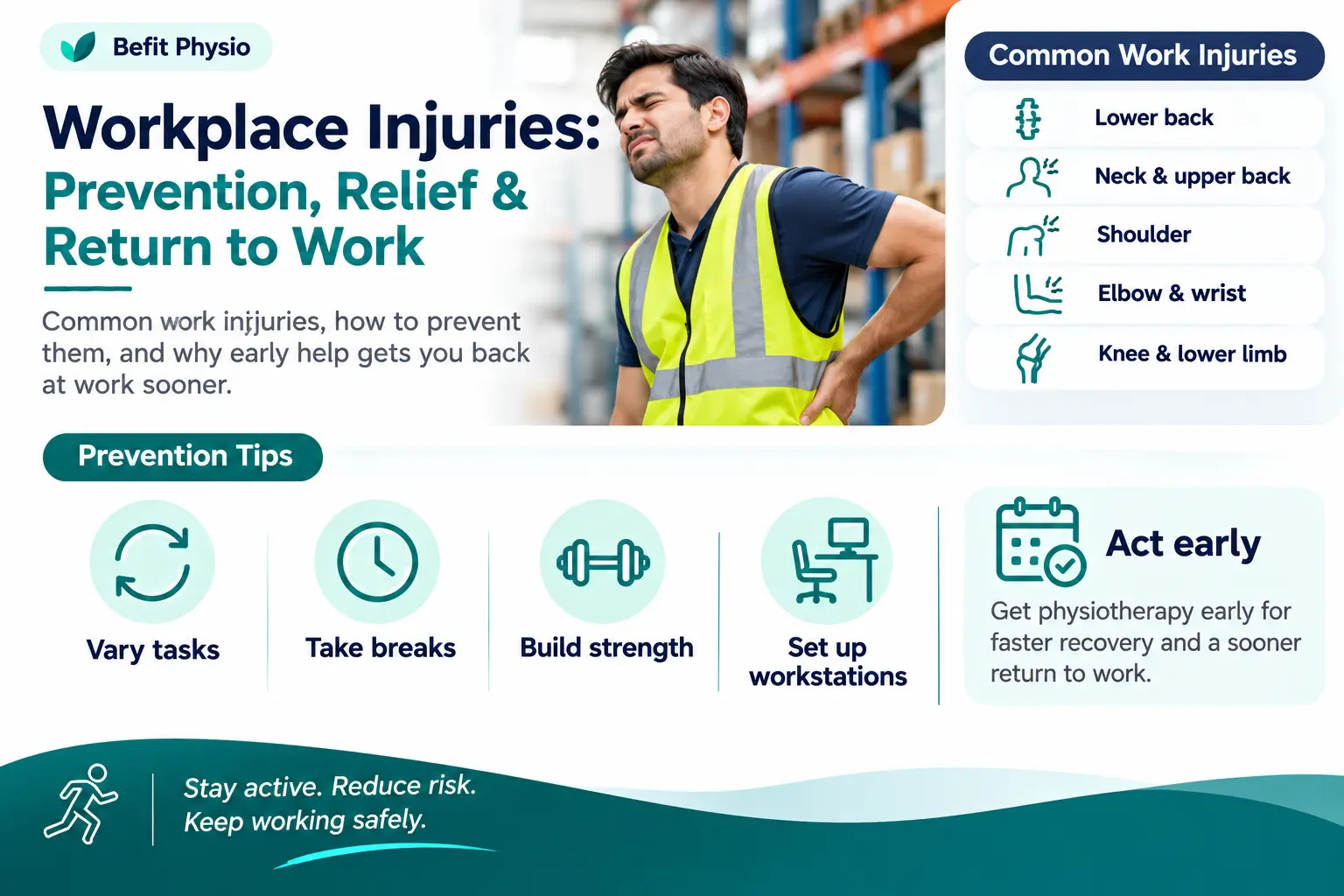
The pattern of work injuries tracks the demands of the job. In Australia, body stressing, the official term for lifting, carrying, pushing, pulling and repetitive manual tasks, is the single leading cause of serious workers’ compensation claims, behind roughly one in three of them, and the resulting muscle, tendon, ligament and joint injuries are the biggest category of all (Safe Work Australia on manual tasks). Where it shows up depends on what you do:
| Common work injury | Where it tends to come from |
|---|---|
| Lower back strain | Manual handling: lifting, bending and twisting under load |
| Neck and upper-back pain | Long hours at a desk or driving, head forward and still |
| Shoulder overuse | Repeated overhead or reaching work, trades and stacking |
| Elbow and wrist strain | Repetitive gripping, typing, assembly or tool use |
| Knee and lower-limb injury | Kneeling, climbing, or a slip, trip or fall |
These are not trivial. Serious body-stressing claims keep people off work for a median of around nine weeks, longer than the average for all work injuries, which is why preventing them, and treating them early, is worth real attention rather than a wait-and-see shrug.
Prevention that works: beyond “lift with your legs”
The old advice to “lift with your legs, not your back” is not wrong, but on its own it is far from enough, and the evidence that technique alone prevents back injury is surprisingly weak. Modern injury prevention is really about managing load over time rather than perfecting a single movement. The levers that genuinely help:
- Vary the task. Rotating duties and breaking up long bouts of the same movement stops any one tissue being loaded past its limit.
- Respect fatigue. Most gradual injuries build when a tired body keeps doing a demanding task; micro-breaks and pacing matter more than people think.
- Build capacity. A stronger, fitter body tolerates work demands better, which is why general conditioning is quietly one of the best forms of injury prevention.
- Set the workstation up. For desk-based staff, posture and screen height still matter, and easing a sore neck or back is covered in our tips for relieving lower-back pain.
The theme is that bodies cope with a great deal when the load is varied, built up gradually and matched to a well-rested, capable worker, and they break down when demand spikes, repeats without pause, or lands on someone under-prepared for it.
The biggest lever is time: why early help beats toughing it out
If there is one message worth taking from this, it is to act early. A gradual-onset injury caught in its first weeks, while it is still just an irritable tissue, usually settles quickly; the same problem ignored for months, pushed through every shift, becomes entrenched and far slower to turn around.
There is rarely a prize for toughing it out, and often a real cost. Encouragingly, the system now supports early action: changes to workers’ compensation mean you can access physiotherapy in the early stages of a work injury rather than waiting for a drawn-out approval, and our payment and workers’ compensation options page sets out how that works at the clinic.
The practical rule is simple: if a work-related ache is not settling within a week or two of easing off, get it assessed rather than hoping it fades.
Staying at work usually helps recovery, not harms it
One of the most counterintuitive findings in this area is that, for most injuries, staying at work in some capacity tends to aid recovery rather than hinder it. Long periods away from work are associated with worse physical and mental health and a lower chance of ever returning, whereas a timely, supported return, often on modified or lighter duties while you heal, keeps you moving, connected and recovering.
That does not mean ignoring an injury or pushing into harm; it means the goal is rarely total rest until you are perfect, but a graded return that respects the injury while keeping you active. A physiotherapist helps shape exactly that, working out what you can safely do now and progressing it, in step with your workplace, as you improve.
Getting the right treatment for a work injury
Because “work injury” covers everything from a wrenched back to a repetitive-strain elbow, treatment starts with pinning down what has actually been injured and why. From there the plan follows the same principles as any good rehabilitation: settle the irritated tissue, restore movement and, above all, rebuild the capacity to handle the demands that caused the problem in the first place, so it does not simply return on your first week back.
A repetitive-strain complaint such as tennis or golfer’s elbow is managed quite differently from a manual-handling back injury or nerve pain referred down the leg, which is why a tailored assessment beats a generic “rest and painkillers” approach. Rehabilitating work and sports injuries back to full capacity is the core of our sports injury physiotherapy, and the same thinking applies whether the injury happened on a field or a factory floor (what physiotherapists do).
The paperwork side: workers’ compensation in New South Wales
If your injury is work-related and you intend to claim, a few steps keep it straightforward. Report the injury to your employer, see a doctor to have it assessed and, if needed, to issue a certificate of capacity, and choose a physiotherapy provider registered to treat workers’ compensation patients, which we are.
Your treatment and any modified-duties plan are then coordinated between you, your doctor, your physiotherapist and your employer or insurer. The detail varies with your circumstances and the scheme can change, so it is worth confirming the specifics when you book rather than assuming, and bringing any claim or employer paperwork to your first visit.
Treating work injuries at Befit Physio in Carlingford and North Kellyville
Whether you have strained your back on a lift, developed a nagging wrist from repetitive work, or simply want to stop a grumbling ache becoming a claim, an early assessment is the move that pays off.
We treat work injuries routinely, coordinate with workers’ compensation where it applies, and build the kind of graded plan that gets you back to full duties and keeps you there.
You can be seen at our Carlingford physiotherapy clinic or with our North Kellyville physiotherapists, in the clinic or at your workplace.
| Hurt at work, or an ache that will not settle? Book a one-on-one assessment online, or call Carlingford on 02 9872 2005 or North Kellyville on 02 9624 2047. We will assess it early and build the plan that gets you back to work safely. |
Frequently Asked Questions
What are the most common workplace injuries?
In Australia, injuries from body stressing, lifting, carrying, pushing, pulling and repetitive manual tasks, are by far the most common and account for about a third of serious workers’ compensation claims. They typically show up as lower-back strains, neck and shoulder pain, and elbow or wrist complaints, depending on the job. Slips, trips and falls add a layer of acute injuries, but the gradual, overuse type is the bigger and more preventable problem.
Can I claim physiotherapy on workers’ compensation?
Yes. If your injury is work-related, physiotherapy is generally covered under workers’ compensation, and changes to the system now allow earlier access rather than a long wait for approval. You will usually need the injury reported to your employer and assessed by a doctor, and you should choose a physiotherapy provider registered to treat workers’ compensation patients. The exact process depends on your circumstances, so it is worth confirming the details when you book.
Should I keep working with a work injury or rest completely?
For most injuries, staying at work in some capacity, often on modified or lighter duties, supports recovery better than complete rest. Extended time away is linked to slower recovery and worse outcomes, while a graded, supported return keeps you active and connected. This is not about pushing through harm; it is about doing what you safely can while the injury heals. A physiotherapist, working with your doctor and employer, helps set the right level.
How can I prevent injuries at work?
Think beyond lifting technique, which on its own does little. The bigger levers are varying your tasks so no single tissue is overloaded, pacing and taking micro-breaks to manage fatigue, building general strength and fitness so your body tolerates the demands, and setting up your workstation or tools well. Catching early warning signs, stiffness or twinges, and easing off before they become injuries is also a genuine prevention strategy.
Do I need to see a doctor before a physiotherapist for a work injury?
For a standard appointment you can see a physiotherapist directly. However, if you intend to claim workers’ compensation, you will generally also need a doctor to assess the injury and provide a certificate of capacity, and the two work together on your plan. If you are unsure, booking a physiotherapy assessment early is still worthwhile; we can advise on the steps and coordinate with your doctor and employer as needed.
About the author and clinical review
| Author: Anshu Sudan, Principal Physiotherapist and owner, Befit Physiotherapy & Sports Injury Centre (Masters of Physiotherapy, APA member). Clinically reviewed by: a physiotherapist at Befit Physio. Carlingford: Shop 2/1 Post Office St, Carlingford NSW 2118. North Kellyville: 15/21 Hezlett Rd, North Kellyville NSW 2155. |
| Medical disclaimer This article is general information, not personal medical advice, and reflects current evidence and Australian guidance as at November 2026. Injuries and workers’ compensation rules vary with your circumstances and can change, so see a physiotherapist or doctor for an individual assessment and confirm the claim process that applies to you. Seek prompt medical care for severe pain, a significant fall or crush injury, numbness, or any rapidly worsening symptom. |