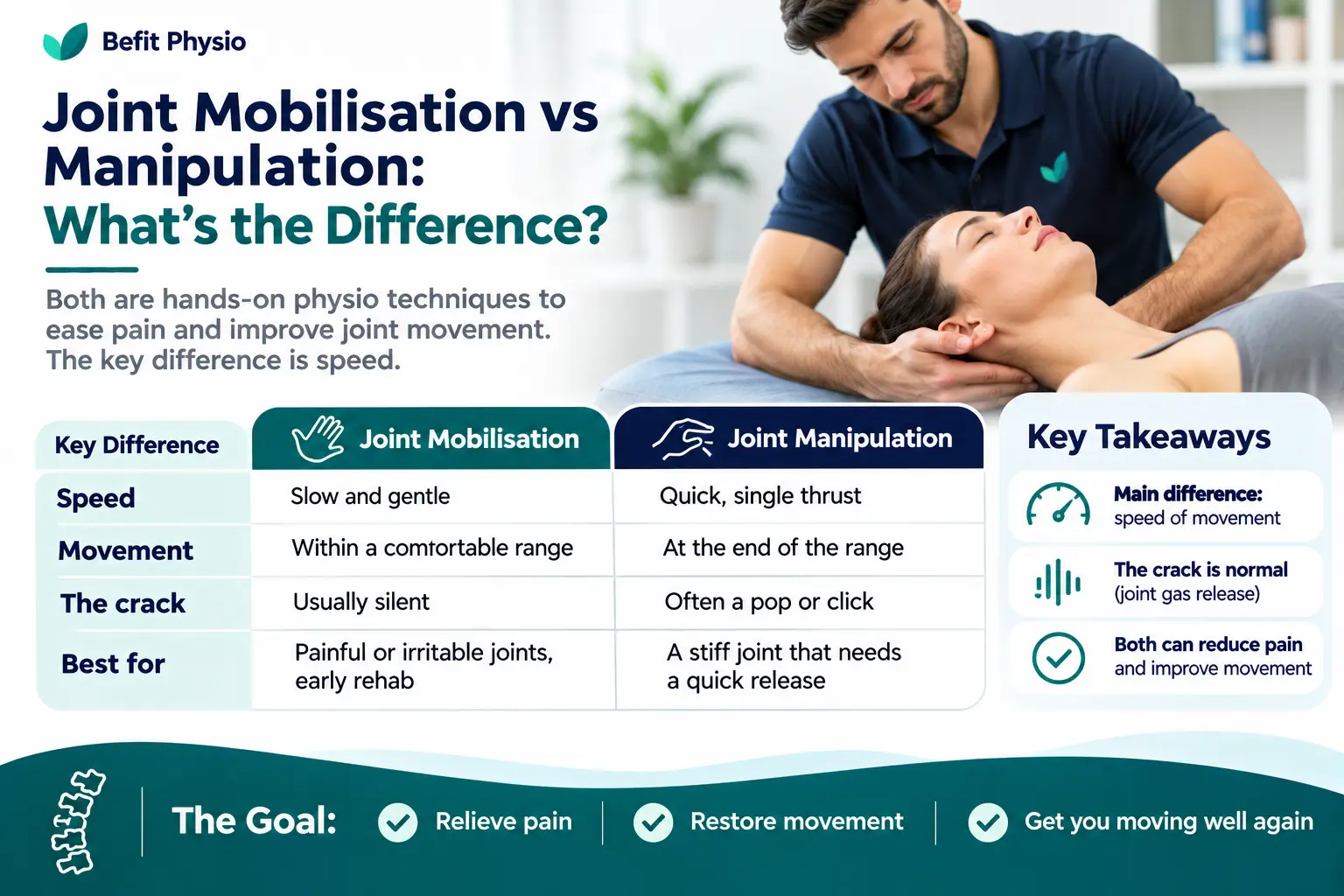
Say “manipulation” and most people picture the same thing: a quick movement, a loud crack, and a dramatic sense of something being put back in place. Say “mobilisation” and far fewer people know what you mean, even though it is the technique a physiotherapist is far more likely to use on you.
Both belong to the same family of hands-on treatment, both are used to ease pain and free up a stiff joint, and both are performed by trained clinicians. Yet they are genuinely different things, and the differences, in speed, in control, and in that famous crack, matter when you are deciding what you want done to your spine.
Here is what actually separates them, minus the mystique.
Two hands-on techniques, one defining difference: speed
Strip everything else away and the line between the two comes down to how fast the movement happens. Joint mobilisation is a slow, rhythmic, controlled movement that a physiotherapist applies to a stiff joint, coaxing it through its available range to ease pain and restore glide.
Joint manipulation is a single, fast, small thrust, known in the trade as a high-velocity, low-amplitude technique, delivered right at the end of a joint’s range. Mobilisation is a conversation with the joint; manipulation is one quick, decisive word. Everything else that differs between them, the grip, the sound, the sensation, flows from that one contrast in tempo.
Side by side: how mobilisation and manipulation compare
| What differs | Joint mobilisation | Joint manipulation |
|---|---|---|
| Speed and force | Slow, gentle, repeated oscillations | A fast, single, low-force thrust |
| Where in the range | Within the joint’s available range | Right at or just past the end of range |
| Your control | Slow enough to relax, resist or stop it | Too quick to guard against |
| The sound | Usually silent | Often a distinct pop or click |
| Typically used for | Sensitive, stiff or irritable joints; early rehab | A stiff segment that needs a quick release |
Neither is automatically “better.” They are different tools for different moments, and a skilled physiotherapist carries both and chooses between them, which is quite different from the idea that one must replace the other.
About that “crack”: what the pop actually is
The sound is the most misunderstood part of the whole business. That satisfying pop is cavitation: a sudden drop in pressure inside the fluid-filled joint causes a gas bubble to form and release, much like the noise when you crack your knuckles. It is not the sound of a bone snapping back into place, because nothing was meaningfully out of place to begin with. This matters, because people often chase the crack, believing the click is the cure. It is not. The relief that can follow a manipulation comes from effects on the nervous system and the joint, not from realigning a wandering vertebra, and a treatment that happens to be silent can work just as well as a noisy one. If anything, reading the pop as proof of success is how people end up pursuing repeated cracking they do not need.
Grades as a dial: how a physiotherapist tunes mobilisation
One reason mobilisation is so widely used is that it is adjustable. Physiotherapists grade it from very gentle, small movements for a hot, irritable joint right up to firmer, larger movements for one that is simply stiff, dialling the intensity to how angry the joint is on the day. That tunability lets treatment stay comfortable and safe even when a joint is painful, which is exactly when a fast thrust would be the wrong call.
The deeper story of how these graded, hands-on techniques calm a cranky spine is one we tell in our guide to how joint mobilisation eases chronic neck and spine pain, and it sits within the wider set of hands-on techniques for neck and spine pain a physiotherapist can draw on.
The point for this comparison is simpler: mobilisation can be scaled to almost anyone, whereas manipulation is a more specific tool for a more specific situation.
Do they actually work? What the evidence says
Honestly, both help, and to a broadly similar degree. For ongoing back pain, there is moderate-quality evidence that manipulation and mobilisation each reduce pain and improve function (review of manipulation and mobilisation for low back pain). What the research does not support is the idea that either is a magic reset.
The most useful way to think about hands-on treatment is as a window: it can calm pain and free up a stiff joint enough that you can move and exercise more comfortably, and it is that active movement and strengthening that drives the lasting change.
This is why a good physiotherapist rarely uses either technique on its own, folding it into a plan that also rebuilds strength and movement, the same thinking behind the techniques that help a stiff, painful neck. Used as a standalone “fix,” hands-on treatment disappoints; used to unlock progress, it is genuinely valuable.
Is manipulation safe? The honest answer
For the right person, both techniques are safe in trained hands, and a little soreness for a day afterwards is the most common side effect of either. Manipulation warrants a bit more caution, mainly because it is fast and you cannot guard against it, so a physiotherapist screens carefully first and avoids it where it does not belong, such as with significant osteoporosis, a suspected fracture, or certain neck presentations.
Neck manipulation in particular carries a very small, much-discussed risk involving the arteries of the neck; serious harm is rare, but it is the reason a careful clinician assesses thoroughly and will often prefer gentler options at the neck.
By contrast, mobilisation can be stopped by you at any moment and is generally considered the safer of the two (comparison of manipulation and mobilisation), which is part of why it is the everyday workhorse. The sensible rule is simple: these are techniques to have done by a qualified professional after an assessment, never forced or rushed.
Which one will you get, and who decides?
In practice, the choice is made at the assessment, not by the name of the technique. A physiotherapist weighs up how irritable the joint is, how it responds to movement, your history and your own comfort, then selects the gentlest effective option, which for most people most of the time is mobilisation.
Manipulation is reserved for situations where a quick release genuinely helps and the screening is clear. Your preference counts too: if the idea of a thrust technique makes you tense up, say so, because a guarded patient is not a good candidate for it anyway, and there is almost always an equally effective gentler route. Good treatment is a shared decision, not something done to you without a word.
Hands-on help at Befit Physio in Carlingford and North Kellyville
If a stiff, painful back or neck has you wondering whether you need “cracking” or something gentler, the useful first step is an assessment, so the technique is matched to your joint rather than to a reputation.
Our physiotherapists use graded joint mobilisation therapy as the everyday approach and reserve firmer techniques for when they are clearly the right fit, always after screening and always as part of a plan that gets you moving.
You can be seen at our Carlingford physiotherapy clinic or with our North Kellyville physiotherapists, in the clinic or at home.
| Stiff back or neck and not sure what you need? Book a one-on-one assessment online, or call Carlingford on 02 9872 2005 or North Kellyville on 02 9624 2047. We will assess the joint and choose the gentlest technique that works. |
Frequently Asked Questions
Is joint manipulation safe?
In trained hands and after a proper assessment, yes, for the right person; mild soreness for a day is the most common after-effect. Because manipulation is fast and cannot be guarded against, a physiotherapist screens first and avoids it where it is not appropriate, such as with significant osteoporosis or a suspected fracture. Neck manipulation carries a very small, well-known risk involving the neck’s arteries, which is why careful clinicians assess thoroughly and often favour gentler options there.
Does the crack mean a bone went back into place?
No. The pop is cavitation, a gas bubble forming and releasing inside the joint fluid as pressure changes, the same mechanism as cracking your knuckles. Nothing is snapping back into alignment, because nothing was meaningfully out of place. Any relief that follows comes from effects on the joint and nervous system, not from repositioning a bone, so a silent treatment can work just as well as a noisy one.
Which is better, mobilisation or manipulation?
Neither is better in general; they suit different situations. Mobilisation is gentle, adjustable and patient-controllable, which makes it the everyday choice for most stiff or irritable joints, while manipulation is a quicker, more specific option for a segment that needs a decisive release. The evidence shows both reduce pain and improve function to a broadly similar degree, so the right answer depends on your joint, your history and your preference, decided at assessment.
Can physiotherapists do manipulation, or only chiropractors?
Physiotherapists are trained in both mobilisation and manipulation and use them as part of broader musculoskeletal care. Chiropractors and osteopaths also use manual techniques. The difference is less about the title and more about the assessment behind the technique and the plan around it: a physiotherapist tends to use hands-on treatment to unlock movement, then build strength and function so the improvement lasts rather than relying on repeated sessions.
Does mobilisation or manipulation hurt?
Generally not much. Mobilisation is slow and stays within a comfortable range, and you can stop it at any time, so it is usually well tolerated even on a painful joint. Manipulation is quick and the pop can be startling, but it is typically brief rather than painful. A day or two of mild soreness afterwards is normal with either, much like after exercise, and anything sharper is worth mentioning to your physiotherapist.
About the author and clinical review
| Author: Anshu Sudan, Principal Physiotherapist and owner, Befit Physiotherapy & Sports Injury Centre (Masters of Physiotherapy, APA member). Clinically reviewed by: a physiotherapist at Befit Physio. Carlingford: Shop 2/1 Post Office St, Carlingford NSW 2118. North Kellyville: 15/21 Hezlett Rd, North Kellyville NSW 2155. |
| Medical disclaimer This article is general information, not personal medical advice, and reflects current evidence as at November 2026. Spinal pain has several possible causes, so see a physiotherapist or doctor for an individual assessment before any hands-on treatment, and have manual techniques performed only by a qualified professional. Tell your clinician about any osteoporosis, recent injury, or dizziness, and seek prompt medical advice for severe or worsening symptoms. |