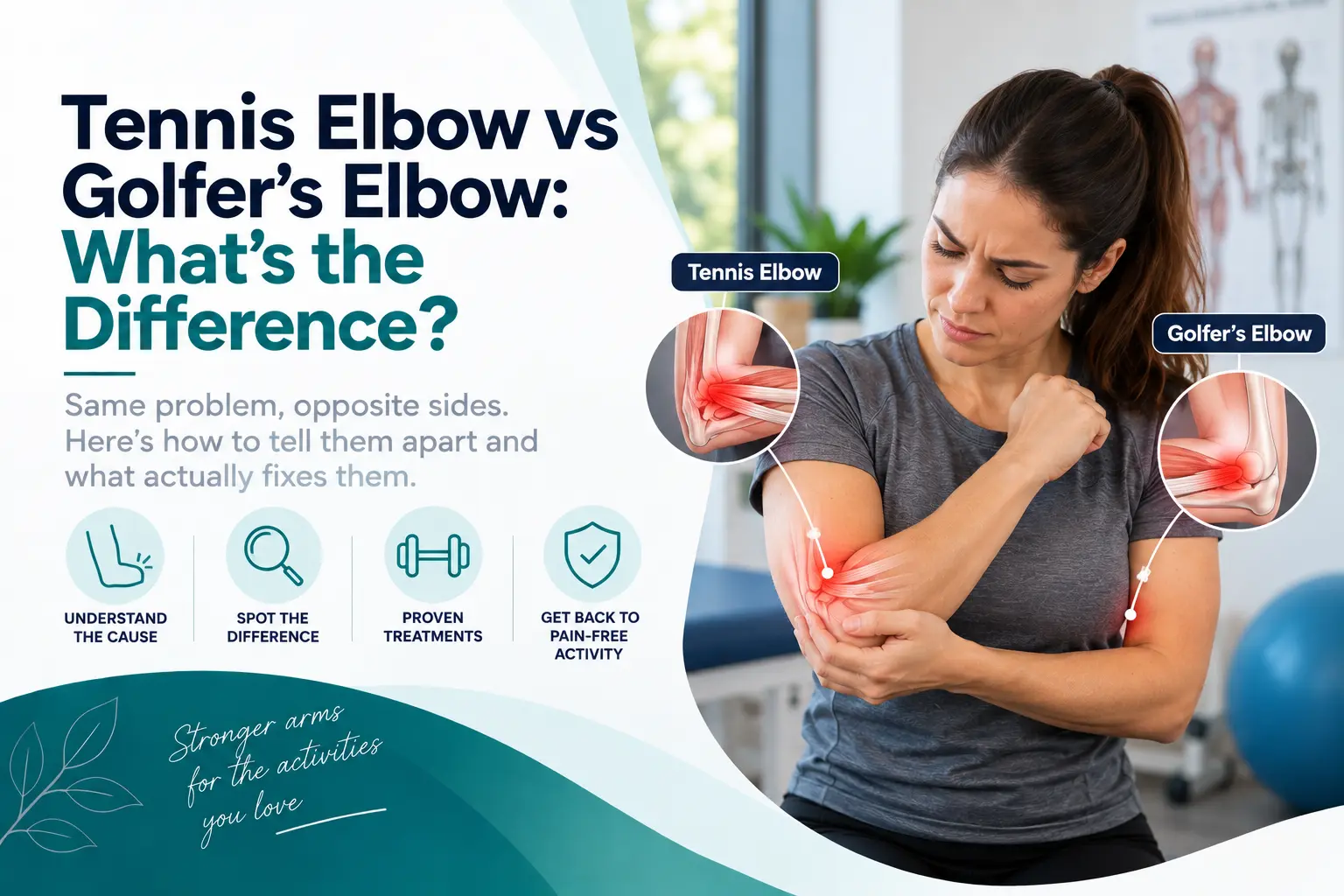
If the pain is on the outside of your elbow, people call it tennis elbow; if it is on the inside, golfer’s elbow. That much is roughly right, but the names cause two big misunderstandings. The first is that you need to play tennis or golf to get them, which is untrue for most people who have them. The second is hidden in the medical labels, lateral and medial “epicondylitis,” where the “itis” wrongly suggests the problem is inflammation.
Tennis elbow alone affects around 2 in 100 adults aged 30 to 65 (healthdirect), so getting the picture right matters to a lot of people. Here is what actually separates the two, and what genuinely fixes them.
Same problem, opposite sides: both are tendon overload, not inflammation
Underneath the two names is one shared problem. Both conditions are a tendinopathy, an overuse injury of the tendons that anchor your forearm muscles to the bony bumps at the elbow. Tennis elbow affects the tendon on the outer (lateral) side, where the muscles that straighten your wrist and fingers attach; golfer’s elbow affects the tendon on the inner (medial) side, where the wrist-bending and gripping muscles attach. Same type of injury, mirror-image location.
The word “epicondylitis” is a hangover from an older idea that these were inflamed tendons. It is now understood that a long-standing tendinopathy involves more wear and disordered healing than active inflammation.
That is not a technicality; it is the reason anti-inflammatory tablets and cortisone injections can dull the pain for a while but do not repair the tendon, and why the treatments that actually work are the ones that rebuild it.
The differences at a glance
For a quick side-by-side, this is how the two compare on the things that matter when you are trying to tell them apart.
| Tennis elbow | Golfer’s elbow | |
|---|---|---|
| Where it hurts | Outer (lateral) side of the elbow | Inner (medial) side of the elbow |
| Tendons involved | Wrist and finger extensors | Wrist flexors and forearm pronators |
| What sets it off | Gripping, lifting, a backhand, screwdriver work | Gripping, a golf or throwing action, hammering |
| Medical name | Lateral epicondylitis / tendinopathy | Medial epicondylitis / tendinopathy |
| How common | The more common of the two | Less common than tennis elbow |
Most cases have nothing to do with tennis or golf
The sporting names stuck for historical reasons, but the typical patient is not an athlete. Both problems come from repeated gripping and loading of the forearm, so the real culprits are usually everyday and occupational: using a screwdriver or hammer, painting, plumbing, meat cutting, long hours of typing and mouse work, or a sudden burst of DIY over a weekend.
The common thread is doing more repetitive gripping than the tendon is used to, whether that is on a court, at a keyboard or up a ladder. Worth knowing too: pain around the elbow can occasionally be referred from the neck rather than coming from the tendon itself, which is one reason an accurate diagnosis is worth getting rather than assuming.
How to tell which one you have, and when it is neither
A rough self-check comes down to where it hurts and which movements reproduce it. Tennis elbow tends to flare when you straighten the wrist against resistance or grip with the palm down, and the outer bony point is tender to press. Golfer’s elbow does the opposite, complaining when you bend the wrist or grip with the palm up, with tenderness over the inner bony point. Both often ache with a simple firm handshake.
Some symptoms, though, point away from a straightforward tendinopathy and are worth a prompt check rather than a wait-and-see:
- Pins and needles, numbness or weakness in the hand or fingers, which suggests a nerve rather than a tendon.
- The elbow locking, catching or giving way, or a joint that is hot, red and swollen.
- Pain that followed a fall or blow, or that comes with fever or feeling generally unwell.
None of those fit the usual overuse pattern, and a physiotherapist or doctor can sort out quickly which problem you are actually dealing with.
What actually fixes it: load the tendon, do not just rest or inject it
Here is where getting the diagnosis right pays off, because tennis and golfer’s elbow are treated in essentially the same way, and the most effective approach is often the opposite of what people expect. Complete rest tends to leave the tendon weak and no better, while the treatment with the strongest evidence is progressive strengthening of the affected forearm muscles, loading the tendon in a controlled, graded way so it rebuilds its capacity. Alongside that, it helps to ease off the specific aggravating task for a while rather than stopping everything, and a brace or forearm strap can take the edge off during daily activities.
The role of cortisone is worth spelling out, because it is where a lot of people go wrong. A steroid injection can genuinely reduce pain in the short term, but reviews of the evidence show that benefit does not last, and injected tendons tend to fare worse over the following year, with higher rates of the problem returning, than those managed with exercise (elbow tendinopathy research).
It is a short-term patch that can cost you long-term recovery, which is why it is no longer a first-line answer. Imaging such as an ultrasound is usually unnecessary too, and reserved for cases that do not follow the expected course.
Recovery takes patience, but it is usually complete
The frustrating truth about elbow tendinopathy is that it is slow. Tendons remodel over months, not days, and recovery commonly takes anywhere from a few months up to a year, particularly if it has been grumbling for a while before you act. The encouraging truth is that it almost always does settle, and the great majority of people recover fully without surgery.
The way to get there is consistency: keep up the strengthening even as the pain fades, reintroduce the aggravating activity gradually rather than all at once, and tidy up the things that overloaded the tendon in the first place, such as grip size, technique and taking breaks during repetitive tasks. Acting early, before it becomes deeply entrenched, tends to shorten the whole process.
Getting elbow pain assessed at Befit Physio in Carlingford and North Kellyville
If elbow pain has hung around for more than a few weeks, is affecting your grip, or you simply want to know which problem you are dealing with, an assessment takes the guesswork out and gets you onto the right loading program sooner.
Working out whether it is tennis elbow, golfer’s elbow, a nerve or something referred from the neck is part of our hand, arm and elbow physiotherapy, and if it is your first visit, here is what to expect at your first appointment. You can be seen at our Carlingford physiotherapy clinic or with our North Kellyville physiotherapists.
| Nagging elbow pain that will not settle? Book a one-on-one assessment online, or call Carlingford on 02 9872 2005 or North Kellyville on 02 9624 2047. We will confirm what it is and build the loading plan that fixes it. |
Frequently asked questions
What is the difference between tennis elbow and golfer’s elbow?
They are the same type of injury, a tendon overuse problem, on opposite sides of the elbow. Tennis elbow affects the outer side, where the wrist-straightening muscles attach, and flares with gripping and lifting. Golfer’s elbow affects the inner side, where the wrist-bending and gripping muscles attach. Where the pain sits, and which movements reproduce it, is the main way to tell them apart.
Which is worse, tennis elbow or golfer’s elbow?
Neither is inherently worse; they behave very similarly and are treated the same way. Tennis elbow is more common, but severity depends on how long it has been present and how much the tendon has been overloaded, not on which side it is on. Both respond well to progressive strengthening and both can linger if left unaddressed.
How long does tennis or golfer’s elbow take to heal?
Recovery is usually slow, commonly a few months and sometimes up to a year, because tendons remodel gradually. It tends to take longer the more entrenched it has become before treatment starts. The reassuring part is that most people recover fully without surgery, provided they stick with a graded strengthening program rather than resting and hoping.
Should I get a cortisone injection for tennis elbow?
Usually not as a first step. A cortisone injection can ease pain in the short term, but the evidence shows the benefit does not last and injected tendons tend to do worse over the following year, with a higher chance of the problem returning, than those treated with exercise. Loading the tendon with a progressive strengthening program is the more reliable path to lasting recovery.
Do I need a scan to diagnose elbow tendinopathy?
Usually not. Tennis and golfer’s elbow are generally diagnosed from your history and a physical examination, including where it is tender and which resisted movements reproduce the pain. Imaging such as an ultrasound is reserved for cases that do not follow the expected pattern, or when a physiotherapist or doctor suspects something other than a tendinopathy.
About the author and clinical review
| Author: Anshu Sudan, Principal Physiotherapist and owner, Befit Physiotherapy & Sports Injury Centre (Masters of Physiotherapy, APA member). Clinically reviewed by: a physiotherapist at Befit Physio. Published 27 September 2026. Last reviewed 27 September 2026. Carlingford: Shop 2/1 Post Office St, Carlingford NSW 2118. North Kellyville: 15/21 Hezlett Rd, North Kellyville NSW 2155. Open Monday to Saturday, with late evenings till 8 PM. |
| Medical disclaimer This article is general information, not personal medical advice, and reflects current evidence as at September 2026. Elbow pain has several possible causes, so see a physiotherapist or doctor for an individual assessment and diagnosis before starting treatment. Seek prompt care for numbness, weakness, a hot or swollen joint, or pain following an injury, which can point to something other than a tendinopathy. |