That deep ache down the inner edge of your shin that flares when you run and fades when you stop is one of the most common reasons active people end up on the treatment table. “Shin splints” is the label everyone reaches for, and it is common enough to earn it: the problem affects somewhere between 13 and 20 per cent of runners (Physiopedia), and more among dancers and military recruits.
But the label hides the part that actually matters, which is that shin splints are one point on a spectrum of bone stress. Where you sit on that spectrum decides how you should treat it, and whether it is safe to keep training at all.
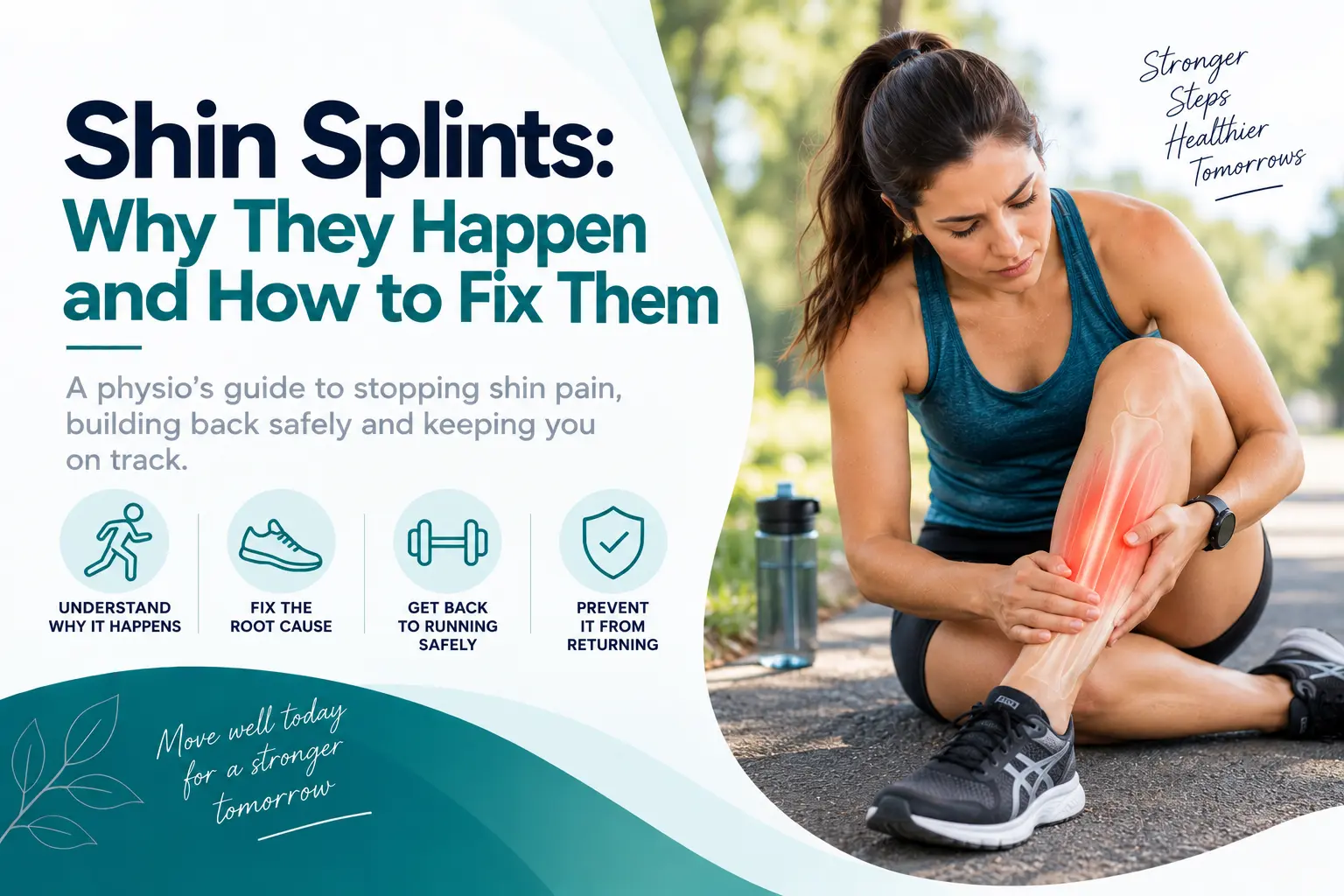
Shin splints are a stress reaction in the bone and its tissues, not just tired muscles
The medical name for the common form is medial tibial stress syndrome, or MTSS, and the everyday name undersells it. This is not simple muscle soreness; it is a stress reaction where the muscles, tendons and the outer layer of the shinbone itself become irritated by repeated load faster than they can recover.
There are two versions worth knowing apart: the common medial type, felt along the inner edge of the shin, and a less common anterior type felt down the front. Both produce a dull, aching pain that worsens with activity and settles with rest, and the area can feel tender and slightly swollen to touch.
Thinking of it as a stress reaction rather than a niggle changes how seriously you take it, because the same overload that irritates the bone can, if it keeps going, tip over into a stress fracture. That is the whole reason not to simply push through.
| Untreated shin splints can worsen over time and may lead to a stress fracture. Australia’s national health service, healthdirect |
Almost every case starts with too much, too soon, plus a few extra loads
Shin splints are, at heart, a load problem. The trigger is nearly always a sudden jump in how much or how hard you are training, before the tissue has had time to adapt, which is why they so often appear a week or two after a new running block, a change of sport, or a return from a break.
On top of that spike, a handful of factors quietly add to the load on the shin. The table sorts the usual suspects.
| Contributing factor | How it loads the shin | What helps |
|---|---|---|
| A spike in training | More distance, speed or hills than the bone is used to | Build up gradually, changing one thing at a time |
| Hard or uneven surfaces | Concrete and cambered roads increase impact | Mix in softer or flatter surfaces where you can |
| Worn or unsupportive shoes | Less shock absorption reaches the shin | Well-fitting shoes, with shock-absorbing insoles if needed |
| Foot posture | Flat feet or rolling inward changes how load travels up the leg | Assessment, and orthotics only if genuinely indicated |
| Weak or tight calves and hips | Less capacity to absorb impact, so the bone takes more | Progressive calf, foot and hip strengthening |
The training spike is the one that does most of the damage, and it is also the one most within your control.
Because the same principle drives most overuse injuries, the deeper how-to of building load safely sits in our guide to managing training load; this article stays focused on the shin.
Shin splints or a stress fracture? The signs that tell them apart
This is the distinction that matters most, because the two need very different handling, and telling them apart early can save weeks. The useful tell is how the pain behaves. Shin-splint pain is spread along a stretch of the inner shin, comes on as you get going, and eases fairly quickly once you stop, often even warming up during a session.
Stress-fracture pain is the opposite: it is sharp and pinpoint over one spot of bone, it gets worse the longer you go rather than better, and it can ache at rest or at night. If you can cover the sore area with a couple of fingers, or hopping on the leg reproduces a sharp pain, treat it as a possible fracture until proven otherwise.
| What you notice | Points to shin splints (MTSS) | Points to a stress fracture |
|---|---|---|
| Where it hurts | Spread along the inner shin | One small, pinpoint spot |
| Through a session | Often eases or warms up | Gets steadily worse |
| At rest or at night | Usually settles | Can keep aching |
| The hop test | Uncomfortable but bearable | Sharp, focal pain |
If the pattern looks like a stress fracture, or shin pain simply is not settling with a week or two of sensible rest, that is the point to be assessed and, if needed, imaged, since an MRI or bone scan picks up bone stress that an ordinary X-ray can miss. This is genuinely worth acting on rather than waiting out.
How to settle shin splints and stop them coming back
The good news is that true shin splints usually respond well, and often within a few weeks, when you treat the cause rather than just the symptom. The first move is relative rest, which means backing the load off to a level the shin tolerates rather than stopping everything; swapping some running for cycling or swimming keeps your fitness while the bone settles. Ice after activity and simple pain relief help with the soreness in the early days.
The part that actually prevents a repeat is rebuilding capacity. A physiotherapist works out which of the loads above set it off, then targets them: progressive calf, foot and hip strengthening so the leg absorbs impact rather than passing it to the bone, a look at your footwear and running surfaces, and small changes to running form or cadence where they help.
From there the return to running is graded, adding a little at a time so the tissue keeps pace. Skipping this rebuilding step is the single most common reason shin splints come back the moment training ramps up again.
Getting back to running without a relapse
Coming back is less about a fixed number of weeks and more about meeting a few markers: the shin is comfortable through daily life, tender-free to touch, and you can walk and then jog short distances without it flaring the next morning.
From there, build back gradually rather than jumping straight to your old mileage, keep the strength work going even once the pain is gone, and treat any early return of symptoms as a signal to ease off rather than push on. Shin splints are common across many sports, so if running is your thing, our wider guide to preventing and treating running injuries puts the shin in the context of the whole lower limb.
Sorting out shin splints with Befit Physio in Carlingford and North Kellyville
If your shins have been aching for more than a week or two, keep flaring when you train, or you are not sure whether it is shin splints or something that needs imaging, an assessment takes the guesswork out.
A physiotherapist can confirm what is going on, rule out a stress fracture, and build the strength-and-load plan that settles it for good. That is part of our sports injury physiotherapy, and you can be seen at our Carlingford physiotherapy clinic or with our North Kellyville physiotherapists for the Hills district.
| Shins flaring every time you run? Book a one-on-one assessment online, or call Carlingford on 02 9872 2005 or North Kellyville on 02 9624 2047. We will check what is driving it and map a safe way back to training. |
Frequently asked questions
How long do shin splints take to heal?
True shin splints often settle within a few weeks once you reduce the aggravating load and start targeted strengthening, though it varies with how long they have been building and how well the cause is addressed. If pain has tipped into a stress fracture, recovery is considerably longer and needs a break from impact, which is one reason it is worth telling the two apart early.
Can I keep running with shin splints?
Sometimes, with modification, but not by pushing through worsening pain. Mild discomfort that settles quickly and does not build through a run can often be managed with reduced load and cross-training, while pain that sharpens during the run, lingers the next morning, or becomes pinpoint is a signal to stop and get assessed. Running through it is how shin splints progress toward a stress fracture.
How do I know if it is shin splints or a stress fracture?
The pattern is the giveaway. Shin splints spread along the inner shin, come on as you start and often ease as you warm up, and settle with rest. A stress fracture is sharp and pinpoint over one spot, worsens the longer you go, and can ache at rest or at night. If hopping on the leg brings on sharp, focal pain, treat it as a possible fracture and get it checked.
What actually causes shin splints?
A sudden increase in training load is the main driver, doing more distance, speed or impact than the shin has adapted to. Hard or uneven surfaces, worn or unsupportive shoes, flat feet or inward rolling of the foot, and weak or tight calves and hips all add to the load. It is usually the training spike combined with one or two of these, rather than a single cause.
Do insoles or new shoes fix shin splints?
They can help as part of the picture, not as a stand-alone cure. Supportive, well-fitting shoes and, where genuinely indicated, shock-absorbing insoles or orthotics reduce some of the load on the shin. But if the underlying training spike and any strength deficits are not addressed, the problem tends to return, which is why footwear works best alongside load management and strengthening.
About the author and clinical review
| Author: Anshu Sudan, Principal Physiotherapist and owner, Befit Physiotherapy & Sports Injury Centre (Masters of Physiotherapy, APA member). Clinically reviewed by: a physiotherapist at Befit Physio. Carlingford: Shop 2/1 Post Office St, Carlingford NSW 2118. North Kellyville: 15/21 Hezlett Rd, North Kellyville NSW 2155. Open Monday to Saturday, with late evenings till 8 PM. |
| Medical disclaimer This article is general information, not personal medical advice, and reflects Australian guidance current as at September 2026. Shin pain has several causes, so see a physiotherapist or doctor for an individual assessment and diagnosis. Seek prompt care for sharp, pinpoint shin pain that worsens with activity or aches at rest, which can signal a stress fracture rather than shin splints. |