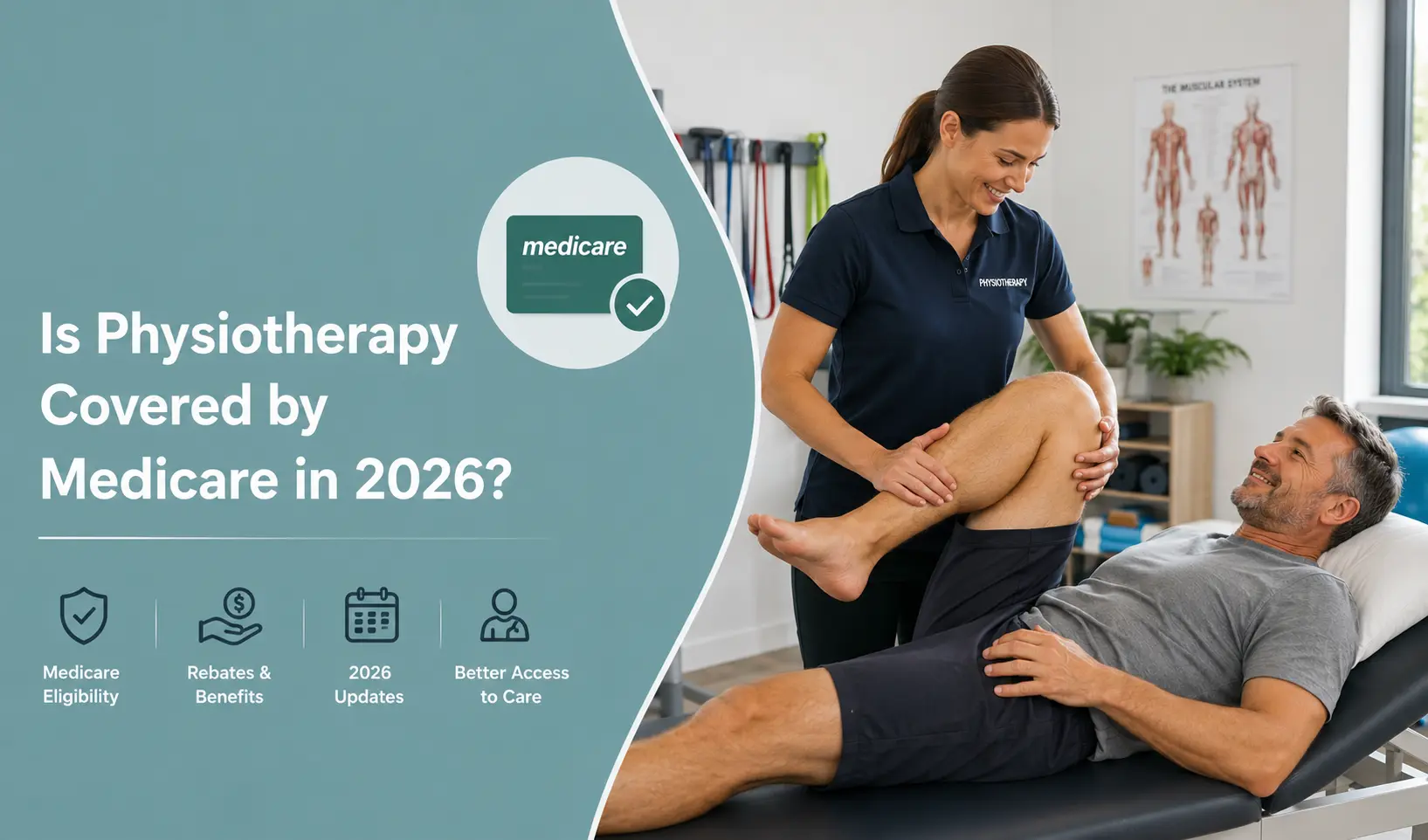
If you have an ongoing health condition, Medicare can help cover your physiotherapy, though the coverage is specific. Under the Medicare Benefits Schedule (MBS), it pays a rebate only when physiotherapy is delivered under a GP Chronic Condition Management Plan (Services Australia), which funds up to five allied-health sessions per calendar year at a set rebate of $63.40 a visit. For everyday sprains, strains and acute pain, standard Medicare does not pay, so you would use private health extras or pay privately.
That distinction trips a lot of people up. Many assume Medicare quietly chips in on every physio visit, when its help is limited to chronic conditions. The plan is often still called a care plan or a Chronic Disease Management (CDM) plan, and below we explain who qualifies, how the rules changed in 2025, what you get back, and what to do if Medicare is not the right door for you.
Medicare covers physiotherapy only for chronic or terminal conditions, through a GP Chronic Condition Management Plan. You get up to five subsidised allied-health sessions a year, shared across all disciplines, with a $63.40 rebate each. Acute injuries are not covered, so use private health extras, DVA, NDIS, WorkCover, CTP or self-funding.
What “covered by Medicare” actually means for physiotherapy
Medicare-subsidised physiotherapy is physiotherapy that attracts a partial Medicare rebate because it is delivered under a GP-prepared chronic condition care plan. Medicare pays a fixed amount toward the visit; it does not usually cover the full fee.
That definition matters, because “covered” rarely means “free.” Medicare sets a rebate, a fixed contribution, rather than paying whatever the clinic charges. Your physiotherapist assesses and treats you; Medicare returns a set amount; you cover the difference unless the clinic bulk bills. Private health insurance works differently again: it is not Medicare at all, and extras cover is money from your private fund, claimed on the spot through HICAPS.
Medicare subsidises physio only through a GP Chronic Condition Management Plan
For physiotherapy in private practice, there is essentially one Medicare route: the chronic condition pathway. Your GP decides you have a condition that has lasted, or is likely to last, at least six months, such as osteoarthritis, persistent lower back pain, diabetes-related complications or a neurological condition, and that a physiotherapist should be part of managing it. The GP prepares a plan and writes you a referral. Only then does Medicare contribute to your physio.
If your problem is a fresh sprain, a tweaked shoulder from the gym, or neck pain after a heavy week at a desk, standard Medicare will not pay for those visits. It is worth saying plainly, because many people assume Medicare works like a universal discount on physio. It does not. That funding is reserved for ongoing, complex conditions.
When to seek urgent care first
Some symptoms need a doctor or emergency care before physiotherapy, regardless of funding. Seek urgent help if you have loss of bladder or bowel control, numbness around the groin or inner thighs, rapidly worsening leg weakness, severe pain after a serious fall or accident, unexplained weight loss with back pain, or signs of a blood clot (calf swelling, heat and pain). These are red flags, not physiotherapy problems, and they come before any Medicare question.
What changed on 1 July 2025: GPMP and Team Care Arrangements became the GPCCMP
If you used Medicare for physio before, you may remember a “GP Management Plan” (GPMP) and “Team Care Arrangements” (TCA). From 1 July 2025, those were replaced by a single, simpler plan: the GP Chronic Condition Management Plan (GPCCMP) (see Services Australia and the RACGP). Here is what changed for patients.
| Feature | Before 1 July 2025 | From 1 July 2025 (2026) |
| The plan | GP Management Plan (GPMP) + Team Care Arrangements (TCA) | One GP Chronic Condition Management Plan (GPCCMP) |
| Allied-health referral | Structured Medicare referral form required | A standard referral letter from your GP is enough |
| Sessions per year | Up to 5 allied-health services per calendar year | Unchanged: up to 5 per calendar year (10 for Aboriginal & Torres Strait Islander patients) |
| Physio rebate (item 10960) | $61.80 (2024-25) | $63.40 (from 1 July 2026) |
| Old plans still valid? | n/a | GPMP/TCA plans made before 1 July 2025 stay valid until 30 June 2027 |
| Plan review | Varied | New plan once every 12 months; reviews every 3 months |
Sources: Services Australia (chronic condition allied health billing); RACGP CDM FAQs; the APA; MBS Online item 10960.
The practical takeaway: the paperwork got lighter, the five-session limit stayed the same, and any existing plan you already hold keeps working through a transition period ending 30 June 2027.
How many sessions Medicare funds, and what the rebate is worth
Under a GPCCMP, Medicare subsidises up to five individual allied-health services per calendar year. The number that surprises people: those five are shared across every allied-health discipline, not five each. If you see a physiotherapist, a podiatrist and a dietitian in the same year, that is three of your five, not fifteen. The count resets each January.
Key facts at a glance
| Attribute | 2026 detail |
| Who it covers | People with a chronic or terminal condition (present, or likely, 6+ months) |
| Plan required | GP Chronic Condition Management Plan (GPCCMP) plus GP referral |
| Sessions funded | Up to 5 allied-health services per calendar year, shared across all disciplines |
| Higher cap | Up to 10 per year for Aboriginal & Torres Strait Islander patients (specific items) |
| Physio MBS item | 10960 (individual chronic condition management physiotherapy) |
| Rebate per visit | $63.40 (schedule fee $74.55, from 1 July 2026) |
| Out-of-pocket | The “gap” between the clinic fee and the rebate, unless bulk billed |
| When to see a physio | When a chronic condition limits movement, strength or daily function |
Source: MBS Online, item 10960; Services Australia. Rebate amounts are indexed on 1 July each year.
Who qualifies, who doesn’t: the Befit Medicare Physio Eligibility Matrix
Eligibility trips people up because the answer depends entirely on why you need physio. This matrix maps the situations we field most often at reception in Carlingford and North Kellyville. Find the row that matches your situation, and it tells you whether Medicare helps, which pathway applies, and your next step.
| Your situation | Medicare helps? | Pathway | Your next step |
| Chronic/terminal condition (6+ months), e.g. osteoarthritis, ongoing back pain | Yes, partially | GPCCMP + item 10960 | Ask your GP for a GPCCMP and physio referral |
| Aboriginal or Torres Strait Islander with a chronic condition | Yes, higher cap | GPCCMP (up to 10/yr) | See your GP about a plan |
| Acute injury this week (ankle, shoulder, neck) | No (standard Medicare) | Private / extras | Book privately; claim via HICAPS extras |
| Private outpatient after recent surgery | Usually no | GPCCMP if eligible, else extras | Ask GP if a plan fits |
| Veteran / DVA cardholder | Yes, via DVA | DVA referral | Ask your GP for a DVA referral |
| Approved NDIS plan with physio funding | Yes, via NDIS | NDIS funding | Use your NDIS funds |
| Work-related injury | Yes, via WorkCover | WorkCover claim | Bill to the insurer |
| Motor-vehicle-accident injury | Yes, via CTP | CTP scheme | Provide claim details |
| No chronic condition, no extras | No | Self-funded | Ask us about payment options |
Befit Physiotherapy Medicare Eligibility Matrix v1.0 · 11 July 2026 · general guidance, not a substitute for advice from your GP.
How we use the five sessions
In our clinics, the five subsidised sessions work best as a starting block. We commonly use them to assess the problem and set up a progressive program for a chronic condition, then patients continue privately or with their extras cover once they feel the difference. The plan does not cover everything, but it lowers the cost of getting started, which is often what tips someone from putting up with the pain to acting on it.WE don’t Bulk Bill . You pay us the fee and we can get your claim from medicare on the spot provided you have the right bank card ( Debit / Savings card from your bank )
Why you’ll still have a gap fee, and how the Safety Net helps
Because the rebate is a fixed $63.40 and most clinics charge more than that for a one-on-one session, you will usually pay a gap, the difference between the fee and the rebate.
If Medicare won’t cover you: the other funding doors
Medicare is one pathway, not the only one. Depending on your circumstances, physiotherapy may be funded through:
- Private health extras (HICAPS): if you hold extras cover, you claim a portion back on the spot at the clinic. This is the most common route for acute, everyday injuries.
- DVA: eligible veterans access physiotherapy through the Department of Veterans’ Affairs with a GP referral, separate from Medicare.
- NDIS: if physiotherapy is funded in your plan, you use those funds directly.
- WorkCover and CTP: work injuries and motor-vehicle-accident injuries are billed to the relevant insurer, not Medicare.
- My Aged Care: older adults may access allied health, including in-home physiotherapy, through aged-care funding.
If you are not sure which door is yours, our team can help you work it out before you book. It is a short conversation that can save you money.
How to get a Medicare-subsidised physio appointment at Befit Physiotherapy
- See your GP and ask whether your condition qualifies for a GP Chronic Condition Management Plan.
- Get your plan and referral. Since July 2025, a standard referral letter is enough, with no special Medicare form needed.
- Book with us at our Carlingford physiotherapy clinic or with our North Kellyville physiotherapists, and bring your referral and plan.
- Claim your rebate. Where possible, the Medicare rebate is processed at the visit, provided you have the right paperwork and the debit/ savings card from your bank .
Frequently asked questions
Is physiotherapy free on Medicare in 2026?
Not usually. Medicare pays a fixed rebate ($63.40 per physio visit under item 10960) for eligible chronic-condition patients, but it rarely covers the whole fee. You pay the gap unless the clinic bulk bills that appointment. Fully free physio generally only happens through bulk billing or another fully funded scheme such as DVA.
How many physio sessions does Medicare cover per year?
Up to five allied-health services per calendar year under a GP Chronic Condition Management Plan, and those five are shared across all allied-health providers, not five per profession. Aboriginal and Torres Strait Islander patients may access up to ten. The count resets each January.
Do I need a GP referral for Medicare to cover physio?
Yes. Medicare-subsidised physiotherapy always requires your GP to prepare a Chronic Condition Management Plan and provide a referral. Since 1 July 2025, that referral can be a standard letter rather than a special Medicare form. Without a plan and referral, Medicare will not contribute.
Does Medicare cover physio for a sports injury or sprain?
Generally no. Standard Medicare does not fund physiotherapy for acute injuries like sprains, strains or a sore shoulder from the gym. Those are usually claimed through private health extras or paid privately. Medicare’s physio funding is reserved for ongoing chronic conditions.
Does Medicare cover physio after surgery?
Not automatically. Private outpatient physiotherapy after an operation is not funded by Medicare simply because surgery happened. If you have an eligible chronic condition, a Chronic Condition Management Plan may apply. Otherwise most people use private health extras or self-fund the rehab.
What is the difference between Medicare and private health cover for physio?
Medicare is government funding limited to chronic-condition care plans, with a fixed rebate. Private health extras is your own insurance, claimed on the spot through HICAPS, and it typically covers a set amount per visit for any physio, including the acute injuries Medicare will not touch. Most people use one or the other, not both on the same visit.
Can I use Medicare and private health insurance together for the same physio visit?
No. You cannot claim a Medicare rebate and a private health extras benefit for the same appointment. You choose the pathway that suits each visit. Our reception team can help you decide which gives you the better outcome for a given session.
About the author and clinical review
| Author: Anshu Sudan, Principal Physiotherapist, Befit Physiotherapy & Sports Injury Centre. Clinically reviewed by: a Befit physiotherapist. Carlingford: Shop 2/1 Post Office St, Carlingford NSW 2118. North Kellyville: 15/21 Hezlett Rd, North Kellyville NSW 2155. |
| Medical disclaimer This article is general information, not personal medical advice, and reflects Medicare rules as at July 2026. Rebate amounts and item numbers are indexed and can change, so always confirm the current figures with your GP, the clinic, or Services Australia. Eligibility for any funding pathway depends on your individual circumstances. If you have severe or rapidly worsening symptoms, seek urgent medical care. |