A rolled ankle is one of the most shrugged-off injuries there is. You stumble off a kerb or land awkwardly, the ankle throbs for a few days, the swelling fades, and life carries on, usually without a second thought. That casual response is exactly where the trouble starts.
An ankle sprain is a genuine ligament injury, and the biggest risk it carries is not the first sprain at all but the next one, because an ankle that is not rehabilitated properly is far more likely to roll again.
Understanding what you have actually done, how badly, and what it really takes to recover changes a recurring nuisance into a one-off.
What tears when you roll an ankle: the ligament, usually the ATFL
Most sprains happen when the foot rolls inward underneath you, stretching the ligaments on the outer side of the ankle beyond what they can take. These lateral sprains make up more than three-quarters of all ankle sprains, and the ligament that bears the brunt is the anterior talofibular ligament, or ATFL, the smallest and weakest of the outer-ankle ligaments, which is involved in the large majority of cases.
A ligament is a tough band that connects bone to bone and holds the joint stable, so when it is overstretched or torn, the ankle loses some of its passive stability and the tissue becomes painful, swollen and bruised. That is the injury in a nutshell: a stability structure, strained past its limit (healthdirect on sprains and strains).
How bad is it? Grading an ankle sprain
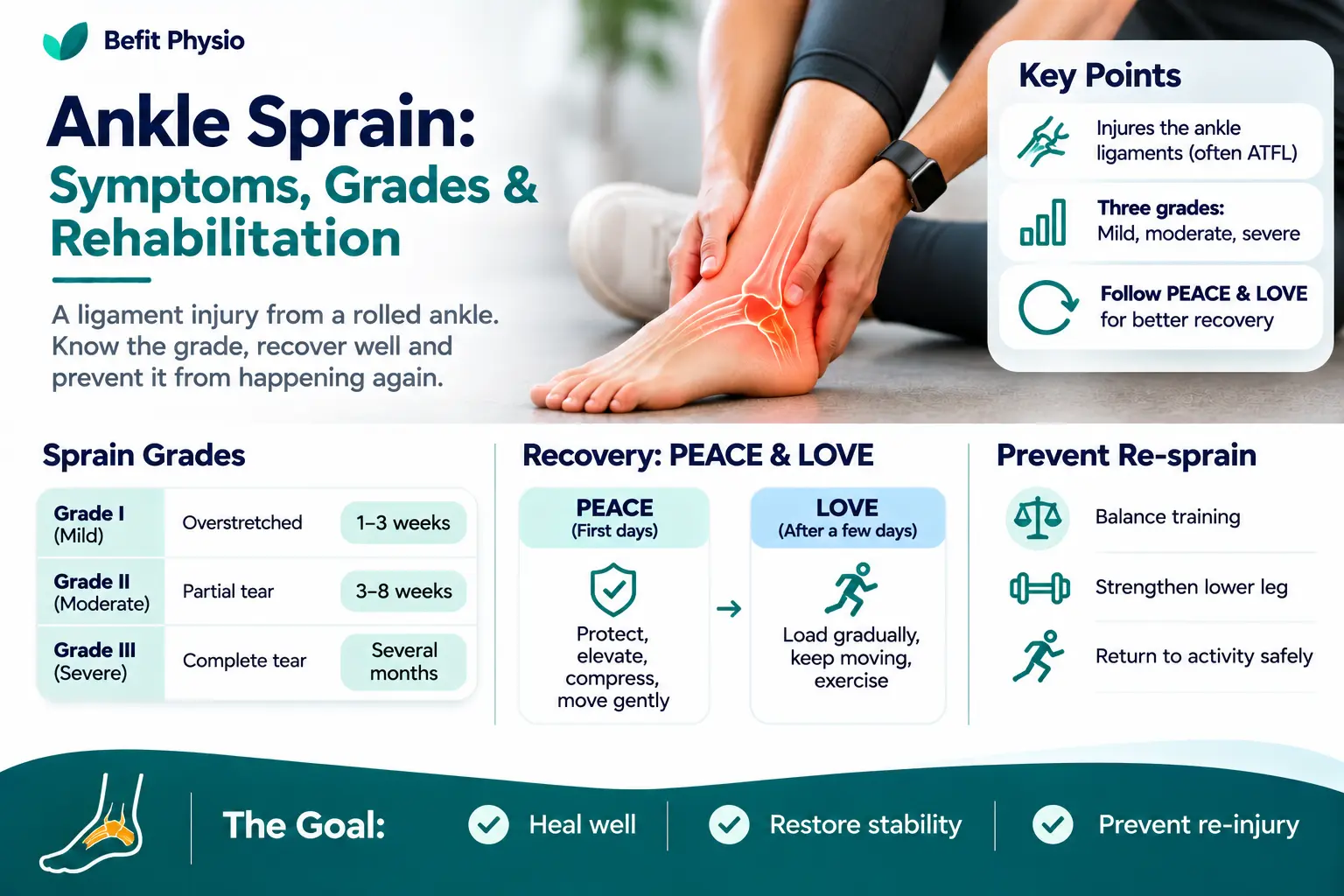
Not all sprains are equal, and the grade, based on how much of the ligament is damaged, sets the realistic timeline for recovery. It is a guide rather than a stopwatch, because people heal at different rates, but it helps make sense of what you are dealing with.
| Grade | What has happened | How it feels | Rough recovery |
|---|---|---|---|
| Grade I (mild) | Ligament overstretched, microscopic tearing | Mild pain and swelling; ankle still stable, can usually weight-bear | 1 to 3 weeks |
| Grade II (moderate) | Partial tear of the ligament | Moderate pain, swelling and bruising; some instability, walking is sore | 3 to 8 weeks |
| Grade III (severe) | Complete rupture of one or more ligaments | Marked swelling and bruising; the ankle feels unstable and weight-bearing is hard | Several months |
A physiotherapist grades the injury from a hands-on examination rather than the swelling alone, since a tense, puffy ankle can look dramatic while the ligament underneath is only mildly strained, and vice versa.
The first 72 hours: why RICE is out and PEACE & LOVE is in
If you learned to treat a sprain with RICE, rest, ice, compression, elevation, the advice has moved on. Current soft-tissue guidance uses two newer acronyms, PEACE for the first few days and LOVE for the weeks after, and the shift matters. The headline changes are that complete rest is replaced by early, protected movement, and that reaching routinely for anti-inflammatory tablets and ice is discouraged, because the early inflammation is part of how the ligament heals and blunting it may actually slow recovery.
In practice the first few days are about protecting the ankle from further injury, easing swelling with compression and elevation, and keeping gentle movement going within comfort, then progressively loading it as it settles. The old instinct to wrap it up and stay off it entirely is precisely what leaves an ankle stiff, weak and prone to rolling again.
When to get it X-rayed: ruling out a fracture
Most sprains do not need a scan, but some ankle injuries hide a broken bone, and there is a well-validated way to tell the difference. Clinicians use the Ottawa Ankle Rules, a simple checklist that flags when an X-ray is warranted (how the Ottawa Ankle Rules work).
The practical signals to get it properly assessed are being unable to take more than a few steps on it, or bony tenderness right on the ankle knobs or the outer edge of the foot, which point to a possible fracture rather than a simple sprain.
Severe swelling, obvious deformity, numbness or an ankle that gives way completely also warrant prompt medical review. When a fracture is ruled out, targeted physiotherapy is the standard path back.
The real danger is not the sprain, it is the re-sprain
Here is the statistic that should change how seriously people take a rolled ankle: more than 40% of ankle sprains recur, and roughly a third of people re-sprain the same ankle within a year. Worse, somewhere between a fifth and two-fifths of people who sprain an ankle go on to develop chronic ankle instability, a frustrating state of repeated sprains, lingering pain and an ankle that keeps “giving way.”
The reason is revealing. A sprain damages more than the ligament’s strength; it disrupts the ankle’s position sense, the constant stream of feedback that tells your brain where your foot is and triggers the split-second muscle reactions that catch you when you wobble.
Rebuild the ligament’s strength but neglect that sense, and the ankle is mechanically healed yet still blind to the ground, which is exactly how the cycle of re-spraining takes hold.
Rehabilitation that prevents the next one: restoring balance and control
Good ankle rehabilitation is staged, and the later stages are the ones most people skip. Early on, the focus is gentle movement and easing swelling; next comes rebuilding the strength of the muscles that support the joint. The stage that actually breaks the re-injury cycle, though, is balance and proprioception retraining, the wobble-board and single-leg work that reawakens the ankle’s position sense and sharpens those protective reflexes.
A physiotherapist grades this so it challenges the ankle without overloading it, and times the return to running, cutting and sport around how the ankle performs rather than the calendar. This is also where a known case shows what thorough rehab looks like: our ankle sprain recovery case study follows one patient from a swollen, unstable ankle back to full, confident movement.
Keeping that control going afterwards is the best insurance there is, which is the thinking behind our tips on looking after your ankles for the long run. Rebuilding a sprained ankle properly is a core part of our foot, ankle and heel physiotherapy.
High ankle sprains and other reasons to get it looked at
Not every ankle sprain is the common lateral kind. A high ankle sprain injures the ligaments that bind the two shin bones together just above the joint, tends to follow a twisting or outward-rotation force, and is notoriously slower to settle than a standard sprain, so it is worth identifying early rather than wondering why it is not improving.
More generally, an ankle that stays painful or swollen beyond the expected timeline, keeps giving way, or never quite feels trustworthy again deserves an assessment, because these are the cases where a specific weak link, rather than bad luck, is driving the problem.
Many people roll an ankle during sport, where a sudden spike in training load is often lurking in the background, which is part of why our guide to the load errors behind many sports injuries is a useful companion.
Rehabilitating a sprained ankle with Befit Physio in Carlingford and North Kellyville
If you have rolled an ankle, an assessment works out the grade, rules out anything that needs a scan, and builds the staged plan, right through the balance work, that gets you back on your feet and keeps you there.
We treat these constantly, and the people who rehabilitate fully, rather than stopping once the swelling goes, are the ones who do not end up back with the same problem.
You can be seen at our Carlingford physiotherapy clinic or with our North Kellyville physiotherapists, in the clinic or at home.
| Rolled your ankle, or one that keeps giving way? Book a one-on-one assessment online, or call Carlingford on 02 9872 2005 or North Kellyville on 02 9624 2047. We will grade it and build the plan that gets it strong and stable again. |
Frequently Asked Questions
How long does a sprained ankle take to heal?
It depends on the grade. A mild Grade I sprain often settles in one to three weeks, a moderate Grade II in roughly three to eight weeks, and a severe Grade III can take several months. Pain and swelling usually ease well before the ankle is fully strong and stable, which is why stopping rehabilitation early is a common reason ankles stay weak. Finishing the balance and strength work is what shortens the real recovery.
Should I walk on a sprained ankle or rest it completely?
Gentle, protected weight-bearing is generally better than complete rest, as long as you can do it without sharp pain. Modern guidance has moved away from total rest because early, controlled movement helps the ankle recover, whereas staying off it entirely tends to leave it stiff and weak. Use support or crutches at first if you need them, but aim to move within comfort rather than immobilising it, and get it assessed if you cannot weight-bear at all.
Do I need an X-ray for a sprained ankle?
Usually not. Most sprains are diagnosed and managed without imaging. An X-ray is warranted if you cannot take more than a few steps on the ankle, or if there is bony tenderness over the ankle knobs or the outer edge of the foot, which are the signs clinicians use to screen for a fracture. If a fracture is ruled out, physiotherapy is the standard treatment, so the scan is about excluding a break, not diagnosing the sprain.
Why does my ankle keep rolling after a sprain?
Because a sprain damages more than ligament strength: it dulls the ankle’s position sense and the fast reflexes that normally catch you when you wobble. If rehabilitation rebuilds strength but skips balance retraining, the ankle is mechanically healed yet still slow to react, so it rolls again easily. This repeated giving-way is called chronic ankle instability, and it is treatable, specifically with the proprioception and control work that restores those reflexes.
Can physiotherapy prevent future ankle sprains?
Yes, and this is one of its clearest benefits. A structured program that rebuilds strength and, above all, retrains balance and proprioception measurably lowers the risk of spraining the same ankle again. The protective reflexes that stop a wobble becoming a sprain can be trained back, and keeping up a little balance work after you recover maintains them. It is the difference between recovering from this sprain and preventing the next one.
About the author and clinical review
| Author: Anshu Sudan, Principal Physiotherapist and owner, Befit Physiotherapy & Sports Injury Centre (Masters of Physiotherapy, APA member). Clinically reviewed by: a physiotherapist at Befit Physio. Carlingford: Shop 2/1 Post Office St, Carlingford NSW 2118. North Kellyville: 15/21 Hezlett Rd, North Kellyville NSW 2155. |
| Medical disclaimer This article is general information, not personal medical advice, and reflects current evidence as at November 2026. Ankle injuries vary, so see a physiotherapist or doctor for an individual assessment and diagnosis. Seek prompt medical care if you cannot weight-bear, there is bony tenderness, obvious deformity or numbness, or an ankle that gives way completely, which can indicate a fracture or more serious injury. |